AI Fundamentals
What is Overfitting?

 Add Unite.AI to your preferred sources on Google

Overfitting occurs when a model captures patterns or noise that work unusually well on its training data but fail to generalize to new examples. An overfit model may have very low training error while validation or real-world performance is substantially worse.
The opposite problem is underfitting: the model or training process cannot capture enough of the signal even on the training set. Good modeling balances fit with generalization rather than pursuing perfect training performance.
Key takeaways
- Training performance alone cannot diagnose generalization.
- Early stopping should use validation behavior, never repeated decisions on the final test set.
- More data can help, but more features or capacity can also worsen overfitting.
- Regularization, augmentation, cross-validation, leakage prevention, and appropriate evaluation address different causes.
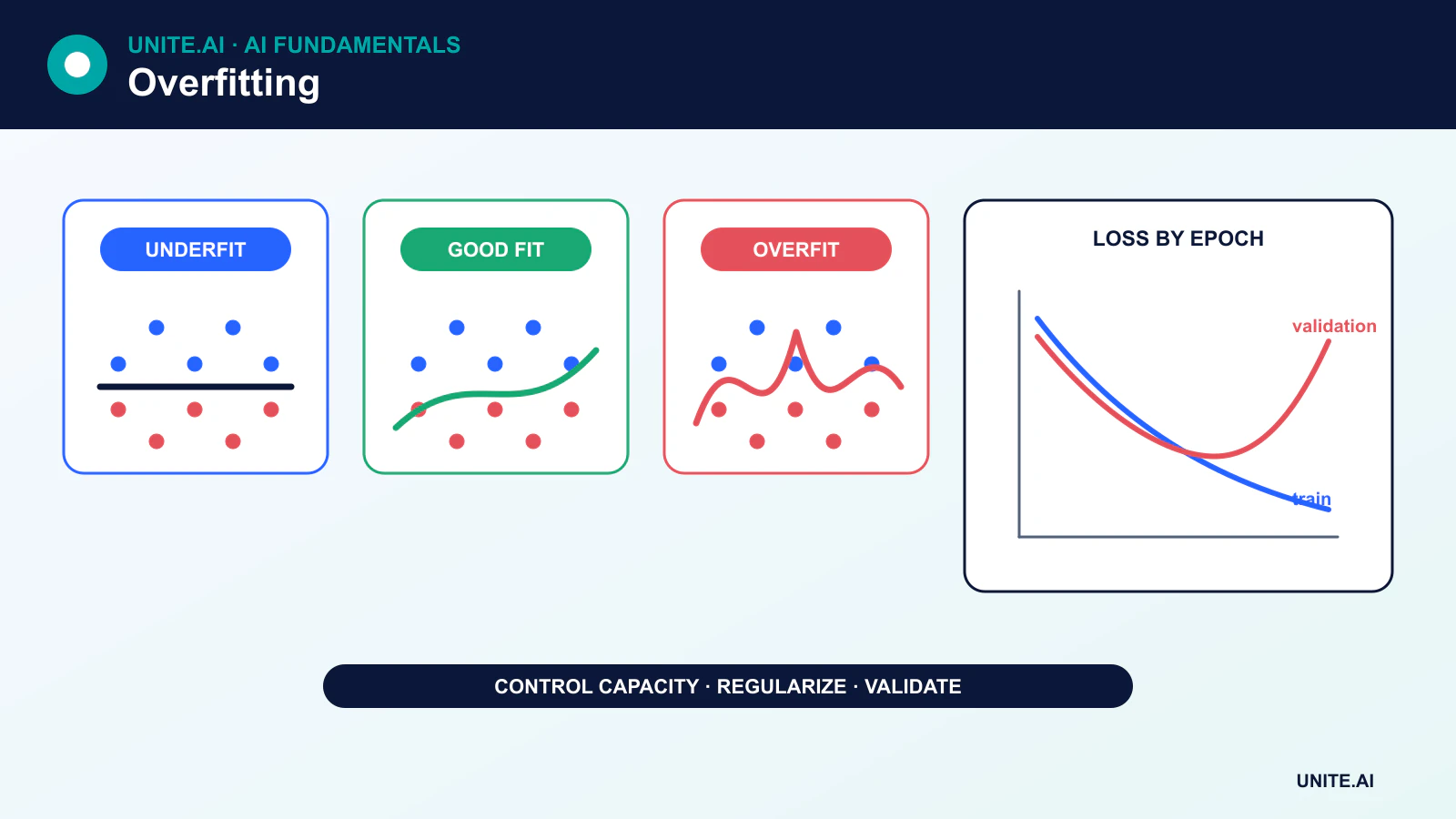
Fit, underfitting, and overfitting
A model underfits when its assumptions are too restrictive, its features omit important signal, optimization is inadequate, or training is insufficient. Adding relevant features or capacity may help, but simply adding arbitrary features can increase noise and overfitting.
A model overfits when its effective capacity is too high relative to the information in the training data. Examples include a deep decision tree that creates tiny leaves, a polynomial that follows random fluctuations, or a neural network that memorizes examples.
The role of train, validation, and test data
- Training data fits model parameters.
- Validation data selects architecture, hyperparameters, thresholds, and stopping time.
- Test data provides a final estimate after those choices are complete.
If the test set repeatedly guides decisions, it becomes part of the development process and no longer provides an unbiased final estimate. Cross-validation can make more efficient use of limited data, but all preprocessing and feature selection must occur inside each training fold.
Early stopping
During training, training loss usually continues to fall. Validation loss may fall at first and later rise as the model specializes to training noise. Early stopping saves the checkpoint with the best validation objective or stops after validation has failed to improve for a defined patience period.
The correct checkpoint is not the one with the lowest training loss. A separate final test set is evaluated after early-stopping and tuning decisions are finished.
Regularization methods
Weight penalties
L2 regularization or weight decay discourages large parameter values. L1 regularization can encourage sparse coefficients. Their effects depend on the model and optimizer; AdamW, for example, decouples weight decay from the adaptive update.
Dropout and stochastic regularization
Dropout randomly masks activations during training. Other methods drop paths, perturb features, or smooth labels. These techniques change the training objective and must be disabled or handled appropriately at inference.
Data augmentation
Augmentation creates realistic variations—such as crops, rotations, noise, or paraphrases—that should preserve the target. Invalid transformations can change the label and harm the model. For vision, tools such as Albumentations help implement controlled pipelines.
Capacity control
Shallower trees, fewer parameters, feature selection, pruning, and simpler hypothesis classes can reduce variance. Tree pruning is criterion-driven, not random removal of learned detail.
Data leakage can look like exceptional performance
Leakage occurs when information unavailable at prediction time enters training or evaluation. Common examples include fitting normalization on the full dataset, splitting repeated records across folds, using future data to predict the past, or including a feature derived from the target.
Leakage is not ordinary overfitting, but it creates the same misleading gap between offline results and deployment. Split strategy should respect time, identity, location, and data-generation processes.
Distribution shift is a separate problem
A model can generalize to its test distribution and still fail when production data changes. New devices, policies, populations, seasons, or adversarial behavior can shift the input or target relationship. Monitoring and periodic re-evaluation are necessary even when the original model was not overfit.
Diagnosing overfitting
Use learning curves, cross-validation variance, subgroup metrics, calibration, and error inspection. If both training and validation performance are poor, focus on underfitting, features, labels, or optimization. If training is strong and validation is weak, investigate capacity, leakage, regularization, and representativeness before simply collecting more data.
Why overfitting happens and how to detect it
Overfitting occurs when a model learns patterns that reduce training error but do not generalize to the target population. Causes include excessive capacity relative to effective data, label noise, repeated entities, flexible feature selection, leakage, and tuning against the same validation set. A widening gap between training and validation performance is common evidence, but a small gap does not rule out overfitting if both sets share contamination or differ from deployment. Learning curves across data volume and capacity help distinguish variance from bias.
Leakage is especially deceptive: future information, duplicates, subject overlap, preprocessing fit on all data, or labels encoded in metadata can produce excellent held-out scores. Split by the unit that will be new at deployment—patient, customer, machine, location, or time—before fitting transformations or augmentations. Keep a final test set sealed while choosing features, architecture, and thresholds. If teams repeatedly inspect test results, the test set becomes another validation set and needs replacement or formal correction.
Regularization, model selection, and production drift
Reduce overfitting with more representative data, lower capacity, weight decay, dropout, early stopping, augmentation, ensembling, or constraints reflecting domain structure. Each method has tradeoffs: augmentation can distort labels, dropout changes optimization, and ensembles add serving cost. Cross-validation estimates selection variability, but grouped or time-aware folds must preserve the deployment boundary. Compare with a simple model and report uncertainty across folds or seeds rather than selecting the most favorable run.
Production can reveal a different form of generalization failure when inputs, users, incentives, or measurement change. Monitor feature and prediction distributions, calibration, subgroup outcomes, and delayed ground truth. Do not retrain automatically on unreviewed feedback; the model’s own decisions can shape the labels it later sees. Diagnose whether failure comes from drift, data pipelines, policy changes, or an invalid target. Overfitting is controlled by experimental design and lifecycle discipline, not a single regularization setting.
Worked example: eliminating leakage in a fraud model
An initial fraud classifier scores extremely well because repeated card and merchant events appear in random train and test rows, and chargeback information recorded weeks later is included as a feature. The team reconstructs each feature’s availability time, removes post-decision fields, groups by account, and uses a forward time split. Performance falls sharply but now estimates the actual decision. A simple rules baseline and learning curves guide the required model complexity.
Regularization and early stopping are tuned only within historical folds. The final evaluation reports precision at review capacity, recall, calibration, and cost by fraud type and customer segment. In production, confirmed labels arrive late and are biased by which transactions were reviewed, so monitoring separates score drift from outcome estimates. Retraining uses adjudicated cases and replay against the current policy. The project prefers a lower honest score to a high leaked one that cannot survive deployment.
Implementation evidence and operational readiness
A production decision needs more than a successful demonstration. Define the intended users, operating environment, inputs, outputs, dependencies, owner, and the consequence of each important failure. Establish a reproducible baseline and a versioned evaluation set before tuning. Test ordinary cases, boundary conditions, malformed or missing input, distribution shift, dependency outage, misuse, and the groups or environments most likely to be underserved. Measure task quality together with calibration or uncertainty, latency, throughput, resource cost, accessibility, privacy, and security. Record every transformation and threshold so an independent reviewer can reproduce the result and distinguish evidence from an attractive prototype.
Before launch, assign authority for release, exceptions, changes, rollback, and retirement. Use a staged rollout, preserve a safe fallback, and verify monitoring with deliberately injected failures. Operational telemetry should reveal input quality, output behavior, model or rule version, dependency health, human overrides, and confirmed outcomes without collecting unnecessary sensitive data. Define alert thresholds and a response owner, then review real-world evidence after deployment rather than assuming offline performance will persist. Reevaluate whenever data sources, users, models, vendors, policies, hardware, or objectives change. A maintained system also needs documented recovery, incident learning, deletion and retention procedures, and a clear point at which it should be disabled or replaced.
Frequently asked questions
Can a simple model overfit?
Yes. Repeated feature selection, threshold tuning, or evaluation on the same holdout can overfit the development process even when the final model is simple.
Does more training data always solve overfitting?
No. More representative, correctly labeled data can help, but duplicated, biased, leaked, or out-of-domain data may not. The learning objective and evaluation design still matter.
Primary references