AI Fundamentals
AI Education During Crisis: Lessons from the AI for Ukraine Initiative

 Add Unite.AI to your preferred sources on Google

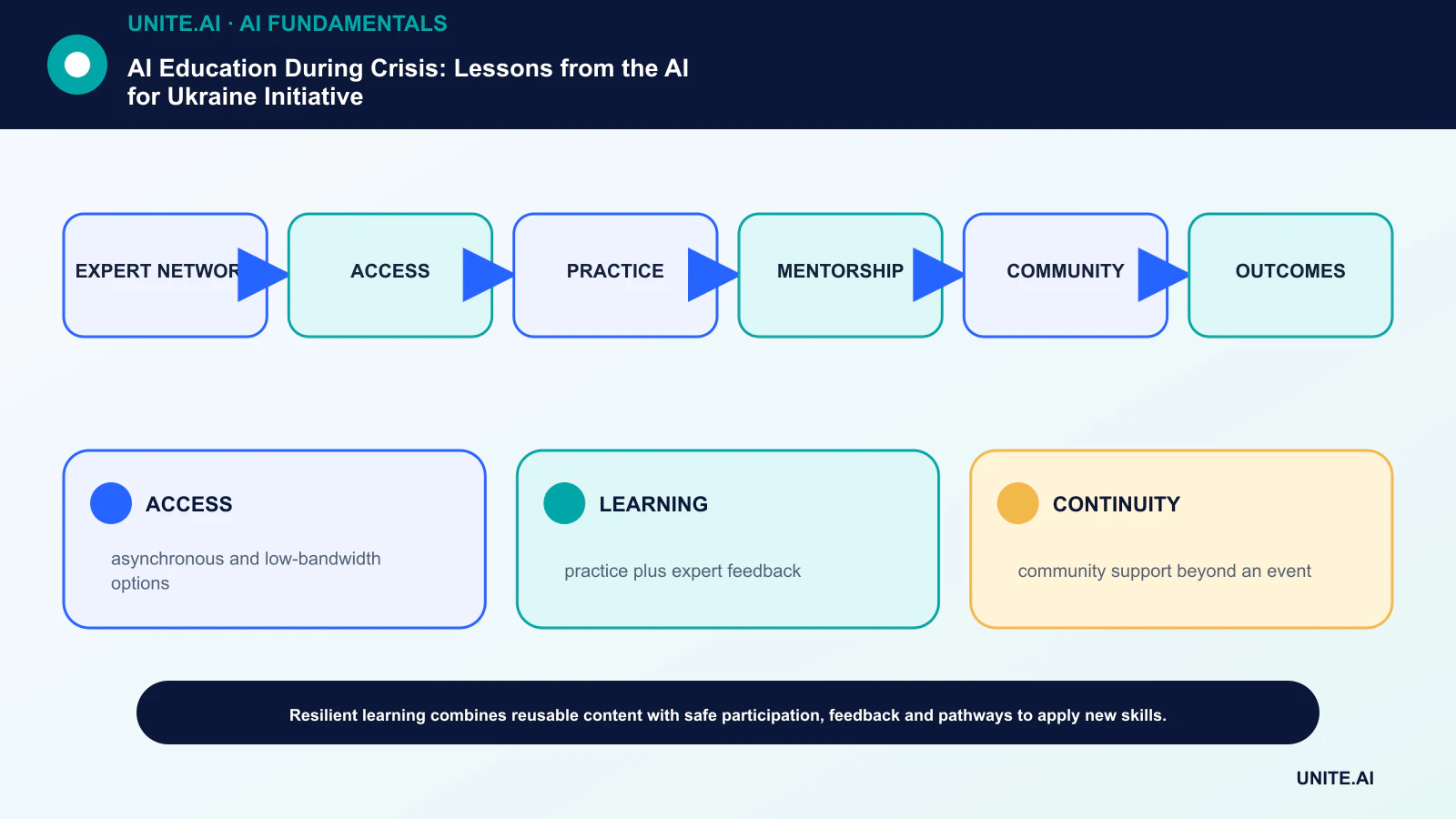
Technical education can help a professional community remain connected during war, displacement and infrastructure disruption, but only when the program is designed around the realities learners face. Live attendance, stable power, quiet space and uninterrupted study cannot be assumed.
AI HOUSE launched AI for Ukraine in 2022 as a charitable series of lectures, workshops and discussions with international AI experts. The initiative is a useful case study because its recordings remain available after the live seasons, extending access beyond the original schedule.
Key takeaways
- Crisis-resilient education should work asynchronously, on low bandwidth and across time zones.
- Expert lectures create access, but practice, feedback and mentorship are needed for durable skill development.
- Programs should protect participant privacy and avoid collecting more sensitive information than necessary.
- Measure completion, applied projects, mentorship and career continuity—not registrations alone.
Design for interrupted participation
Recordings, transcripts, downloadable notes and small files let learners resume after outages or relocation. Modular lessons reduce the cost of a missed session. Clear prerequisites help a learner choose material suited to their current foundation.
Accessibility includes captions, readable diagrams, keyboard-friendly platforms and language support. When a program is taught in English, glossaries or community translation can reduce the additional burden on learners without diluting technical content.
Connect concepts to deliberate practice
A lecture can introduce machine learning, but competence develops through exercises, projects, code review and reflection. Small datasets and cloud-free alternatives matter when hardware, bandwidth or payment access is constrained.
Practice should distinguish reproducing a tutorial from solving a new problem. Learners need feedback on data leakage, validation, debugging and communication—not only whether a notebook runs.
Build community and mentorship
Cohorts, office hours and peer groups create continuity that a video library cannot. Mentors can help learners sequence material, interpret failed experiments and connect skills to realistic research or employment paths.
Participation must be safe. Public profiles, location data and employer details can create risk during conflict. Programs should minimize collection, explain visibility settings and let learners participate without unnecessary disclosure.
The AI for Ukraine model
AI HOUSE describes AI for Ukraine as a charity project launched in 2022 to share current knowledge, connect Ukrainian AI enthusiasts with international experts and raise funds. Its sessions span workshops, lectures and panels, with recordings retained after the second season.
The case illustrates the value of an expert network and an asynchronous archive. It also shows the limit of event-style learning: recordings are an input, while sustained capability depends on practice, mentoring, local institutions and opportunities to apply skills.
Evaluate outcomes with care
Track lesson completion, project quality, mentorship continuity, research participation, job or study transitions and learner-reported usefulness. Interpret these measures cautiously because crisis conditions affect participation and outcomes independently of program quality.
Publish what was offered, who could access it, what privacy safeguards were used and which claims are self-reported. An honest account of barriers helps future programs improve support for fields such as computer vision, data science and transformer-based AI.
Designing resilient AI education during disruption
War, displacement, infrastructure damage, economic shock, and public-health emergencies interrupt education through power, connectivity, safety, mobility, and psychological stress. A resilient AI program begins with learner needs and constraints rather than copying an intensive campus curriculum online. Provide asynchronous material, downloadable notebooks, low-bandwidth formats, flexible deadlines, recorded sessions, and multiple communication channels. Assume devices are shared and interruptions are normal. Safety and well-being take precedence over attendance or rapid progression.
The curriculum should preserve fundamentals—programming, data, probability, machine learning, evaluation, ethics, and security—while offering practical projects relevant to local needs. Cloud credits can help but may require stable internet and payment identities; local or browser-based tools provide alternatives. Do not expose sensitive locations or personal data in exercises. Translation, captions, accessibility, and prerequisite bridges expand participation. Mentors need guidance for trauma-aware support and clear boundaries; they are educators, not substitutes for professional care.
Partnerships, credentials, and learner protection
Initiatives such as AI for Ukraine can connect volunteers, universities, companies, diaspora experts, and learners. Coordination needs ownership, learner consent, data minimization, safeguarding, and transparent partner roles. Free tools may later charge or change terms; provide exportable work and open alternatives. Verify instructors and prevent recruitment scams, propaganda, harassment, and exploitation. Projects involving defense, surveillance, biometrics, or critical infrastructure require explicit ethical and security review.
Credentials should represent assessed skills. Use portfolios, oral reviews, reproducible notebooks, and practical evaluations that work despite unreliable connectivity. Prevent plagiarism through authentic project design and conversation, not invasive proctoring. Recognize partial completion and transferable credit so disruption does not erase progress. Collect only necessary learner information and define deletion, especially for people at heightened physical or political risk.
Measuring durable impact
Track access, completion by constraint, skill growth, portfolio quality, continued education, employment or research pathways, mentor capacity, and learner safety. Testimonials are valuable but insufficient. Compare outcomes with the resources and selection process, and ask learners what blocked them. Sustainable programs build local teaching capacity, institutional partnerships, and reusable materials instead of depending indefinitely on crisis attention. AI education during crisis succeeds when it preserves agency and long-term opportunity while respecting that learners’ circumstances may change without warning.
Worked example: a low-bandwidth AI course
A crisis-affected program offers downloadable lessons, small datasets, CPU notebooks, transcripts, captions, and optional live mentoring. Learners can submit work by repository, file, or message when connectivity returns. The curriculum uses public, nonsensitive data and teaches baselines, evaluation, and ethics before complex models. Deadlines are flexible, and progress is recorded in modular credentials so displacement or power loss does not erase completed work.
Mentors are verified and trained in safeguarding and referral boundaries. Learner identities, locations, and personal circumstances are minimized and never exposed in public leaderboards. Assessment uses reproducible projects and short oral reviews rather than invasive remote proctoring. The program tracks skill growth, access barriers, continuation, portfolio quality, and local teaching capacity. Sustainability plans migrate materials and coordination to partner institutions instead of relying indefinitely on emergency volunteers and free vendor credits.
Implementation evidence and operational readiness
A production decision needs more than a successful demonstration. Define the intended users, operating environment, inputs, outputs, dependencies, owner, and the consequence of each important failure. Establish a reproducible baseline and a versioned evaluation set before tuning. Test ordinary cases, boundary conditions, malformed or missing input, distribution shift, dependency outage, misuse, and the groups or environments most likely to be underserved. Measure task quality together with calibration or uncertainty, latency, throughput, resource cost, accessibility, privacy, and security. Record every transformation and threshold so an independent reviewer can reproduce the result and distinguish evidence from an attractive prototype.
Before launch, assign authority for release, exceptions, changes, rollback, and retirement. Use a staged rollout, preserve a safe fallback, and verify monitoring with deliberately injected failures. Operational telemetry should reveal input quality, output behavior, model or rule version, dependency health, human overrides, and confirmed outcomes without collecting unnecessary sensitive data. Define alert thresholds and a response owner, then review real-world evidence after deployment rather than assuming offline performance will persist. Reevaluate whenever data sources, users, models, vendors, policies, hardware, or objectives change. A maintained system also needs documented recovery, incident learning, deletion and retention procedures, and a clear point at which it should be disabled or replaced.
Frequently asked questions
Is a recorded lecture an online course?
It can be part of one, but a complete course usually also supplies learning objectives, sequencing, exercises, feedback and assessment.
What makes technical education resilient during disruption?
Asynchronous access, low-bandwidth materials, modular pacing, privacy protection, mentorship and multiple ways to demonstrate learning.
Primary references