AI Fundamentals
What are Quantum Computers?

 Add Unite.AI to your preferred sources on Google
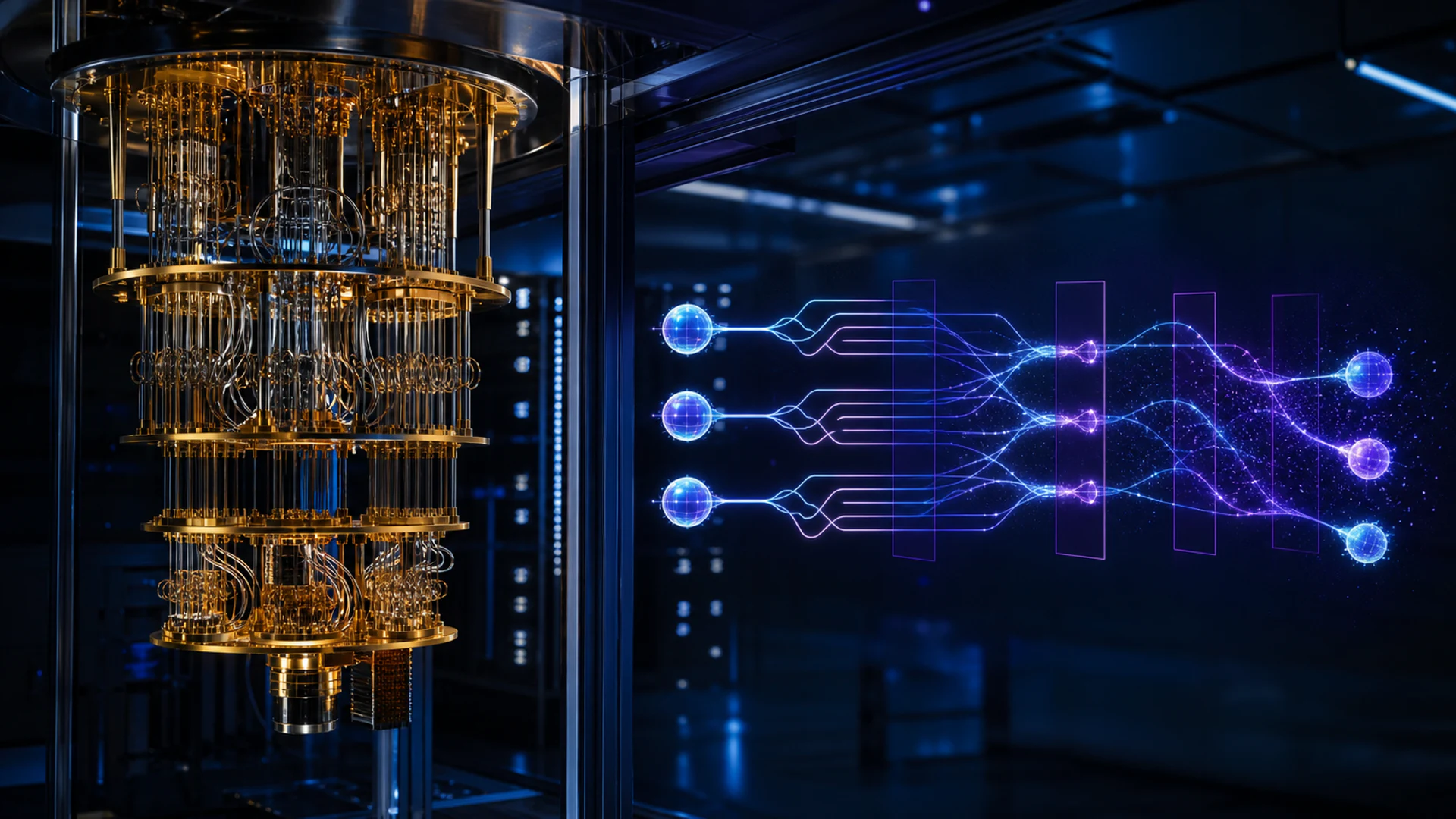
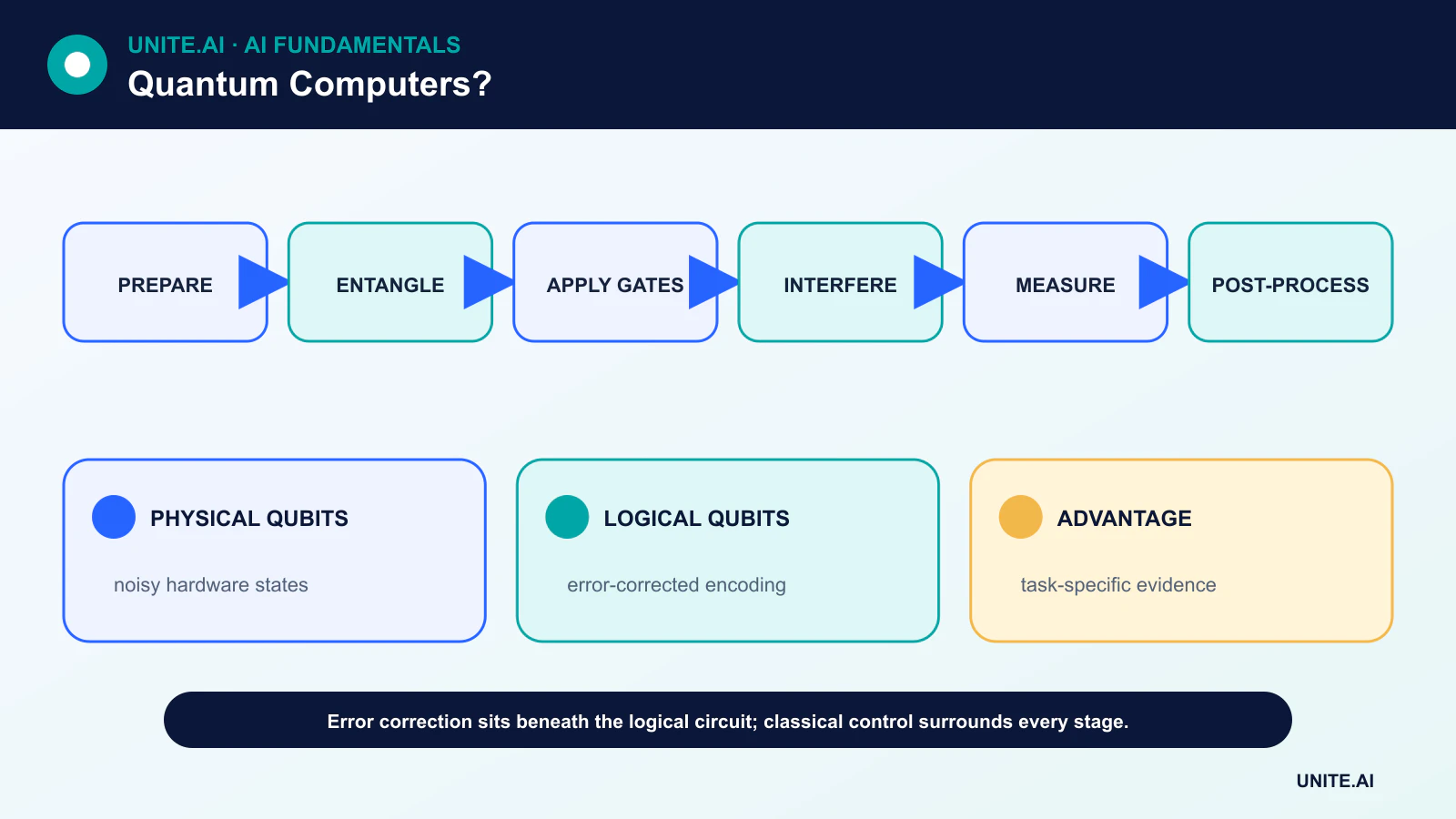
Quantum computers process information with quantum states. Their basic unit, the qubit, can be prepared in a superposition and correlated with other qubits through entanglement. Quantum gates shape amplitudes so that interference increases the probability of useful measurement outcomes.
A quantum computer does not simply try every answer in parallel and reveal the best one. Measurement returns a limited classical result. A useful algorithm must deliberately construct interference and usually repeat the circuit many times to estimate probabilities.
Key takeaways
- Qubits are quantum states; gates manipulate amplitudes and measurement produces classical outcomes.
- Entanglement creates correlations that classical descriptions may represent inefficiently, but it is not a universal speedup.
- Noise limits circuit depth, so useful large-scale systems require error correction and many physical qubits per logical qubit.
- Quantum advantage is task-specific; classical computing remains essential in hybrid workflows.
Qubits, superposition and measurement
A classical bit is read as 0 or 1. A qubit can be prepared as a weighted combination of basis states, described by complex amplitudes whose squared magnitudes determine measurement probabilities. Gates rotate and couple these states in a mathematically controlled way.
Measurement is not a readout of every amplitude. It produces an outcome such as 0 or 1 and changes the state. Algorithms therefore use repeated runs, carefully designed interference and classical post-processing to extract a useful estimate.
Entanglement and quantum circuits
Entanglement describes a joint quantum state that cannot be factored into independent states for each qubit. It can be a computational resource, but entanglement alone does not solve a problem. A circuit combines state preparation, one- and two-qubit gates, measurement and often a classical optimizer.
Hybrid variational algorithms repeatedly run parameterized circuits and update parameters on a classical computer. They are attractive for near-term experiments, although evidence of practical advantage must compare against strong classical baselines including total sampling and error-mitigation cost.
Noise and quantum error correction
Physical qubits lose coherence and gates introduce error. Adding more noisy operations can make a result worse. Quantum error correction encodes one logical qubit across many physical qubits, detects error syndromes and corrects faults without directly measuring the protected information.
The required overhead depends on hardware error rates, code choice, connectivity and the target algorithm. Counts of physical qubits from different systems are therefore not directly comparable, and a large physical-qubit count is not the same as a large fault-tolerant machine.
Where quantum algorithms may help
Known algorithms offer theoretical advantages for specific tasks such as factoring, unstructured search and simulation of quantum systems. Research also explores optimization and machine learning, but many proposals do not yet beat the best classical method under realistic hardware and data-loading assumptions.
A credible claim should name the problem, input size, error model, accuracy target, classical comparator and total resource estimate. “Quantum supremacy” or “advantage” is an experimental statement about a defined task, not proof that quantum computers are generally faster.
Quantum computing and cybersecurity
A sufficiently capable fault-tolerant quantum computer would threaten widely used public-key systems based on factoring and discrete logarithms. It would not automatically break every symmetric cipher or hash function.
NIST finalized its first post-quantum cryptography standards in 2024, so organizations should inventory cryptographic dependencies and plan migration well before a cryptographically relevant quantum computer exists. This is a cybersecurity and data-lifecycle issue because captured encrypted data may remain valuable for years.
Qubits, gates, and quantum information
A qubit is described by a quantum state whose amplitudes determine measurement probabilities. Superposition permits a state to combine basis possibilities, while entanglement creates correlations not representable as independent qubits. Quantum gates are reversible unitary operations; a circuit prepares a state, applies gates, and measures classical bits. Measurement does not reveal amplitudes directly, so an algorithm must arrange interference that increases useful outcomes and suppresses others. Quantum parallelism alone does not mean every possible answer is read at once.
Physical qubits can use superconducting circuits, trapped ions, neutral atoms, photons, spins, or other systems. Each platform differs in gate speed, connectivity, fidelity, coherence, measurement, control, cooling, and manufacturability. Noise accumulates during computation. Quantum error correction encodes a logical qubit across many physical qubits and repeatedly detects errors without directly measuring the protected logical information. Useful fault-tolerant machines require error rates below thresholds and substantial overhead for logical gates and decoding.
Algorithms, complexity, and current hardware
Shor’s algorithm offers polynomial-time factoring and discrete logarithms on a sufficiently capable fault-tolerant computer, motivating migration to post-quantum cryptography. Grover’s algorithm provides a quadratic speedup for unstructured search, not an exponential one. Quantum simulation is a natural target because quantum systems are hard to represent classically. Variational algorithms combine short quantum circuits with classical optimization, but noise, trainability, and classical competition limit evidence of practical advantage on today’s machines.
A claim of quantum advantage must define the task, input, output quality, hardware time, sampling, preprocessing, error mitigation, and strongest classical baseline on comparable resources. Qubit count alone is insufficient; circuit depth, connectivity, fidelity, and logical error matter. Some demonstrations solve specially constructed sampling problems with limited application. Cloud access is useful for research and education, but workloads may wait in queues, depend on proprietary calibration, and return probabilistic samples that require statistical analysis.
Planning responsibly for quantum computing
Organizations should inventory cryptography and begin standards-based post-quantum migration independent of predictions about a cryptographically relevant machine. For applications, identify a precise computational bottleneck, estimate logical resources, and compare continually improving classical algorithms and hardware. Protect sensitive data sent to cloud quantum services and preserve reproducible circuit, compiler, and calibration records. Quantum computing is a different computational model with proven theoretical speedups and active engineering progress, but it is not a general replacement for CPUs, GPUs, or classical AI.
Worked example: evaluating a quantum optimization claim
A logistics study maps a routing subproblem to a quantum circuit and compares it with classical heuristics. The evaluation includes data encoding, circuit compilation, queue, sampling, error mitigation, and result decoding, and reports solution quality and wall-clock time. It uses the strongest available classical baseline on equivalent problem instances and explains whether the quantum device solves the full business problem or a small constructed kernel.
Results are repeated across calibrations and sizes, with circuit depth, two-qubit error, shots, and failure rate disclosed. A noisy variational result that matches a classical solution is not called quantum advantage. Resource estimates show the logical qubits and error-correction overhead needed for scale. The organization separately begins post-quantum cryptography inventory because that security migration is prudent regardless of whether the optimization experiment produces near-term value.
Implementation evidence and operational readiness
A production decision needs more than a successful demonstration. Define the intended users, operating environment, inputs, outputs, dependencies, owner, and the consequence of each important failure. Establish a reproducible baseline and a versioned evaluation set before tuning. Test ordinary cases, boundary conditions, malformed or missing input, distribution shift, dependency outage, misuse, and the groups or environments most likely to be underserved. Measure task quality together with calibration or uncertainty, latency, throughput, resource cost, accessibility, privacy, and security. Record every transformation and threshold so an independent reviewer can reproduce the result and distinguish evidence from an attractive prototype.
Before launch, assign authority for release, exceptions, changes, rollback, and retirement. Use a staged rollout, preserve a safe fallback, and verify monitoring with deliberately injected failures. Operational telemetry should reveal input quality, output behavior, model or rule version, dependency health, human overrides, and confirmed outcomes without collecting unnecessary sensitive data. Define alert thresholds and a response owner, then review real-world evidence after deployment rather than assuming offline performance will persist. Reevaluate whenever data sources, users, models, vendors, policies, hardware, or objectives change. A maintained system also needs documented recovery, incident learning, deletion and retention procedures, and a clear point at which it should be disabled or replaced.
Frequently asked questions
Will quantum computers replace classical computers?
No. They are specialized accelerators for particular algorithms and will depend on classical systems for control, compilation, networking and post-processing.
Is a qubit both 0 and 1?
A qubit can be in a superposition of basis states, but measurement returns a classical outcome according to the state’s probabilities. The phrase “both at once” is an incomplete shortcut.
Primary references