AI Fundamentals
What Is an NPU? Neural Processing Units Explained

 Add Unite.AI to your preferred sources on Google
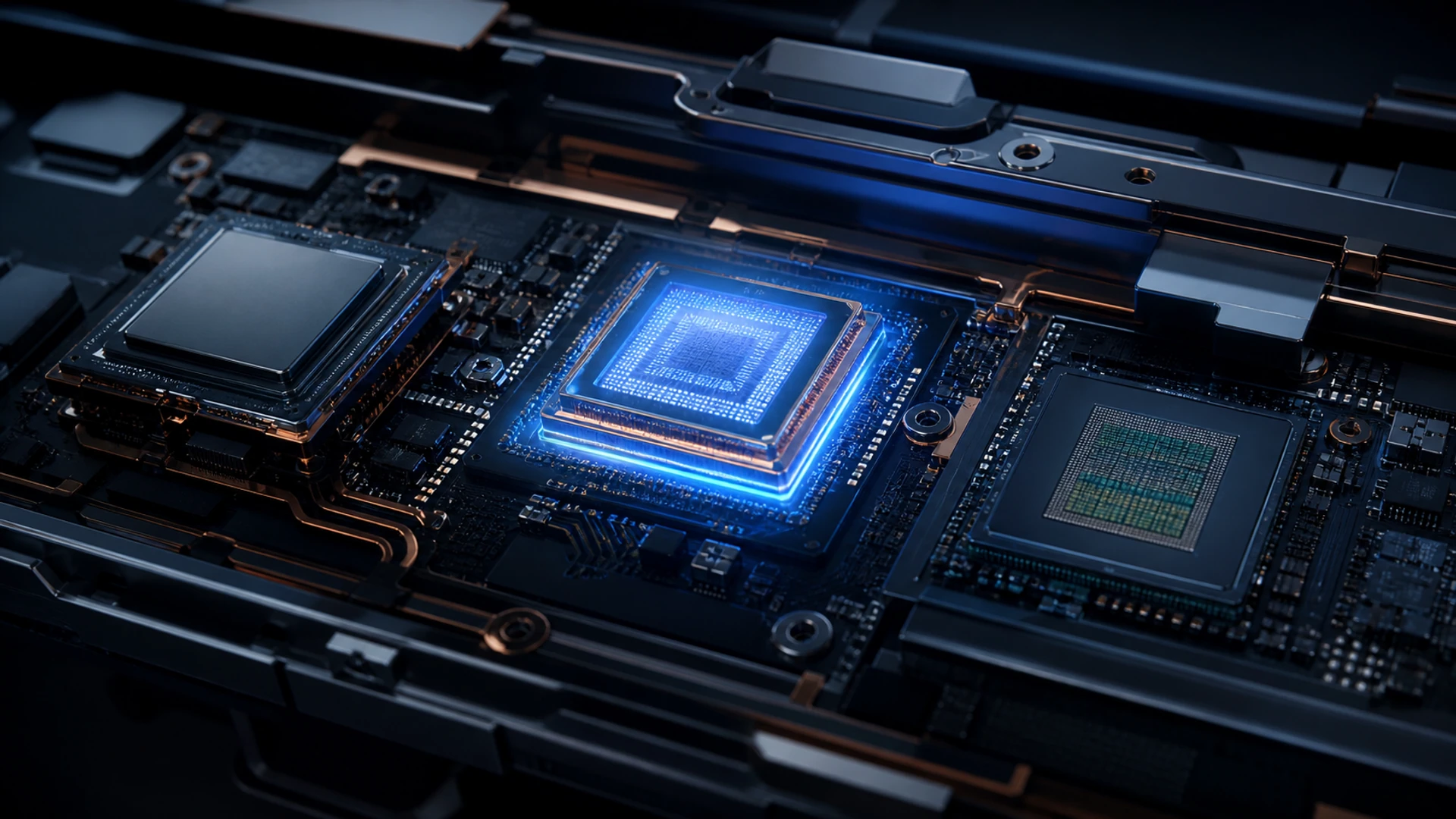
A neural processing unit (NPU) is a specialized accelerator designed to execute common neural-network operations efficiently. In phones, PCs, vehicles, cameras, and embedded systems, it can run supported AI workloads with lower energy or free the CPU and GPU for other tasks.
NPU is a broad industry term rather than one universal architecture. Performance depends on supported operators, numerical formats, memory, compiler and runtime, thermal limits, and how much of an application can remain on the accelerator.
Key takeaways
- NPUs emphasize matrix, vector, and tensor operations with high data reuse and low power.
- Peak TOPS is not an end-to-end application benchmark and may assume a specific precision or sparsity.
- A model may need conversion, quantization, graph partitioning, and fallback for unsupported operations.
- Compare latency, throughput, energy, memory, quality, privacy, and portability on the real workload.
CPU, GPU, and NPU roles
CPUs excel at general control flow and broad compatibility. GPUs provide programmable parallel throughput and large software ecosystems. NPUs specialize repeated tensor operations and may include local memory, multiply-accumulate arrays, and dataflow optimized for inference.
Heterogeneous systems schedule different parts where they fit best. This matters for edge AI, where sustained power and responsiveness can be more important than peak data-center throughput.
Model compilation and execution
A framework graph is converted into an intermediate representation, optimized, quantized where appropriate, and compiled for supported operators. The runtime may partition the graph so unsupported layers execute on CPU or GPU.
Transfers between processors can erase accelerator gains. Static shapes, layout, precision, batching, and memory reuse influence performance. Test the compiled artifact because deep-learning model quality can change after conversion.
Understand TOPS and efficiency claims
TOPS reports trillions of operations per second under defined assumptions. Vendors may count multiply and add separately, use low-bit integer precision, or assume sparsity. A higher number does not guarantee lower latency for a particular model.
Measure cold and warm start, per-query latency, throughput, energy, peak memory, thermal throttling, supported context or image size, and the fraction of the graph accelerated. Use equivalent accuracy and software versions.
On-device AI trade-offs
Local execution can reduce network dependence and keep raw inputs on the device, but downloaded models, logs, backups, and cloud fallbacks still create data flows. Secure model delivery and platform updates remain necessary.
NPUs can support vision, audio, language, and sensor applications, including TinyML-adjacent workloads. Developers should design graceful fallback and communicate when processing leaves the device.
NPU architecture and supported operations
An NPU accelerates tensor operations by using arrays of multiply-accumulate units, local memory, dataflow scheduling, and specialized numeric formats. Keeping weights and activations close to compute reduces expensive data movement. Real devices differ in operator support, memory hierarchy, precision, sparsity, programmability, and how work is shared with CPU and GPU.
Peak performance is often advertised in TOPS, but TOPS does not specify precision, utilization, memory limits, operator coverage, or end-to-end latency. Two processors with the same headline number may perform differently on the same model. Benchmark the compiled model, realistic batch and sequence sizes, preprocessing, transfers, and power mode.
NPUs are effective for supported neural workloads such as vision, speech, denoising, background effects, and compact language models. Unsupported operators may fall back to CPU or GPU, creating transfers and unpredictable latency. Inspect compiler reports and runtime traces to confirm placement rather than assuming the entire graph uses the accelerator.
Model conversion, quantization, and deployment
Deployment usually moves from a training framework through export, graph optimization, quantization, vendor compilation, and runtime integration. Static shapes and common operators are easiest to accelerate. Dynamic control flow, custom kernels, large intermediate tensors, and unsupported normalization or attention patterns may require graph changes or hybrid execution.
Integer and lower-precision formats reduce model size, bandwidth, energy, and latency, but calibration data must represent real inputs. Compare post-training quantization with quantization-aware training when quality is sensitive. Evaluate per-class and worst-case behavior because average accuracy can hide degradation in rare or safety-relevant cases.
On-device inference improves latency, offline operation, and privacy by limiting data transfer, but the device still needs secure models, permission-aware data access, and update mechanisms. Protect model files where appropriate, sign updates, disclose cloud fallback, and ensure telemetry does not reintroduce the privacy exposure the local architecture was meant to reduce.
Performance evaluation and system-level tradeoffs
Measure cold-start and steady-state latency, throughput, energy per inference, memory, thermal behavior, accuracy, and battery impact. Long tests reveal throttling that short benchmarks miss. Include preprocessing and postprocessing because resizing, tokenization, decoding, or data copies may dominate an otherwise fast accelerator.
Scheduling is a system problem. The CPU manages application logic, the GPU may render or execute unsupported layers, and the NPU runs compatible graphs. Concurrent camera, audio, display, and AI workloads compete for memory bandwidth and power. Test the complete user scenario rather than an isolated model in a vendor tool.
Portability remains limited across compilers and runtimes. Prefer standard model representations where they work, isolate vendor-specific code behind interfaces, preserve reference outputs, and maintain device test coverage. Choose hardware based on validated workloads, software support, update horizon, and total system cost—not a single accelerator specification.
Worked example: deploying a vision model to an NPU laptop
A team trains a segmentation model for background effects, exports it to a supported interchange format, replaces unsupported operators, and calibrates integer quantization with representative cameras, lighting, skin tones, clothing, and backgrounds. The vendor compiler reports which nodes run on the NPU and which fall back. The team treats any fallback crossing as a system cost, because tensor transfers can dominate a fast individual kernel.
Benchmarking measures camera preprocessing, model execution, compositing, memory, cold start, steady-state latency, frame stability, power, and thermal throttling during a real video call. Results are compared with CPU and GPU paths at equal output quality. The application uses capability detection and a tested fallback rather than assuming the accelerator exists or supports the same graph after a driver update.
Release testing covers device models, operating-system and driver versions, concurrent workloads, battery modes, and malformed input. Model packages are signed and versioned; telemetry records performance and failures without collecting unnecessary video. The product explains when processing stays on device and when cloud features are used. The NPU earns its place by improving the complete experience under realistic constraints, not by achieving an isolated TOPS or kernel benchmark.
Practical implementation checklist
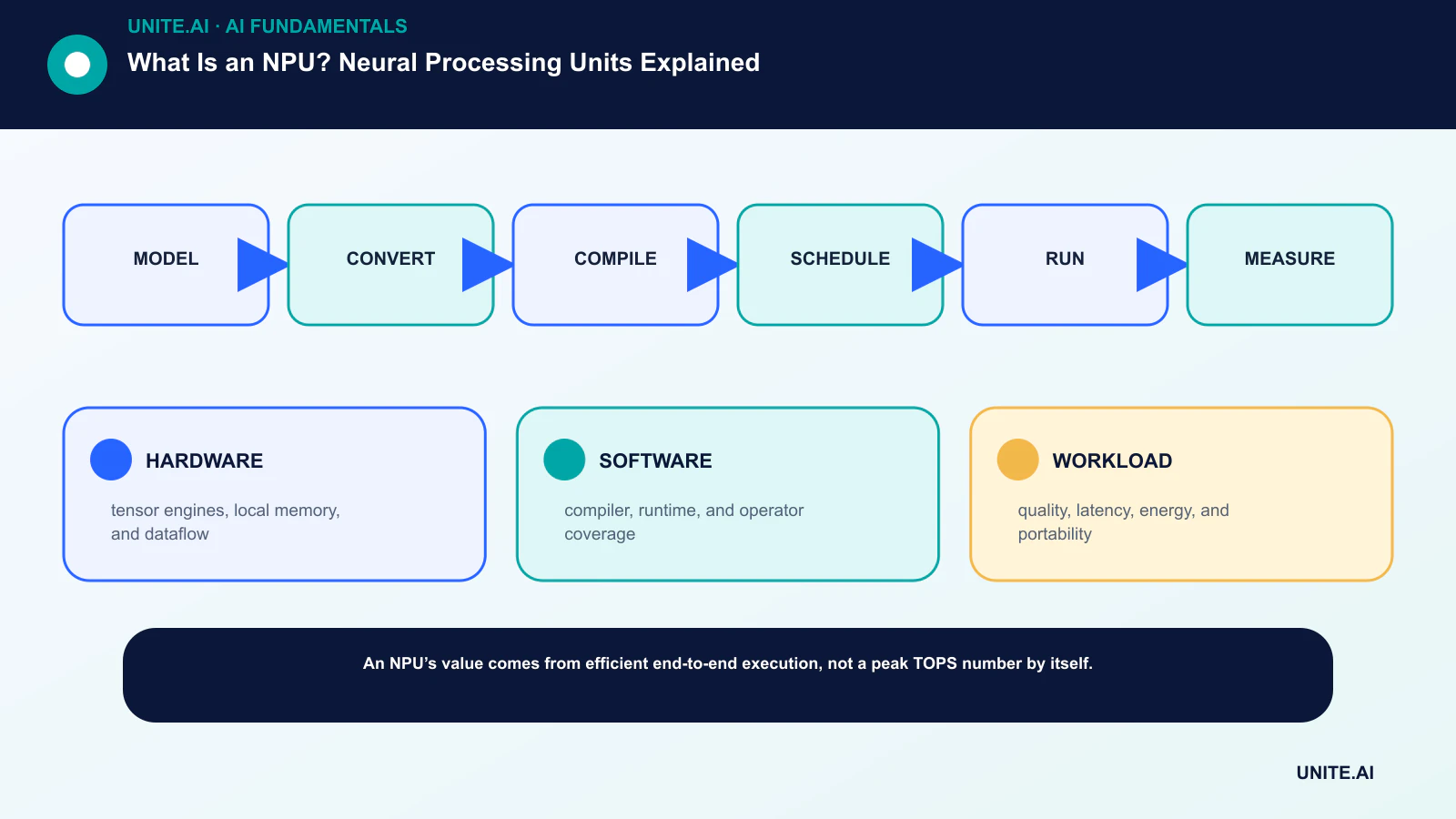
Turn the concept into a bounded, testable workflow: model → convert → compile → schedule → run → measure. Name an accountable owner, document the data and dependencies, establish a simple baseline, set acceptance and stop criteria, test representative failures, and define monitoring, rollback, and review before expanding scope. Record versions and assumptions so another team can reproduce the result and understand what changed.
Before launch, run a documented readiness review with the people who build, operate, secure, and are affected by the system. Test normal cases, boundary conditions, dependency failures, and misuse; preserve the evidence and unresolved risks. Define who can approve release, change a threshold, override an output, or stop operation. Revisit the decision after real-world data arrives, because a technically successful pilot does not guarantee reliable performance at broader scale.
- HARDWARE: tensor engines, local memory, and dataflow.
- SOFTWARE: compiler, runtime, and operator coverage.
- WORKLOAD: quality, latency, energy, and portability.
Frequently asked questions
Is an NPU faster than a GPU?
It depends on the model, precision, operator support, batch size, power limit, and software. An NPU may be more efficient for a supported on-device workload while a GPU is faster or more flexible elsewhere.
Does an NPU keep all AI data private?
No. It enables local processing, but the application may still send data or outputs to cloud services. Privacy depends on the complete architecture and policy.
Primary references