
Artificial Intelligence
When AI Agents Start Building AI: The Recursive Intelligence Explosion Nobody’s Prepared For

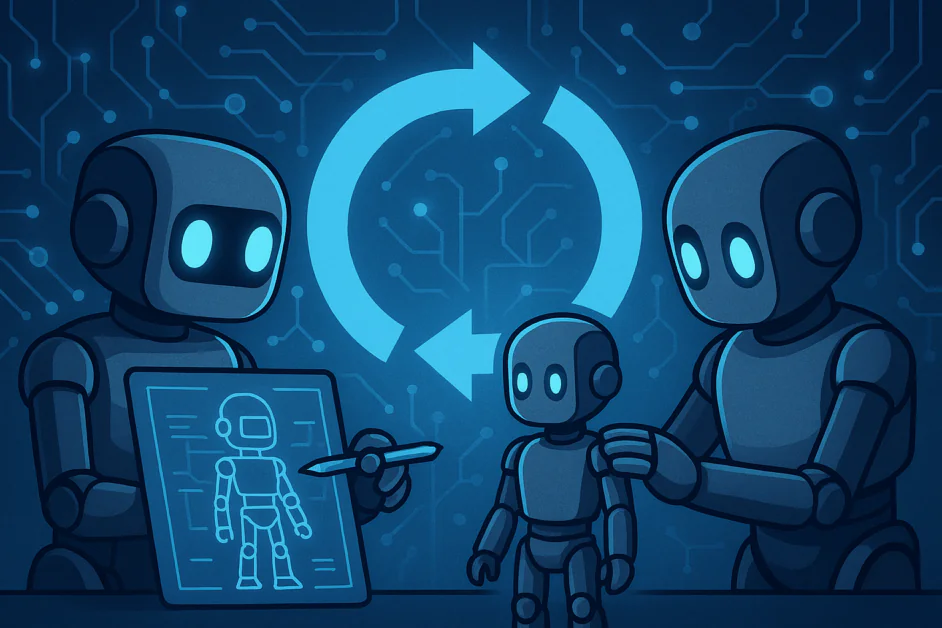
For decades, artificial intelligence advanced in careful, mostly linear steps. Researchers built models. Engineers improved performance. Organizations deployed systems to automate specific tasks. Each improvement depended heavily on human design and oversight. That pattern is now breaking. Quietly but decisively, AI systems are crossing a threshold where they are no longer just tools built by humans. They are becoming builders themselves.
AI agents are beginning to design, evaluate, and deploy other AI systems. In doing so, they create feedback loops where each generation improves the next. This shift does not announce itself with dramatic headlines. It unfolds through research papers, developer tools, and enterprise platforms. However, its implications are profound. When intelligence can recursively improve itself, progress no longer follows human timelines or intuitions. It accelerates.
This article explores how we arrived at this moment, why recursive intelligence matters, and why society is far less prepared for it than it should be. The intelligence explosion, once a philosophical idea, has now become a concrete engineering challenge.
The Evolution of the Intelligence Explosion
The idea that a machine could improve its own intelligence predates modern computing. In the early 1960s, British mathematician I. J. Good introduced the concept of an “intelligence explosion.” His reasoning was that: If a machine became intelligent enough to improve its own design, even slightly, the improved version would be better at improving the next one. This cycle could repeat rapidly, leading to growth far beyond human understanding or control. At the time, this was a philosophical thought experiment, discussed more in theory than in practice.
Several decades later, the idea gained technical grounding through the work of computer scientist Jürgen Schmidhuber. His proposal of the Gödel Machine described a system that could rewrite any part of its own code, provided it could formally prove that the change would improve its future performance. Unlike traditional learning systems, which adjust parameters within fixed architectures, the Gödel Machine could alter its own learning rules. While still theoretical, this work reframed intelligence explosion as something that could be studied, formalized, and eventually built.
The final shift from theory to practice came with the rise of modern AI agents. These systems do not merely generate outputs in response to prompts. They plan, reason, act, observe results, and adjust behavior over time. With the emergence of agentic architectures, intelligence explosion moved from philosophy into engineering. Early experiments, such as Darwin Gödel Machine concepts, hint at systems that evolve through iterative self-improvement. What makes this moment different is recursion. When an AI agent can create and refine other agents, learning from each iteration, improvement compounds.
When AI Agents Start Building AI
Two major trends are driving this transition. The first is the rise of agentic AI systems. These systems pursue goals over extended periods, break tasks into steps, coordinate tools, and adapt based on feedback. They are not static models. They are processes.
The second trend is automated machine learning. Systems now exist that can design architectures, tune hyperparameters, generate training pipelines, and even propose new algorithms with minimal human input. When agentic reasoning combines with automated model creation, AI gains the ability to build AI.
This is no longer a hypothetical scenario. Autonomous agents such as AutoGPT demonstrate how a single goal can trigger cycles of planning, execution, evaluation, and revision. In research environments, systems like Sakana AI’s Scientist-v2 and DeepMind’s AlphaEvolve show agents designing experiments, proposing algorithms, and refining solutions through iterative feedback. In neural architecture search, AI systems already discover model structures that rival or surpass human-designed networks. These systems are not just solving problems. They are improving the mechanisms used to solve problems. Each cycle produces better tools, which enable better cycles.
To scale this process, researchers and companies increasingly rely on orchestrator architectures. A central meta-agent receives a high-level objective. It decomposes the task into subproblems, generates specialized agents to address them, evaluates outcomes using real-world data, and integrates the best results. Poor designs are discarded and successful ones are reinforced. Over time, the orchestrator becomes better at designing agents themselves.
While the exact timeline for when AI agents will fully build and improve other AI systems remains uncertain, current research trajectories and assessments from leading AI researchers and practitioners suggest the transition is approaching faster than many expect. Early, constrained versions of this capability are already appearing in research labs and enterprise deployments, where agents are beginning to design, evaluate, and refine other systems with limited human involvement.
The Emergence of Unpredictability
Recursive intelligence introduces challenges that traditional automation never faced. One of these challenges is unpredictability at the system level. When many agents interact, their collective behavior can diverge from the intentions behind their individual designs. This phenomenon is known as emergent behavior.
Emergence arises not from a single flawed component, but from interactions among many competent ones. Consider automated trading systems. Each trading agent may follow rational rules designed to maximize profit within constraints. However, when thousands of such agents interact at high speed, feedback loops can form. One agent’s reaction can trigger another’s response, which can trigger another, until the system destabilizes. Market crashes can occur without any single agent malfunctioning. This failure is not driven by malicious intent. It results from misalignment between local optimization and system-wide goals. The same dynamics can also apply to other fields.
The Multi-Agent Alignment Crisis
Traditional AI alignment research focused on aligning a single model to human values. The question was simple: how do we ensure this one system behaves as we intend? That question becomes significantly harder when the system contains dozens, hundreds, or thousands of interacting agents. Aligning individual agents does not guarantee aligned system behavior. Even when every component follows its rules, the collective outcome can be harmful. Existing safety methods are not well-suited to detect or prevent these failures.
Security risks also multiply. A compromised agent in a multi-agent network can poison the information that other agents rely on. A single corrupted data store can propagate misaligned behavior across the entire system. The infrastructure vulnerabilities that threaten one agent can cascade upward to threaten foundational models. The attack surface expands with every new agent added.
Meanwhile, the governance gap keeps widening. Research from Microsoft and other organizations found that only about one in ten companies has a clear strategy for managing AI agent identities and permissions. Over forty billion autonomous identities are expected to exist by the end of this year. Most operate with broad access to data and systems but without the security protocols applied to human users. The systems are advancing rapidly. Oversight mechanisms are not.
The Bottom Line
AI has entered a phase where it can improve itself by building better versions of itself. Recursive, agent-driven intelligence promises extraordinary gains, but it also introduces risks that scale faster than human oversight, governance, and intuition. The challenge ahead is not whether this shift can be stopped but whether safety, alignment, and accountability can advance at the same pace as capability. If they do not, the intelligence explosion will move beyond our ability to guide it.



