Thought Leaders
What Happens When AI Gets a Control Room? The Smart Safety Command Center (SSCC) Era Begins

 Add Unite.AI to your preferred sources on Google
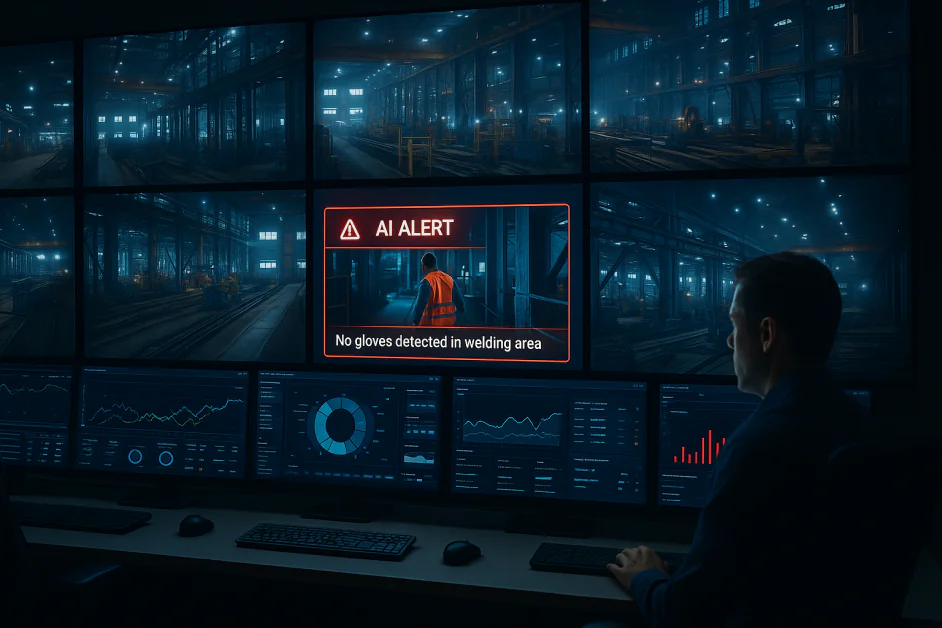
Let’s dive into the operations at a large-scale manufacturing plant in Central Europe. It was a normal day at work when a minor violation occurred—an operator entered a welding area without gloves.
But it was caught not by a supervisor but by an AI system analysing video feeds. Seconds later, an alert appeared in the central command room, and AI flagged the non-compliance, marking it for EHS review.
The incident that day luckily didn’t escalate. No injury occurred. But every day is not the same.
According to the Occupational Health and Safety Administration (OSHA), the latest yearly report recorded 5283 fatal workplace injuries, which is equivalent to 3.5 fatalities per 100,000 workers.
Further, around 395 million workers worldwide sustain a non-fatal work injury every year, as per the International Labour Organisation.
This is where the era of Smart Safety Command Center (SSCC) begins— one where AI isn’t just a tool for data or video analytics is not just for recording task footage; it becomes the silent commander of workplace vigilance.
The Control Room Gets a Brain
We all can imagine what a traditional control rooms in high-risk industries like oil & gas, mining, construction, and manufacturing look like. They have always been designed for visibility.
But visibility without intelligence often amounts to oversight without insight. There are operators monitoring dozens of screens, reacting to flashing alarms, and relying on legacy systems that only signalled after something went wrong.
What makes the modern-day Smart Safety Command Center (SSCC) different is its ability to fuse live video, sensor data, digital permits, and predictive algorithms into a central nervous system.
Every violation, every report and every suggestive action, for not just one but multiple sites, is now visible in one dashboard.
When connected to site-wide video analytics, a smart command center can identify near-miss patterns, automate safety alerts, and even initiate preventive actions—all in real time.
The shift is subtle but seismic. It transforms safety from something reactive and episodic into something continuous and intelligent. In fact, as per McKinsey, in the next 3 years, 92 per cent of companies are planning to increase their investments in AI for a better workplace.
The Rise of the Watchful Machine
Across high-risk sectors, AI-powered smart safety command centres are already reconfiguring how safety is managed. Traditional interventions in the form of manual check-ins, scheduled breaks often fail to capture real risk.
But once an AI-driven SSCC is introduced, changes begin surfacing in unexpected places.
For example, an offshore oil rig off the coast of Saudi Arabia integrated video analytics, and the smart safety command system began detecting micro-signals of fatigue in heavy machinery operators, such as slowed response times and irregular walking patterns.
The SSCC cross-referenced these insights with environmental data like heat index and shift timing, identifying a specific window between 2 PM and 4 PM as a high-risk zone for operator fatigue.
Within weeks, shift rotations were adjusted, hydration stations were strategically repositioned, and predictive alerts were introduced. There was a 41% reduction in fatigue-related near-misses and a 23% drop in overall incident reports over three months, seen —a series of improvements that traditional systems had failed to trigger for years.
A Conversation, Not Just a Dashboard
What makes today’s command centers in workplace safety truly “smart” isn’t just data volume, but it is how that data becomes accessible. Conversational AI now allow supervisors to ask natural-language queries on their mobile devices, like, “Show me all safety violations in Zone D over the last 48 hours.”
Rather than combing through logs or CCTV footage, the SSCC surfaces clips, contextual data, and risk assessments in seconds from the exact time.
In large construction projects in the Middle East, this capability has proven invaluable. Supervisors who are overseeing multiple sites are now able to virtually navigate them through digital twins, with the system flagging not just what’s happening, but what shouldn’t be.
This requires fewer on-site inspections, a set of faster responses, and a significant reduction in both paperwork and downtime.
A Safety System That Sees—and Learns
One of the important evolutions of AI-based smart safety command centres (SSCCs) is that they learn and grow. In an automotive facility in Hong Kong, the deployment of video analytics to track PPE compliance saw an unexpected side benefit: behavioral patterning.
The AI began associating frequent violations with specific teams, time blocks, and even weather conditions, such as increased non-compliance during night shifts and rainy mornings.
Over time, the Smart Safety Command Center used this insight to anticipate likely lapses and alert supervisors in advance. As a result, targeted interventions like pre-shift briefings and micro-breaks were introduced during such high-risk periods.
Within a span of just 90 days, the PPE compliance improved by 74%, and the facility reported a 37% reduction in safety-related downtime, saving approximately $1.2 million in lost productivity and injury costs.
In the 2025 World Day for Safety and Health at Work, the International Labour Organisation highlighted the effective role of AI in reducing occupational safety and health (OSH) issues across the world.
Now, to take a closer look, the real innovation with AI here wasn’t just in catching someone gloveless. It was in creating a closed feedback loop, where data from past violations improved future safety in real time through these smart command centres.
From Monitoring to Mindset: Rethinking Safety Leadership
Adopting a Smart Safety Command Center isn’t just a technical upgrade a site can have; it also demands a cultural shift in how safety is viewed, managed, and led. For decades, compliance has driven safety strategy. But compliance alone is reactive. It ensures boxes are ticked, not that lives are protected in real time.
With SSCCs, safety leadership evolves from being rule enforcers to risk forecasters. The AI can deliver insights, but what organizations do with those insights defines their outcomes.
Some of the most successful deployments have been in environments where leadership embraces data as dialogue, engaging frontline teams, supervisors, and EHS managers to interpret patterns, respond collaboratively, and close feedback loops.
In one logistics company in Singapore, transitioning to an AI-enabled safety command model, weekly safety meetings transformed. Instead of reviewing past incidents, teams discussed predictive alerts: heatmaps of high-risk zones, patterns in micro-violations, or emerging behavioral trends.
This shift not only reduced safety lag time but also created a more proactive and engaged workforce.
Ultimately, the success of an SSCC doesn’t just lie in its algorithms; it lies in how organizations rewire their thinking. The safety command center may be smart, but it’s the people behind it who make safety intelligent.
The SSCC Isn’t Just Watching—It’s Thinking
In many ways, the smart safety command centres (SSCCs) offer a balance at worksites, like freeing humans from the burden of continuous monitoring while empowering them to step in when complexity demands it. One of the concerns that surrounds the debate over AI use is the ethical concerns surrounding it.
Modern day Smart Safety Command Centers (SSCCs) are designed with privacy at their core, adhering to global standards such as the General Data Protection Regulation (GDPR). Many SSCCs employ advanced anonymization techniques—such as intelligent blurring of faces, license plates, and other personally identifiable information—when displaying or analyzing video feeds, to protect worker privacy.
This approach helps to strike a critical balance between real-time situational awareness and the ethical handling of sensitive data, reinforcing trust among the workforce while maintaining compliance.
As industries grapple with increased regulation, workforce safety challenges, and operational complexity, the SSCC model offers a path forward, not through replacement, but through augmentation.
This is what happens when AI gets a control room: the workplace becomes not only smarter—but safer, more responsive, and more resilient.