
Artificial Intelligence
What Are MCP Apps? The New Standard Turning AI Responses Into Interactive Interfaces

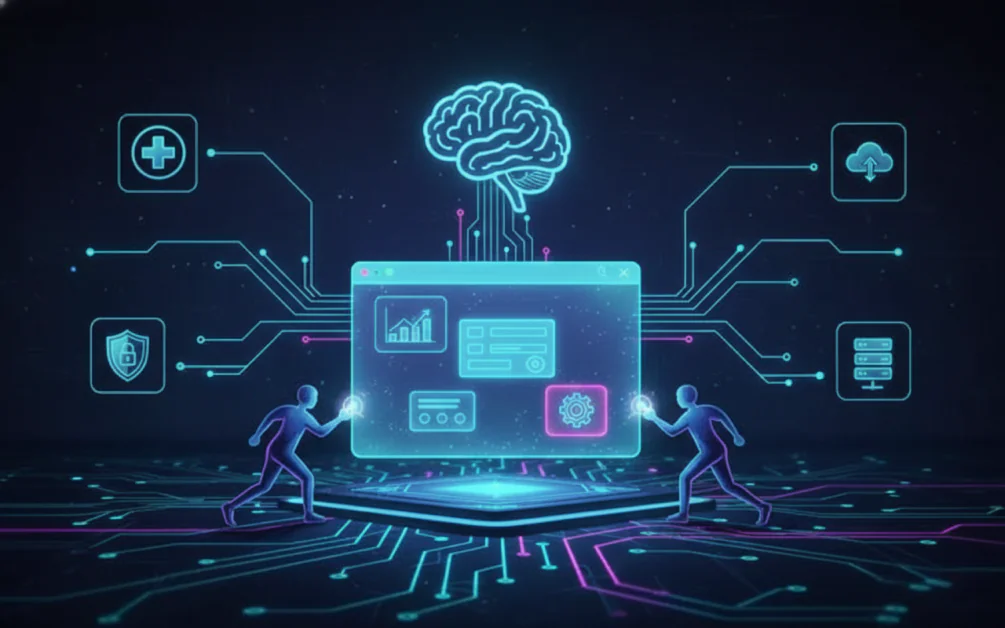
The Model Context Protocol just got its first official extension, and it changes what AI assistants can do. MCP Apps lets tools return interactive user interfaces—dashboards, forms, visualizations, checkout flows—that render directly inside the conversation rather than as text responses.
The extension, announced January 26, represents a collaboration between Anthropic, OpenAI, and community maintainers. It addresses what the MCP team calls “one of the most requested features from the MCP community”: the ability for AI responses to include interactive elements that users can manipulate without typing another prompt.
To understand why this matters, you need to understand what MCP is and how it’s reshaping the AI tool ecosystem.
What Is the Model Context Protocol?
The Model Context Protocol is an open standard Anthropic introduced in November 2024 to solve a fundamental problem: AI assistants were isolated from the data and tools people actually use. Every integration—connecting an AI to your calendar, your files, your business software—required custom implementation.
MCP standardizes these connections. Think of it like USB-C for AI applications. Just as USB-C provides a universal way to connect devices to peripherals, MCP provides a universal way to connect AI models to external systems.
The protocol follows a client-server architecture. MCP hosts (like Claude Desktop or ChatGPT) connect to MCP servers, which are lightweight programs that expose specific capabilities. An MCP server might provide access to your Google Calendar, your company’s database, or a specialized tool like Figma.
What makes MCP powerful is that AI models become active participants rather than passive receivers of data. Models can invoke tools at runtime through the protocol, executing actions rather than just describing what actions might be taken.
The standard has achieved rapid adoption. OpenAI officially adopted MCP in March 2025. In December, Anthropic donated the protocol to the Agentic AI Foundation under the Linux Foundation, with Google, Microsoft, and AWS joining as members. The same open standards approach Anthropic used for its skills framework is now shaping how the entire industry builds AI integrations.
What MCP Apps Adds
Until now, MCP tools returned text. Ask an AI to check your calendar, and it would describe your schedule in words. Ask it to analyze data, and it would summarize findings as paragraphs. The AI could access tools, but the output was always text rendered in the chat window.
MCP Apps changes this. Tools can now return HTML interfaces that render as interactive elements within the conversation. A calendar tool might display an actual calendar grid where you can click dates. A data analysis tool might show charts you can hover over for details. A shopping tool might present a checkout form you can fill out directly.
The technical implementation uses sandboxed iframes for security. MCP servers declare their UI templates in advance, and the client (Claude, ChatGPT, or other hosts) renders them in isolated environments that prevent malicious code execution.
The experience transforms AI from a conversational partner describing actions to an interface layer that presents actionable controls. The model stays in the loop—it sees what users do and responds accordingly—but the UI handles what text can’t: live updates, native media viewers, persistent states, and direct manipulation.
Why This Matters
Consider the difference in practice. Without MCP Apps, exploring data requires iterative prompting: “Show me sales by region.” “Now filter to Q4.” “Sort by revenue.” Each interaction means typing a new prompt and waiting for a text response.
With MCP Apps, the AI returns an interactive data table. Click a column header to sort. Drag sliders to filter date ranges. Hover over values to see details. The AI watches these interactions and can respond to them—”I noticed you’re focusing on the Northeast region; here’s deeper analysis”—but the exploration happens through direct manipulation rather than conversation.
This closes a gap that has limited AI assistants since ChatGPT launched. Adobe’s integration into ChatGPT hinted at what’s possible when AI can present visual interfaces. MCP Apps standardizes that capability so any developer can build it.
Launch Partners and Availability
Anthropic has rolled out MCP Apps support in Claude for Pro, Max, Team, and Enterprise subscribers. Initial integrations come from launch partners including Amplitude, Asana, Box, Canva, Clay, Figma, Hex, monday.com, and Slack. Salesforce integration is coming soon.
The practical result: users can build project timelines in Asana, draft formatted Slack messages, create and edit Figma diagrams, and manage Box files—all from within Claude’s chat interface. Each tool presents its native UI rather than forcing users to describe what they want in text.
For developers, Anthropic has published the ext-apps repository with SDKs and working examples. Reference implementations include 3D visualization with Three.js, interactive maps, PDF viewing, real-time system monitoring dashboards, and sheet music notation. The open specification means developers can build MCP Apps that work across any client that supports the extension.
The Bigger Picture
MCP Apps continues Anthropic’s strategy of building industry infrastructure as open standards. The company has now contributed MCP for tool connectivity, Agent Skills for capability customization, and MCP Apps for interactive interfaces—each released openly rather than as proprietary features.
The approach inverts traditional software dynamics. Instead of apps containing AI features, AI becomes the interface through which apps are accessed. MCP Apps makes that interface richer by letting tools present visual controls rather than just text descriptions.
For users, the immediate benefit is smoother workflows. Actions that required switching between apps or typing detailed prompts can happen through clicks and drags. For developers, MCP Apps offers a new distribution channel—build an interactive tool once, and it works inside any AI assistant that supports the extension.
The extension is production-ready as of January 26. Whether MCP Apps becomes as ubiquitous as MCP itself will depend on how quickly developers build compelling implementations—and how well the sandboxed iframe architecture handles the security challenges of running arbitrary web interfaces inside AI conversations.



