
Artificial Intelligence
The MoE Revolution: How Advanced Routing and Specialization Are Transforming LLMs

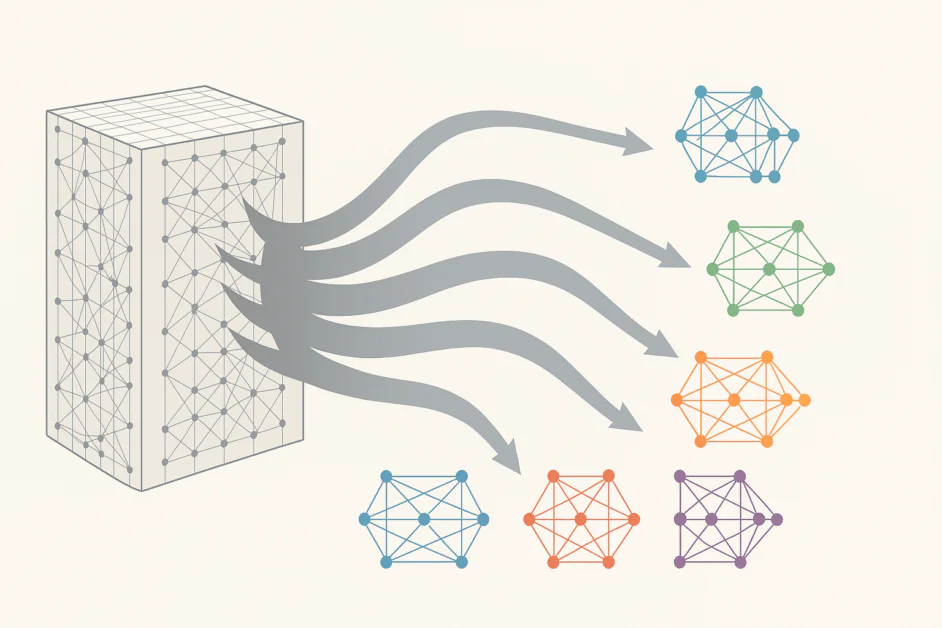
In just a few years, large language models (LLMs) have expanded from millions to hundreds of billions of parameters, showcasing the remarkable progress in our ability to engineer and scale massive AI systems. These massive systems have delivered astonishing capabilities such as writing fluent text, generating code, reasoning through complex problems, and engaging in human-like dialogue. But this rapid scaling comes with a significant cost. Training and running such enormous models consume extraordinary amounts of computing power, energy, and capital. The “bigger is better” strategy that once fueled progress has begun to show its limits. In response to these growing constraints, an AI architecture known as Mixture of Experts (MoE) is advancing to offer a smarter and more efficient path to scaling large language models. Instead of depending on one massive, always-active network, MoE breaks the model into a collection of specialized sub-networks or ‘experts’, each trained to handle specific kinds of data or tasks. Through intelligent routing, the model activates only the most relevant experts for each input to reduce computational overhead while maintaining or even improving performance. This ability to blend scalability with efficiency makes MoE one of the most defining emerging paradigms in AI. This article explores how advanced routing and specialization are driving that transformation and what it means for the future of intelligent systems.
Understanding the Core Architecture
The idea behind the Mixture of Experts (MoE) is not new. It traces back to the ensemble learning methods of the 1990s. What has changed is the technology that makes it work. Only in recent years have advances in hardware and routing algorithms made it practical to bring this concept into modern Transformer-based language models.
At its essence, MoE redefines a large neural network as a collection of smaller, specialized subnetworks, each trained to handle a particular type of data or task. Rather than activating every parameter for every input, MoE introduces a routing mechanism that decides which experts are most relevant for a given token or sequence. The result is a model that uses only a fraction of its parameters at any given time, dramatically reducing computational demand while preserving, or even improving, performance.
In practice, this architectural shift allows researchers to scale models into the trillions of parameters without requiring a proportional increase in compute resources. It replaces the traditional dense feedforward layers with a more intelligent and dynamic system. Each MoE layer contains multiple experts, typically smaller feedforward networks themselves, and a router or gating network that decides which experts should process each piece of input. The router acts like a project manager, sending relevant questions to each expert. Over time, the system learns which experts perform best for different types of problems, refining its routing strategy as it trains.
This design offers a striking combination of scale and efficiency. For example, DeepSeek V3, one of the most advanced MoE models, employs an astonishing 685 billion parameters but activates only a small portion of them during inference. It delivers the performance of a massive model with significantly lower computational and energy requirements.
The Evolution of Routing Mechanisms
The router is the heart of MoE, determining which experts handle each input. Early models used simple strategies, selecting the top two or three experts based on learned weights. Modern systems are far more sophisticated.
Today’s dynamic routing mechanisms adjust the number of activated experts based on input complexity. A simple question might need just one expert, while difficult reasoning tasks might activate several. DeepSeek-V2 implemented device-limited routing to control communication costs across distributed hardware. DeepSeek-V3 pioneered auxiliary-loss-free strategies that allow richer expert specialization without performance degradation.
Advanced routers now act as intelligent resource managers, adjusting selection strategies based on input characteristics, network depth, or real-time performance feedback. Some researchers are exploring reinforcement learning to optimize long-term task performance. Techniques like soft gating enable smoother expert selection, while probabilistic dispatching uses statistical methods to optimize assignments.
Specialization Drives Performance
The core promise of MoE is that deep specialization outperforms broad generalization. Each expert focuses on mastering specific domains rather than being mediocre at everything. During training, routing mechanisms consistently direct certain input types toward specific experts, creating a powerful feedback loop. Some experts excel at coding, others at medical terminology, and others at creative writing.
However, achieving this goal presents challenges. Traditional load-balancing approaches can ironically hinder specialization by forcing uniform expert usage. However, the field is advancing rapidly. Studies reveal that fine-grained MoE models display clear specialization, with different experts dominating in their respective domains. Studies confirm that routing mechanisms play an active role in shaping this architectural division of labor.
Strategies that employ domain key experts have demonstrated notable performance improvements. For example, researchers reported a 3.33 percent accuracy gain on the AIME2024 benchmark. When specialization works, the results are remarkable. DeepSeek V3 outperforms GPT-4o across most natural language benchmarks and leads in all coding and mathematical reasoning tasks, an impressive milestone for an open-source model.
Practical Impact on Model Capabilities
The MoE revolution has delivered tangible improvements in core model capabilities. Models now handle longer contexts more efficiently; both DeepSeek V3 and GPT-4o can process 128K tokens in a single input, with MoE architecture optimizing performance, especially in technical domains. This is crucial for applications like analyzing entire codebases or processing lengthy legal documents.
The cost efficiency gains are even more dramatic. Analysis suggests DeepSeek-V3 is roughly 29.8 times cheaper per token compared to GPT-4o. This price difference makes advanced AI accessible to a wider range of users and applications. It significantly accelerates the democratization of AI.
Furthermore, architecture enables more sustainable deployment. Training a MoE model still requires substantial resources, but the dramatically lower inference cost paves the way for a more efficient and economically viable model for AI companies and their customers alike.
Challenges and the Path Forward
Despite significant advantages, MoE is not without challenges. Training can be unstable, with experts sometimes failing to specialize as intended. Early models struggled with “routing collapse,” where one expert dominated. Ensuring all experts receive adequate training data while only a subset is active requires careful balancing.
The most significant bottleneck is communication overhead. In distributed GPU setups, communication costs can consume up to 77% of processing time. Many experts are “overly collaborative,” frequently activating together and forcing repeated data transfers across hardware accelerators. This is driving fundamental reassessments of AI hardware design.
Memory demands present another significant challenge. While MoE reduces compute costs during inference, all experts must be loaded into memory, straining edge devices or resource-limited environments. Interpretability remains another key challenge, as identifying which expert contributed to a given output adds another layer of complexity to the architecture. Researchers are now exploring methods to trace expert activations and visualize decision pathways, aiming to make MoE systems more transparent and easier to audit.
The Bottom Line
The Mixture of Experts paradigm isn’t just a new architecture; rather, it’s a new philosophy for building AI models. By combining smart routing with domain-level specialization, MoE achieves what once seemed contradictory: greater scale with less computation. While challenges in stability, communication, and interpretability persist, its balance of efficiency, adaptability, and precision points toward the future of AI systems that are not just larger but also smarter.



