
Thought Leaders
The Maintenance Trap: Why AI Vibe Testing Is the Future of QA

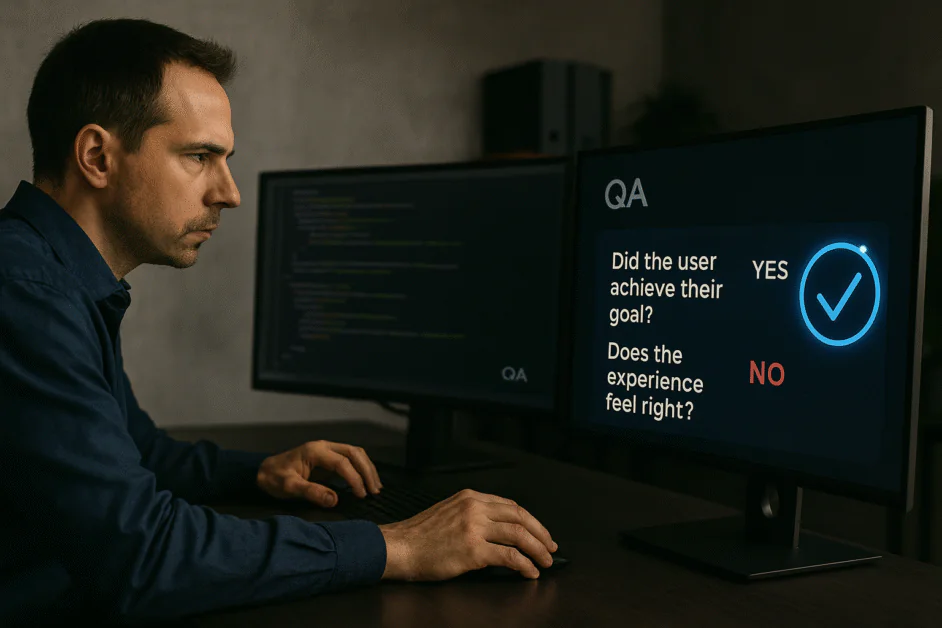
Artificial intelligence has reshaped the rhythm of software creation. With tools like GitHub Copilot and ChatGPT, code now can be generated in minutes instead of weeks, and interfaces evolve almost daily. Yet amid this acceleration, quality assurance, the discipline meant to protect reliability, has become the industry’s most critical bottleneck. What developers once called automation now looks increasingly manual. Tests fail not because applications break, but because test suites do.
The problem lies not in our tools but in our assumptions. For years, the industry has treated QA as a procedural exercise, a sequence of clicks, checks, and verifications. That mindset made sense when software moved slowly, but it no longer does. The new pace of development demands testing that can adapt as quickly as the code it protects. I call this evolution vibe testing, which is quality assurance that understands intent, interprets context, and reacts to change rather than collapsing under it.
The numbers highlight the urgency. The global software testing market exceeded $51.8 billion in 2023 and is projected to grow 7 percent annually through 2032. The automation testing segment alone, valued at $28.1 billion in 2023, is expected to reach $55.2 billion by 2028, a 14.5 percent CAGR. Despite these investments, QA teams remain stuck in reactive cycles. Automation promised speed but often delivered fragility. McKinsey has noted that while, yes, AI-enabled software development is fundamentally reshaping how products are built end to end and increased delivery speed, it is also putting additional pressure on testing and quality practices to keep up with that pace.
Automation’s broken promise
Across organizations, the same pattern repeats. Teams spend their days fixing brittle scripts that fail for reasons unrelated to product quality. A single change in a user interface, such as a renamed button, a new layout, or an added step, can break hundreds of tests. Each correction spawns more maintenance. This has led automation to become the very thing it sought to eliminate, which is repetitive labor.
Procedural automation was built on the assumption that interfaces stay stable and user journeys remain predictable. That assumption has not survived continuous deployment, A/B testing, and real-time personalization. Modern systems are fluid by design. The only way QA can keep up is by learning to interpret behavior and meaning rather than static coordinates on a screen.
This is the maintenance trap. Automation that was supposed to accelerate development actually slows it down because upkeep overhead grows faster than the value delivered. The paradox is one of modern software engineering’s great failures.
Why generative AI missed the point
The rise of generative AI gave many in the field hope that salvation was near. If AI could write code, surely it could test it. But the reality has been more modest. Most so-called “AI for QA” tools still rely on frail logic. They generate scripts faster than humans, yet those scripts remain bound to the same selectors and dependencies that have always failed us. As a result, a comprehensive academic study shows that despite widespread interest in AI-enabled testing, real-world adoption in testing teams remains limited.
These systems accelerate the act of writing tests without transforming the act of assuring quality. They can churn out Selenium scripts at speed, but they still break when a UI element moves or a variable name changes. And while AI testing tools do exist, including from companies already pushing the space forward, the broader industry shift hasn’t materialized yet. Most solutions still focus on code generation rather than understanding intent.
From scripts to semantics
True transformation requires AI systems that grasp why an interaction matters, not merely how it is executed. Vibe testing moves beyond procedural accuracy toward experiential understanding. Instead of verifying that “button A leads to page B,” it assesses whether “the user achieves the intended outcome, even if the interface has changed.”
When a banking application redesigns its login flow, a traditional suite collapses while a vibe-testing system recognizes intent, and then, it finds the new path, validates the outcome, and continues autonomously. The difference determines whether QA enables innovation or obstructs it.
This approach reduces flakiness, cuts maintenance overhead, and lets QA teams focus on exploratory testing and new features rather than repairing broken scripts. At scale, it becomes not just a technical shift but an economic one.
The economics of intent
In financial services, where regulatory updates are constant, intent-based testing has made compliance verification scalable without proportionally expanding QA teams. The World Quality Report from Capgemini, Sogeti, and OpenText describes how quality engineering teams are turning to AI and more intelligent automation just to keep pace with faster delivery cycles and increasing system complexity.
In e-commerce, where interfaces evolve continuously through A/B experiments and personalization, companies adopting intent-driven approaches have reduced test-maintenance time by roughly 40 percent within three months. Enterprise SaaS providers managing multiple deployment environments are using the same logic to maintain quality across all variants without crushing overhead.
These patterns show that we are not talking about incremental improvement. We are talking about a fundamental shift in what’s economically feasible in QA.
Guardrails for an autonomous future
No paradigm shift comes without caveats. Systems that rebuild and refactor themselves autonomously still demand human oversight. AI can misinterpret domain logic if it isn’t trained on the right context. QA leaders must maintain rigorous validation processes, especially in regulated sectors where mistakes carry real risk.
Explainability and traceability also become critical. As QA grows more intelligent, every test must record how it evolved and why it passed or failed. In banking and insurance, that level of auditability is a regulatory requirement.
Intelligent systems excel at primary user flows but can miss rare or risk-critical cases. Security vulnerabilities, compliance scenarios, and data-integrity edge cases still rely on human-crafted tests and deep domain expertise. And cultural resistance remains real. Teams steeped in Selenium or Cypress workflows will not pivot overnight. The transition demands investment in training, change management, and clear demonstrations of value.
The shift toward adaptive QA
The companies adopting vibe testing most effectively share a common pattern. They begin small, often piloting one high-change application area alongside their traditional suites. They measure results carefully, track maintenance hours and flakiness rates, and expand only once outcomes prove durable. They invest in helping QA engineers evolve from script writers to intent modelers and directors of quality rather than executors. They integrate adaptive AI directly into their DevOps pipelines so that tests adjust as code changes instead of breaking under them.
The larger lesson is philosophical as much as technical. Automation, as we have practiced it, sought to eliminate uncertainty through control. Vibe testing accepts that change is constant and designs for it. It treats testing not as a gate at the end of development but as a living conversation between code, user, and system. The result is software that evolves without losing integrity.
Quality assurance now stands at a crossroads. One path leads deeper into the maintenance trap, where scripts multiply and innovation stalls. The other leads toward adaptive, intent-driven testing, software that understands itself well enough to validate its own behavior. The choice will define which organizations keep pace with the AI-accelerated future and which remain stuck debugging the past.
The next decade of QA will not be measured by how much we automate but by how much we understand. And the winners will be those who build systems that feel the pulse of their products, in other words, the vibe, and adapt accordingly.



