
AI Models & Platforms
The Controversies Around AI in Sports

 Add Unite.AI to your preferred sources on Google
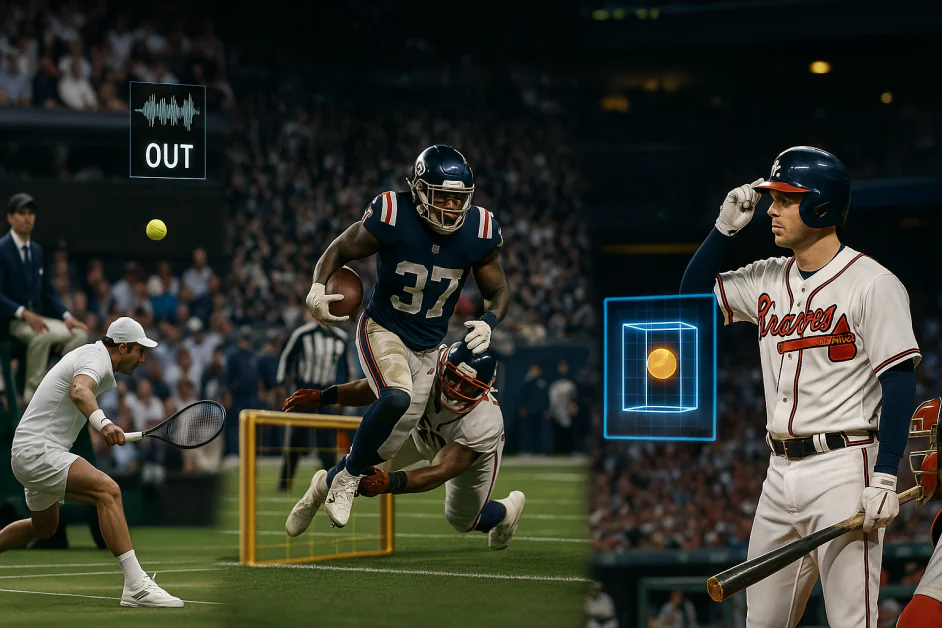
On any given weekend in 2025 a sports fan might zap between three broadcasts and watch artificial intelligence settle pivotal plays in real time. At Wimbledon, a synthetic voice calls a 130-mph serve ‘out’ before the umpire can blink. In Atlanta, a batter taps his helmet, and a 3-D strike-zone animation lights up the scoreboard. In Foxborough, an optical grid confirms a first-down spot while the chain crew stands idle.
Proponents cheer the promise of perfectly consistent decisions and swifter restarts, while sceptics warn that hidden algorithms are rewriting the look and feel of the games they love. Across American stadiums, and increasingly in soccer arenas from London to Doha, the ‘black-box ref’ has arrived, and the debate over its role is only getting louder.
This article unpacks how the technology works, why it is sparking backlash, and the future of AI’s use in making calls in sports.
The Rise of AI-Powered Officiating: Technologies and Their Benefits
The sports industry is no stranger to AI technology: from training athletes to marketing. But its presence on the field is having perhaps the most visible impact for sports fans. AI is being used to assist with the officiating of a wide spectrum of sports, but let’s drill into some of the most prominent (and controversial) applications.
Hawk-Eye: Tennis’s Gateway to Automation
The modern officiating revolution began in tennis. After a missed call cost Serena Williams a crucial point at the 2004 US Open, the sport adopted Hawk-Eye, a computer-vision system that triangulates the ball’s path from up to ten high-speed cameras filming at 340 frames per second.
Independent testing places its average error at roughly 3.6 millimetres (just over 1/10th of an inch), small enough to retire most line judges. A 2024 field study of Grand Slam matches also linked the technology to an 8% drop in overall umpire mistakes. Here in 2025, every major tennis tournament uses Hawk-Eye Live for all lines, although this year’s Wimbledon tournament witnessed a headline-grabbing glitch with the technology that forced a point to be replayed on Centre Court.
American Leagues Embracing Computer Vision
The NFL is one of the newest converts to AI-assisted line technology. Beginning with the 2025 season, a Hawk-Eye camera lattice mounted under each stadium roof delivers centimetre-level x-, y- and z-coordinates for the ball, letting referees confirm first downs without the age-old chain of communication with judges, allowing them to shave minutes off cumulative stoppages.
Baseball has taken a more incremental path. Major League Baseball’s Automatic Balls and Strikes (ABS) challenge system will debut on a national stage at this year’s All-Star Game, giving pitchers, catchers and hitters two appeals apiece. When invoked, an animated strike-zone replay appears on the video board before the plate umpire announces the verdict, usually within 12 seconds, blending algorithmic accuracy with the human touch that many fans still expect.
Basketball’s pace demands rulings in seconds, and the NBA believes richer data helps. A multiyear deal with Sony-owned Hawk-Eye Innovations installs pose-tracking cameras in every arena, capturing 29 skeletal points per player and piping those feeds into the replay centre to speed up out-of-bounds and shot-clock reviews.
Soccer’s Semi-Automated Offside Technology
Outside the United States, soccer offers the most mature example of end-to-end AI officiating. FIFA’s Semi-Automated Offside Technology (SAOT) marries a 500 Hz sensor inside the match ball to twelve roof-mounted cameras that track every limb 29 times per player. A machine-learning model reconstructs a 3-D field and alerts the video assistant referee when an attacker strays beyond the last defender, cutting typical reviews from minutes to roughly 25 seconds.
The Premier League approved full rollout after two seasons of pilot tests, though a record eight-minute hold-up in March underscored that adoption is far from seamless.
Across sports the sales pitch is identical: let silicon handle raw geometry and leave humans to judge intent, ideally combining machine precision with the spirit of the game.
The Growing Controversies and Backlash
‘You’re Killing the Vibe’
What good is a perfect call if everyone has to wait for it? The eight-minute FA Cup delay between Bournemouth and Wolverhampton left 60,000 supporters chanting in frustration and pundits comparing the scene to a courtroom recess. Fans complain that delays mute spontaneous celebrations and fracture momentum, turning goals into verdicts delivered from an unseen control room.
Behavioural Side-Effects
AI oversight also alters human decision-making. A 2024 study found that, although total mistakes fell once Hawk-Eye review became mandatory, tennis umpires grew 37% more averse to call out errors that could be publicly overturned. On serves landing within 20 millimetres (just over 3/4 of an inch) of the line, wrong calls actually rose 22.9%, evidence that constant machine scrutiny encourages ‘defensive officiating’.
On the other side, there are concerns that AI-assistance can actually undermine a referee’s authority, as players and coaches are more willing to challenge referees’ calls. This results in games being broken up even more as referees are forced to check with bots to justify their on-field decisions. This undermining of human referees begs the question whether they could be another role to add to the list that could eventually be phased out entirely by AI.
When the Black Box Misfires
Technology can still whiff spectacularly. In June 2023, Hawk-Eye’s goal-line cameras failed to award English Soccer Team Sheffield United a clear goal against Aston Villa after every angle was blocked, prompting a swift corporate apology.
At this year’s Wimbledon, an ‘out’ call that replays showed to be in caused worldwide controversy within minutes.
Minor-league catchers have complained that ABS calls strikes on curveballs clipping the front edge of home plate but finishing in the dirt, a ruling no human would make.
Transparency and Trust
Each glitch lands harder because the underlying code is proprietary. The English Premier League refuses to publish the tolerance margin SAOT applies to its virtual offside line, forcing data analysts to reverse-engineer it from broadcast graphics. This lack of transparency is obviously of great frustration to fans, coaches, and pundits alike.
Data Privacy and Algorithmic Bias
The same sensors that guide officiating also collect lucrative biometric data. Legal analysts warn that state laws such as Illinois’s Biometric Information Privacy Act could expose leagues to costly lawsuits if player metrics are shared with gambling partners without explicit consent.
Bias poses a subtler risk: a strike-zone model trained mostly on six-foot-plus hitters may expand the high strike for a five-foot-two rookie, effectively changing the rule book for certain body types. Players unions are already negotiating for the right to audit training data.
The Road Ahead: Integration, Adaptation, and Guardrails
League executives now talk less about replacing referees and more about building a durable partnership. MLB’s ABS keeps the plate umpire in charge while granting teams limited appeals, and the NFL still allows officials to overrule optical ball-spots in chaotic pile-ups.
Transparency is the next frontier: European soccer plans to show SAOT’s 3-D offside reconstruction on stadium screens, mirroring the strike-zone replays already familiar to Triple-A baseball crowds. Engineers are adding redundancy, like dual camera arrays, inertial sensors inside balls, and manual fallback modes, so that a single hardware glitch cannot decide a title.
Education follows close behind. Coaches brief players on where SAOT draws the offside plane, and referees attend ‘AI literacy’ workshops to learn latency budgets and error tolerances. Meanwhile, leagues are drafting data-governance codes that sunset raw feeds after set intervals and share revenue with athletes whose metrics power betting markets.
The philosophical debate lingers: should sport chase absolute precision, or is a sliver of human fallibility part of its magic?
Conclusion
AI officiating has already redrawn the rhythm of sport, delivering millimetre-perfect line calls in tennis and near-instant offside rulings in soccer. Yet every eight-minute VAR check, ghost goal, or bland machine-written recap reminds fans that accuracy alone cannot guarantee authenticity.
The most plausible future is a negotiated middle path where algorithms handle the physics and humans interpret intent, fortified by transparent protocols, rigorous testing, and respect for athlete privacy. Get those pieces right, and the black-box ref can fade into a trusted safety net, visible only when it matters most.



