Thought Leaders
Taming the Beast: How Integrated Voltage Regulators Are Solving AI’s Power Crisis

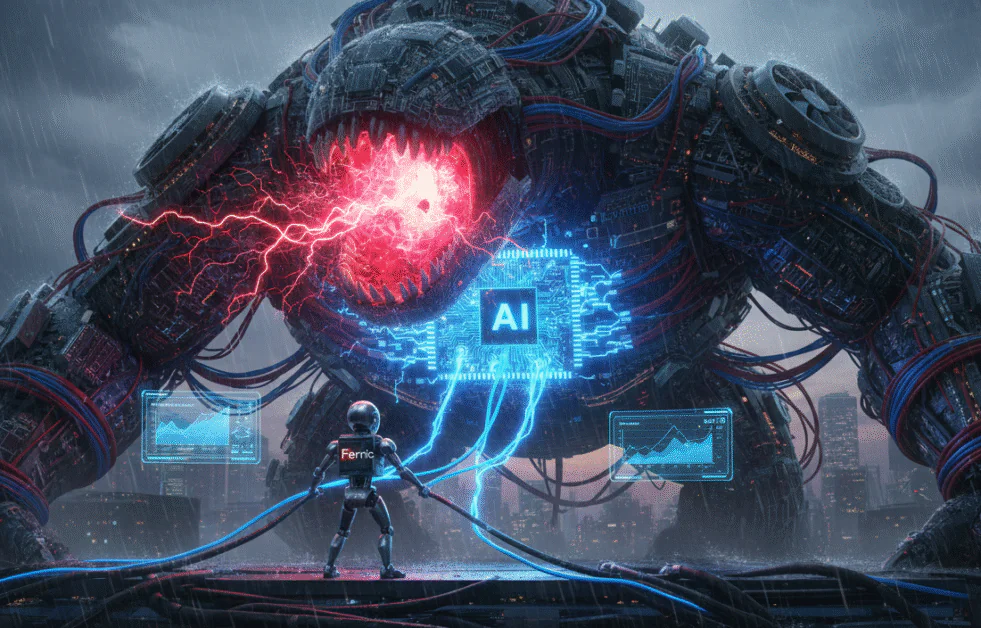
Artificial intelligence is hungry. From training massive language models to powering real-time inference in the cloud, the computational demands of AI are skyrocketing. This insatiable appetite has created a secondary crisis that threatens to stall progress: an unsustainable hunger for electrical power. Data centers, the modern cathedrals of computation, are on track to consume a significant fraction of the world’s electricity, with AI workloads being a primary driver. According to the International Energy Agency (IEA), data centers consumed approximately 2% of global electricity in 2022, and this figure is projected to rise dramatically.
This power problem isn’t just about massive electricity bills and environmental impact; it’s a fundamental engineering bottleneck. The very processors that power AI—the GPUs, TPUs, and custom ASICs—are hitting a thermal wall. You can’t simply keep cramming more transistors onto a chip if you can’t deliver power to them cleanly and efficiently without the chip overheating. The challenge lies not just in generating power, but in delivering it effectively in the last few millimeters before it reaches the silicon. But now a tiny piece of technology known as an Integrated Voltage Regulator (IVR) is fundamentally reshaping the future of high-performance computing.
The “Last-Inch” Problem in Power Delivery
To understand the innovation of the IVR, one must first understand the traditional method of powering a high-performance chip. A modern processor has billions of transistors switching on and off billions of times per second. These operations require a precise, stable, and low-voltage DC power supply. However, the power coming from the wall is high-voltage AC. The journey from the wall socket to the silicon involves a complex chain of conversion and regulation known as the Power Delivery Network (PDN).
Typically, this process involves multiple stages. Power is converted and stepped down on the server motherboard, and the final, critical conversion is handled by a component called a Voltage Regulator (VR). These VRs are usually bulky discrete components—a collection of controllers, power stages, and large, wire-wound inductors—that sit on the motherboard surrounding the processor socket.
This traditional approach has several critical flaws in the age of AI:
- Wasted Energy: Power must travel from these off-chip VRs across the motherboard and through the chip’s packaging. Every millimeter of this path introduces resistance, leading to significant power loss (I2R loss). This lost power is dissipated as heat, which must then be removed by even more power-hungry cooling systems.
- Slow Response Time: When a processor suddenly switches from an idle to a full-load state (a common scenario in AI workloads called a transient load), it demands a massive, instantaneous surge of current. Off-chip VRs can be too slow to respond, causing a temporary voltage drop, or “droop.” To compensate, engineers must design the entire system to run at a higher baseline voltage, wasting yet more power.
- Space Constraints: These bulky, off-chip components consume valuable real estate on the motherboard, space that could be used for more memory channels, faster interconnects, or other performance-enhancing features. This “beachfront property” around the processor is among the most valuable in electronics.
On-Chip Power and Thin-Film Magnetics
Recent advances in thin-film magnetic technology now allow high-performance inductors to be manufactured directly onto a chip or its package substrate using semiconductor fabrication techniques. These microscopic, high-efficiency inductors enable the entire voltage regulator to sit just microns away from the circuits it powers.
This shift in location delivers several advantages:
- Reduced Power Loss: Shortening the power delivery path from inches to microns significantly lowers energy lost during transmission, improving overall system efficiency.
- Granular Power Management: Multiple independent, ultra-low-voltage power domains can supply precisely what each core or functional block needs, when it’s needed, and shut down instantly when it’s not.
- Near-Instantaneous Response: On-package IVRs respond to transient loads in nanoseconds, virtually eliminating voltage droop and enabling lower, more efficient operating voltages without sacrificing performance.
- Simplified Design and Smaller Footprint: Removing voltage regulators from the motherboard frees up board space, simplifies design, and supports denser, higher-performance architectures.
Re-architecting the Future of AI Hardware
The benefits of IVRs directly address the biggest challenges facing AI hardware designers. For companies developing the next generation of GPUs and AI accelerators, integrated power management isn’t just a “nice-to-have”; it’s an enabling technology.
Advanced semiconductor packaging techniques like chiplets and 3D stacking are seen as the path forward now that traditional Moore’s Law scaling is slowing. These techniques involve assembling multiple smaller, specialized dies into a single, powerful package. As explained by industry leaders like TSMC with its CoWoS technology, this approach requires a sophisticated power delivery strategy. IVRs, including ones made by Ferric, are perfectly suited for this paradigm, providing the granular, efficient power needed to manage these complex, heterogeneous systems.
Challenges and Conclusion
The path to widespread adoption is not without its hurdles. Integrating new materials and processes into the highly conservative and complex semiconductor manufacturing ecosystem is a monumental task.
However, the need for a solution is undeniable. The current trajectory of power consumption in AI is unsustainable. Simply making transistors smaller is no longer enough; a holistic re-architecting of the entire system, from software to power delivery, is required. The work of companies like Ferric represents a critical part of that puzzle. By taming the power beast at its source, they are not just creating a more efficient component but are paving the way for the next generation of AI and high-performance computing.
The journey of hardware innovation is one of overcoming bottlenecks. For decades, the focus was on compute speed and transistor density. Today, the most pressing bottleneck is power. The companies that solve this challenge will define the landscape of computing for years to come.
What do you think will be the next major bottleneck in AI hardware design after power delivery is optimized? How will advancements in energy efficiency change the economics of large-scale AI deployment?