
Artificial Intelligence
Reasoning on the Road: Can NVIDIA’s Alpamayo Solve the Self-Driving ‘Edge Case’ Problem?

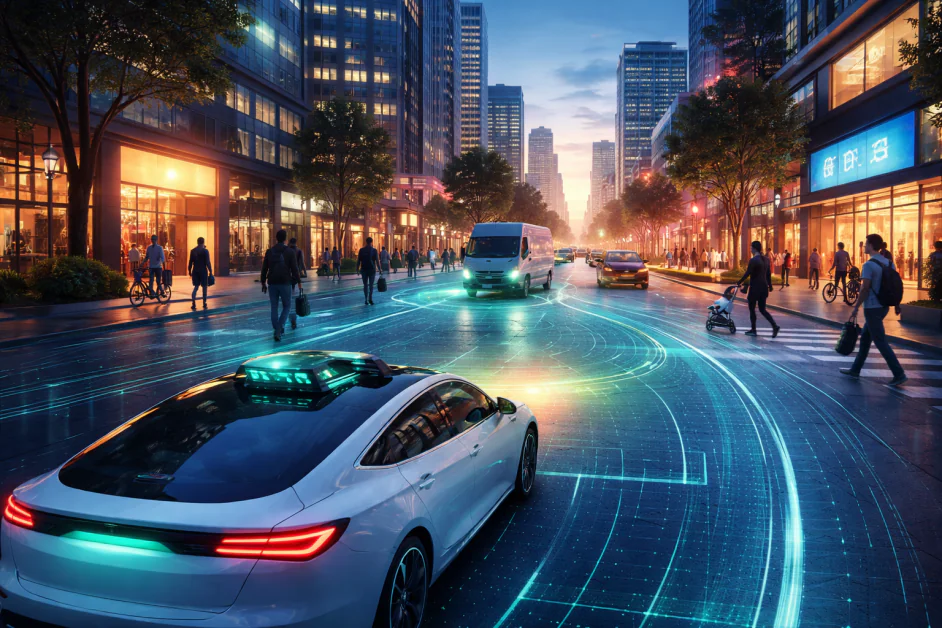
Autonomous vehicles have made remarkable progress over the past decade, accumulating millions of miles and performing well on highways, in controlled test areas, and in select urban zones. However, even in 2026, real-world driving continues to expose critical limitations. For instance, unprotected left turns during heavy rain, construction zones with faded or missing lane markings, and intersections where emergency personnel use improvised hand signals can still challenge advanced self-driving systems.
These situations are not rare anomalies that more data alone can resolve. Instead, they highlight a deeper problem in current autonomous vehicle technology. Modern systems are competent at detecting objects and mapping the environment, yet they struggle to reason about future events, interpret the intentions of other road users, and make context-sensitive decisions. Consequently, perception alone is insufficient for ensuring safety in complex, unpredictable scenarios.
To address this challenge, NVIDIA introduced Alpamayo at CES 2026. This family of open Vision-Language-Action models incorporates an explicit reasoning layer above perception. By combining perception with reasoning, Alpamayo enables vehicles to navigate rare and complex driving situations more safely while providing interpretable explanations for each decision. Therefore, it represents a significant step toward autonomous systems that can think, explain, and adapt rather than observe.
Understanding the Edge Case Problem in Autonomous Driving
Edge cases are one of the most complex problems in self-driving cars. These are rare situations where the safest action depends on subtle context, unwritten social rules, and real-time interactions with other road users. For instance, a pedestrian might wave a car through an intersection even though they technically have the right of way. Or a construction zone may have faded lane markings that conflict with temporary cones. These situations do not happen often, maybe once every few thousand miles, but they cause a large share of safety incidents and system errors.
California’s 2024 disengagement reports clearly show this. Across 31 licensed autonomous vehicle companies, over 2,800 test vehicles drove hundreds of thousands of miles. Yet many failures happened in unusual road layouts, improvised traffic control, or when human behavior was unpredictable. These are precisely the rare situations that traditional self-driving models struggle to handle. Humans, by contrast, can navigate them using experience, quick thinking, and judgment in the moment. Autonomous systems often fail when the real world looks different from what they saw in training.
Modern self-driving technology is very good at perception. Systems can detect vehicles, cyclists, pedestrians, and traffic signs with high accuracy using cameras, lidar, and radar. In addition, end-to-end models convert sensor data directly into steering and throttle commands. On familiar roads, this allows vehicles to drive smoothly and safely.
However, perception alone cannot handle all situations. It cannot answer important questions that arise in complex or unpredictable scenarios. For example, will a jaywalker step into the street? Is it safer to yield in this moment or take a small risk? Why is one maneuver safer than another? Black-box models make these questions harder because they cannot explain their decisions. As a result, safety teams and regulators may find it difficult to trust these systems.
Rule-based planners also have limitations. While they provide clear instructions, programming rules for every rare situation quickly become impossible. Therefore, relying solely on perception or fixed rules leaves gaps in safety and decision-making.
These challenges show why a reasoning layer is necessary for autonomous vehicles. Such a system can understand the situation, anticipate what might happen next, and make decisions that humans and regulators can trust. In addition, reasoning models can produce explanations that can be reviewed, increasing confidence in the vehicle’s actions.
NVIDIA Alpamayo and the Shift Toward Reasoning-Based Autonomy
NVIDIA introduces Alpamayo, a reasoning-focused platform designed to address edge cases that continue to slow progress toward Level 4 autonomous driving. However, instead of operating as a fully self-driving system inside the vehicle, Alpamayo functions as an open research and development environment. It combines three closely connected components: Vision-Language-Action foundation models, the AlpaSim simulation framework, and large-scale Physical AI driving datasets. Together, these elements support the study, testing, and refinement of driving policies that must operate under uncertainty and social complexity while remaining understandable to human reviewers.
The core of this platform is Alpamayo 1. In this model, roughly 10 billion parameters combine an extensive vision-and-language backbone with a dedicated action and trajectory prediction module. As a result, the system can process input from multiple camera views, predict future vehicle motion, and generate clear, natural-language explanations for each decision. These explanations follow a structured sequence. First, the system identifies nearby road users. Next, it estimates their likely intentions. Then, it evaluates visibility limits and safety risks. Finally, it selects a suitable maneuver. For example, when a delivery vehicle blocks part of a lane, the model may consider the possibility of a pedestrian emerging from behind it. It then checks traffic in adjacent lanes. Consequently, it may choose a cautious path adjustment rather than a sudden lane change. This reasoning process closely reflects how a careful human driver would think through the same situation.
Training methods further reinforce this focus on reasoning. Initially, Alpamayo develops a general causal understanding from large multimodal datasets. After that, it is refined using specific data from both real-world recordings and simulations. In addition, physics-based simulation enforces safety constraints such as maintaining sufficient stopping distance and avoiding unsafe responsibility assumptions. At the same time, the system evaluates alternative future outcomes instead of relying on a single prediction. Therefore, by considering what might happen next and favoring conservative responses, the model reduces the risk of failure in unfamiliar conditions.
In contrast, perception-driven systems often perform well in routine settings but struggle when road layouts, weather, or human behavior differ from prior experience. By producing explanations that can be reviewed and tested, Alpamayo gives engineers clearer insight into failure causes. Moreover, it provides regulators with a more transparent basis for safety evaluation, which supports progress beyond limited pilot deployments.
How Alpamayo Applies Chain of Thought Reasoning to Edge Cases
Alpamayo addresses difficult driving situations through explicit, real-world reasoning that adapts to real road behavior. Instead of reacting to scenes as a whole, the system breaks each situation into a sequence of logical steps. Therefore, decisions are not produced as a single output, but as the result of structured analysis. This approach mirrors human reasoning and reduces unexpected behavior in unfamiliar conditions.
First, the model identifies all relevant agents in the scene, including vehicles, pedestrians, cyclists, and temporary objects. Next, it infers likely intent by examining motion patterns, context, and social cues. After that, it evaluates visibility limits, occlusions, and possible hidden hazards. In addition, it considers counterfactual outcomes, such as what may occur if a pedestrian suddenly steps forward. Only then does it compare multiple possible trajectories against safety constraints before selecting a final action. At the same time, the system produces a clear, natural-language reasoning trace that explains each step in order.
This process becomes critical in ambiguous environments. For example, when a delivery vehicle blocks part of a narrow urban lane, Alpamayo does not rely solely on a learned pattern. Instead, it reasons through the situation step by step. It identifies the occluded area behind the vehicle. It then anticipates the possible emergence of a pedestrian or cyclist. Afterward, it checks for oncoming traffic within a short time horizon. Consequently, it may select a minor lateral adjustment that preserves a safety buffer rather than committing to a complete lane change. This decision is supported by reasoning rather than confidence scores alone.
Moreover, chain-of-thought reasoning improves transparency during testing and failure analysis. Engineers can inspect exactly where a decision path failed, such as incorrect intent inference or overly optimistic risk assessment. As a result, errors become easier to diagnose and correct. This differs from black box models, where behavior can be observed but not meaningfully explained.
Simulation further strengthens this reasoning process. Through the AlpaSim framework, Alpamayo operates in closed-loop environments where each action affects future states. Developers can inject rare but realistic edge cases, including sudden jaywalking under glare, aggressive merges by large vehicles, or intersections where drivers rely on gestures instead of signals. Because perception, reasoning, and action operate together, the system must reason under pressure rather than replay static scenarios.
Finally, scalability is achieved through a teacher-student structure. Large Alpamayo models perform chain-of-thought reasoning in data centers and generate trajectories along with reasoning traces across both real and simulated data. Smaller models then learn from these outputs and carry the same reasoning structure into deployment on vehicle hardware. Therefore, causal logic is preserved even when computational limits apply. At the same time, standardized reasoning traces support consistent testing and regulatory review. Together, these mechanisms strengthen reliability and move autonomous systems closer to safe operation in real-world edge cases.
Closing the Long Tail Data Gap Through Reasoning and Simulation
Reasoning-based systems such as Alpamayo do not solve the edge case problem by simply collecting more driving data. Instead, they change how existing data is interpreted, expanded, and tested. Therefore, progress depends on using data more effectively rather than only increasing mileage. NVIDIA addresses this challenge through close integration of its Physical AI driving datasets with the AlpaSim simulation environment, both designed to support reasoning-focused development.
NVIDIA’s Physical AI datasets include more than 1,700 hours of synchronized driving data collected across 25 countries and thousands of cities. The data combines input from cameras, lidar, and radar to capture a wide range of real road behavior. Importantly, these recordings extend beyond a single region or driving culture. As a result, they reflect different traffic norms, weather patterns, road designs, and informal driving practices. This diversity exposes models to realistic examples of rare and confusing situations, such as unclear intersections, damaged lane markings, or roads where negotiation replaces strict rule following. Consequently, reasoning models are trained on conditions that more closely resemble real-world complexity.
However, real data alone cannot represent every rare scenario. For this reason, simulation plays a central role in closing the long tail gap. Through AlpaSim, developers can generate large numbers of controlled yet realistic scenarios that reflect difficult and uncommon situations. These may include partial sensor degradation, unpredictable pedestrian movement, or unfamiliar environmental hazards. Because the simulation operates in a closed loop, each driving decision influences what happens next. Therefore, the system must reason through evolving conditions rather than react to static inputs.
Validation also becomes more structured in this environment. In addition to measuring trajectory accuracy, developers can examine whether reasoning traces stay consistent and credible under stress. This allows assessing not only whether a vehicle behaved safely, but also whether its decision-making process was sound—thereby shifting safety evaluation from trial and error to systematic reasoning. By combining diverse real-world data with reasoning-aware simulation, Alpamayo helps reduce the long-tail challenge in a measurable, reviewable way, supporting safer progress toward advanced autonomous driving.
Industry Impact and Ongoing Challenges
Alpamayo aligns with NVIDIA’s broader autonomous driving strategy by integrating large-scale training, simulation, and vehicle deployment. Training and evaluation occur on high-performance GPU systems in data centers. Meanwhile, smaller models derived from this work run on automotive hardware, such as the DRIVE Thor platform, enabling real-time decision-making in vehicles. Similarly, related systems extend into robotics through Jetson-based platforms. Therefore, Alpamayo enables both road vehicles and other physical systems to share a common development framework.
Industry interest reflects this approach. Several manufacturers and research groups are testing Alpamayo as a reasoning layer atop existing perception systems. For instance, Mercedes-Benz plans to explore integration in future vehicles, while Jaguar Land Rover studies its use for evaluating complex driving situations. At the same time, organizations such as Lucid, Uber, and Berkeley DeepDrive apply Alpamayo for policy testing and safety validation. Consequently, the platform is seen less as a replacement for autonomy stacks and more as a tool to improve safety logic and support Level 4 goals.
Despite these advances, several key challenges remain, and they require careful attention. In particular, chain-of-thought reasoning may describe decisions after the fact rather than reflect the actual internal process, complicating accident investigations. Additionally, transferring cautious behavior from large models into smaller in-vehicle models risks weakening safety margins if validation is insufficient. Therefore, rigorous testing is essential to maintain consistent behavior under tight computational constraints.
Distribution differences create ongoing risks. Reasoning trained in structured urban environments may not transfer smoothly to regions with informal traffic, dense Asian intersections, or unpaved rural roads. Therefore, careful local validation and adaptation are essential to maintain safety across diverse conditions. In addition, public trust and regulatory approval depend on demonstrating that reasoning outputs lead to real improvements in safety, such as reductions in disengagements, near misses, and rule violations.
While Alpamayo’s open development approach encourages collaboration, its integration with NVIDIA’s ecosystem raises questions about long-term reliance on NVIDIA. Nevertheless, the overall shift toward reasoning-based autonomy is clear, and by emphasizing transparency, accountability, and measurable safety outcomes, this approach moves self-driving systems closer to safe deployment beyond controlled pilot programs.
The Bottom Line
Autonomous driving has reached a point where perception alone is no longer enough. While vehicles can see the road with high accuracy, difficult situations still require understanding, judgment, and explanation. Therefore, reasoning-based systems such as Alpamayo mark an essential shift in how these challenges are addressed. By combining structured reasoning, realistic simulation, and transparent evaluation, this approach targets the edge cases that matter most for safety.
Moreover, it provides tools that engineers and regulators can inspect and question, which is essential for trust. However, reasoning does not remove all risk. Careful validation, local testing, and regulatory oversight remain necessary. Even so, by focusing on why decisions are made rather than only on what actions are taken, reasoning-based autonomy moves self-driving technology closer to safe and responsible deployment on real roads.



