Synthetic Divide
Has AI Slop Taken Over YouTube?

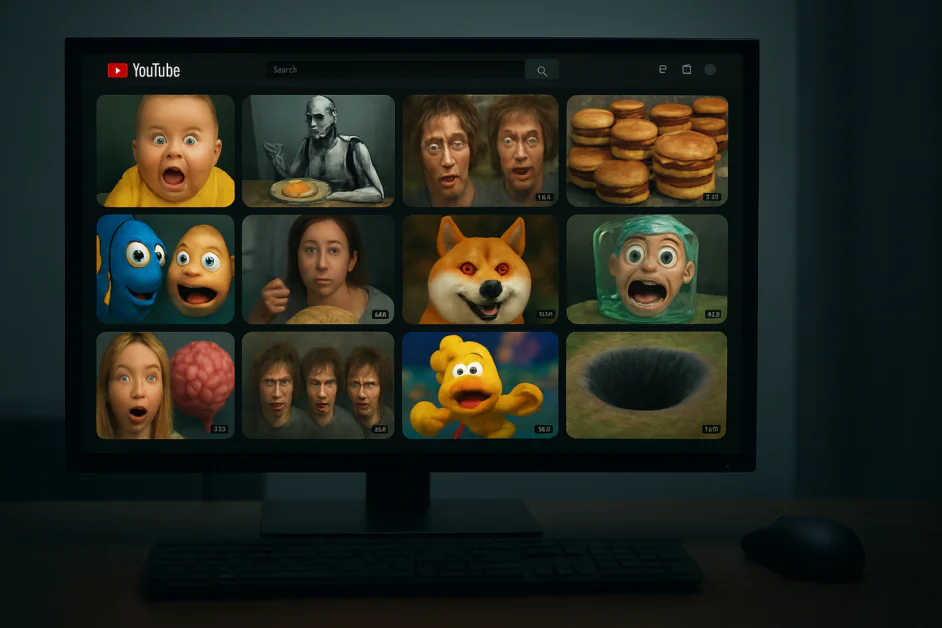
If you’ve opened YouTube lately and felt like you’re scrolling through a junk drawer of recycled voices, generic thumbnails, and strangely familiar scripts, you’re not alone. The rise of AI-generated videos, what many now call AI slop, is beginning to define the platform’s landscape.
Viewers notice eerily similar titles, over-produced thumbnails, and content that feels like it was generated by the same invisible machine.
But is YouTube really being overtaken by low-effort, AI-powered uploads, or is this just a passing wave? The answer reveals a lot about how platforms, creators, and audiences collide in an algorithm-driven ecosystem.
The Anatomy of AI Slop
AI slop isn’t one single type of content—it’s a growing range of low-effort, auto-generated videos that mimic legitimate YouTube formats while hollowing out their originality. It’s one thing to optimize your content for AI SEO, but completely relying on LLMs to churn out videos is going in a completely different direction.
Think of video essays stitched together from stock footage and voice-cloned narrations, or listicles rehashed from Wikipedia with flashy text overlays. AI makes it easy to churn out ten of these a day, each optimized with trending keywords and thumbnail faces distorted into extremes.
Instead of the quirky, personal touch that once defined YouTube, the algorithm is increasingly fed with automated filler designed to satisfy SEO metrics rather than human curiosity.
What makes AI slop so effective is how it rides the platform’s mechanics. Titles are stuffed with terms scraped from trending searches, thumbnails exaggerate emotional cues that trigger clicks, and descriptions are padded with keyword spam.
To the algorithm, these elements check every box. To the human viewer, the result often feels uncanny: videos that look like YouTube, sound like YouTube, but leave you feeling like you just ate fast food when you wanted a home-cooked meal. It’s efficiency over authenticity, and even YouTube has tried to crack down on this in vain.
Why YouTube Is Ripe for It
The platform’s very design makes it vulnerable to this tidal wave of AI slop. YouTube is governed by a recommendation system that rewards watch time, click-through rates, and upload frequency. Human creators, even the most dedicated, can’t compete with machines that can pump out infinite variations of a trending topic overnight. And what can they do when YouTube itself has been used as a training dataset for Google’s Veo 3?
For advertisers and brands, this is a double-edged sword. On one hand, the quantity of content ensures more ad inventory. On the other, the quality is questionable, raising concerns about brand safety and consumer trust. If expensive ads run on AI videos that feel manipulative or hollow, viewers may not just lose patience with the channel—they may sour on the brands appearing alongside it.
The bigger issue is scale. AI allows tiny operations—sometimes a single person with the right software stack—to compete against established creators by blanketing search results with videos. Viewers searching for legitimate content often wade through a sea of knockoffs before landing on something worth watching. This crowding effect risks burying authentic voices under layers of algorithmic padding.
Viewers Can Tell Something’s Off
Despite their efficiency, AI-generated videos don’t pass the vibe check. While you, as a creator or freelancer, are looking for efficiency, art is not a tool. Sure, users will be delighted when merging documents seamlessly using AI, but there’s a time and place for everything.
Viewers are remarkably adept at spotting when something feels soulless, but aren’t good at pinpointing AI-gen content with certainty. Cloned voices have unnatural cadences, stock visuals don’t quite match the narration, and scripts often circle back on themselves with repetitive phrasing. The uncanny valley of YouTube isn’t robots pretending to be people—it’s robots pretending to be creators.
This tension is starting to shape audience behavior. Many users actively seek out channels with visible hosts, authentic storytelling, or transparent production styles as a way to filter out AI slop. The hunger for personality and originality has, in some corners, never been stronger. Ironically, the flood of automation may be making human creativity more valuable by contrast.
At the same time, there’s a darker reality: not everyone cares. For casual viewers looking to kill time, AI slop can be good enough. If the goal is background noise, a synthetic documentary about “10 Secrets of the Ancient World” or a recycled gaming montage can serve the purpose. This divide between those who crave originality and those who just want endless filler may define YouTube’s cultural split going forward.
Creators Are Feeling the Pressure
For traditional YouTubers, the rise of AI slop is both threatening and strangely motivating. On one side, there’s the fear of being drowned out. A creator who spends weeks scripting, filming, and editing a thoughtful video may find their work competing against a dozen near-identical uploads generated in hours.
The metrics don’t always favor the slow and meticulous. When the algorithm sees similar keywords, higher output frequency, and decent engagement, it often elevates the slop alongside—or even above—authentic productions.
Yet the backlash against this phenomenon has sparked a creative arms race. Many creators are leaning harder into their individuality, doubling down on formats that AI can’t easily replicate: unscripted commentary, live interactions, complex editing styles, or niche expertise. Others experiment with hybrid models, using AI tools to assist in scripting or editing while still anchoring the video with their unique voice and perspective.
Conclusion
YouTube was built on the promise of giving anyone with a camera and an idea a chance to share it with the world. That promise is under pressure. The surge of AI-generated slop has filled the platform with videos that feel efficient but empty, engineered to trick algorithms more than entertain audiences.
For viewers, the experience is increasingly a battle between finding something genuine and dodging a wave of sameness.
For creators, it’s a question of survival.
For brands, it’s a test of judgment.
The future of YouTube may not hinge on whether AI slop exists—it already does—but on whether people still care enough to seek out what’s real. That human hunger for originality may be the platform’s last line of defense.