
Thought Leaders
Teacher-in-the-Loop: When AI Joins the Classroom, It Should Bring Empathy With It

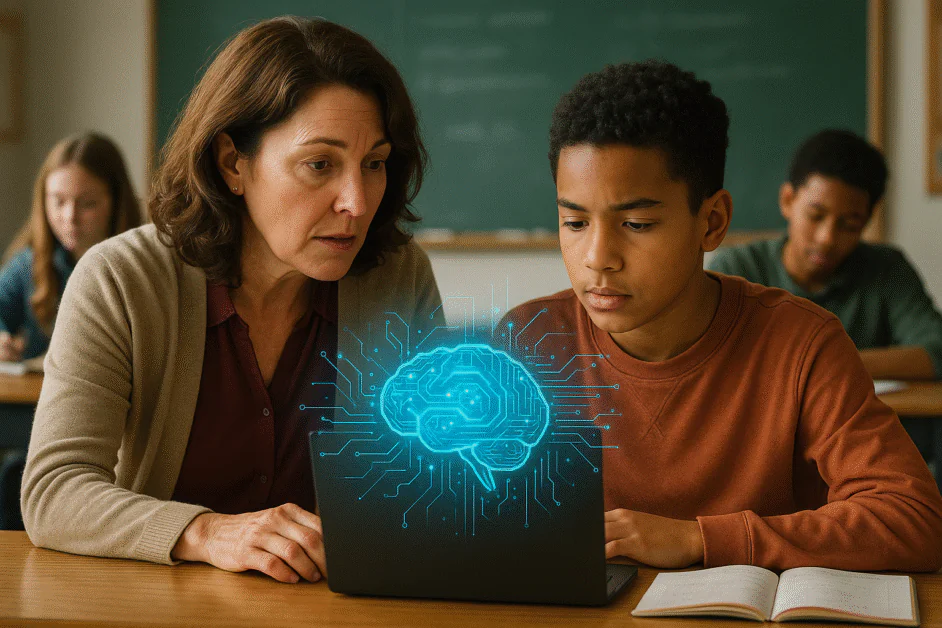
By the time we finish debating one AI use-case, fifty more have emerged. That’s the pace at which the technology is moving, and it’s on us to keep up. It’s quietly rewiring our economy, transforming industries, and bringing what once lived in the pages of science fiction to our everyday lives. In the world of work, productivity gains make sense. In areas like health and wellbeing, more data and insight is generally seen as a good thing. But what about the classroom?
The conversation around AI in education has fallen into a familiar trap: will machines replace teachers, or will teachers resist the machines? In some ways, that’s a false question. More than half of students already use AI for schoolwork, and around two thirds (60%) of teachers use it for planning, ideation, research, and creating lesson materials. The truth is that AI already has a seat in the classroom, so the real question we should be asking is – how do we make sure it supports, rather than detracts from, the learning experience?
Generative AI can already spot learning patterns, predict where a student might struggle, and recommend content to close knowledge gaps. That’s useful, but it can be incredibly impersonal and focuses solely on the work being done rather than the humans doing the work. While some think the next big breakthrough in AI will arrive in the form of bigger models or faster responses, it’s far more likely to come in the form of empathy. If we can add a human context layer to AI and make it more emotionally adaptive, it can help teachers better understand how their students are processing information. A true human context layer interprets not just performance data, but the emotional and cognitive signals that shape how learning happens. Every classroom moment is filled with subtle human cues that shape how learning happens: a pause that signals confusion, a shift in tone that reveals curiosity, or a spark of frustration that points to disengagement. Learning isn’t a mechanical process. It’s deeply human, shaped by emotion, motivation, and attention; the same factors that determine whether a learning opportunity sticks or drifts past unnoticed. AI can help surface these insights, but it’s teachers who make those insights matter. Over time, emotionally aware systems can learn from both teacher and student, building a shared rhythm that mirrors real human interaction.
Yet, many educators find themselves caught between excitement and anxiety. They see AI as both a promise and a threat – a technology that can streamline their workload but also one that might one day make their expertise seem less essential. In reality, the opposite is true. When used thoughtfully, AI can liberate teachers from the cognitive and administrative noise that drains their time and energy. It can free them to focus on what matters most: mentoring, inspiring, and emotionally connecting with students. That’s why, at a time when “intelligent systems” appear to be taking over, the most valuable intelligence in the classroom will always be the grown-up in the room – and AI should empower that role.
Keeping the Human in the Room
AI can track comprehension levels, analyze engagement data, and surface patterns no human could spot unaided. What it can’t do is understand what those signals mean. In a classroom, learning doesn’t unfold in neat datasets. It tends to be messy, full of pauses, glances, and quiet moments of uncertainty. A raised eyebrow might indicate curiosity, or it might signal confusion. An abrupt silence could mean concentration, or it could mean a student has tuned out completely. These are distinctions current algorithms can make, because they require a human context layer that uses empathy, context, and the subtle cues that come from real human connections.
Teachers interpret those cues instinctively. They can tell when to give space, when to encourage, and when to shift approach entirely. That instinct is what keeps learning human-centered. The best teachers don’t just transmit information; they read their students and adjust in real time, and as AI becomes more embedded in classrooms, this ability to sense and respond to emotion will become more – not less – valuable.
AI: Rival or Ally?
The last five years have seen an explosion of AI tools designed to ease the administrative burden on educators. Lesson plans, grading templates, and even classroom resources can now be generated in seconds. This has allowed teachers to reclaim hours once spent planning lessons and marking papers. As planning becomes faster and more automated, the teacher’s role is moving closer to where their true value lies – in guiding understanding, building confidence, and fostering engagement in the classroom.
The next step is to make those same tools emotionally aware. An AI system that recognizes when students are distracted, anxious, or cognitively overloaded could help teachers adapt lessons in real time, adjusting pace, delivery, or format to re-engage attention. By capturing subtle signals of focus or fatigue, these systems can help teachers see patterns they might otherwise miss, giving them a clearer picture of how learning is unfolding. That’s when automation stops being purely about efficiency and starts becoming a feedback loop – one that helps educators teach with greater empathy, precision, and awareness of what their students actually need.



