
Book Reviews
Book Review: The Thinking Machine: Jensen Huang, NVIDIA, and the World’s Most Coveted Microchip by Stephen Witt

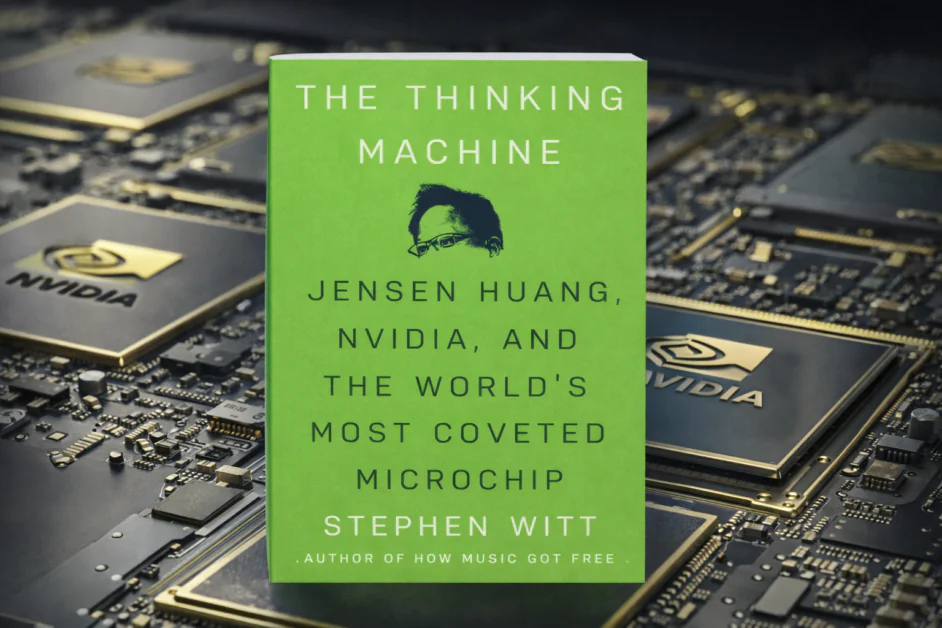
The Thinking Machine: Jensen Huang, NVIDIA, and the World’s Most Coveted Microchip stands apart from most books written about artificial intelligence because it approaches the subject from a direction that many technically literate readers, myself included, have historically underweighted.
Like many people who have followed AI for years, my understanding of the field was shaped by familiar milestones. The story usually begins in 1956 with the Dartmouth workshop, moves through early symbolic systems, then jumps forward to landmark moments such as IBM’s Deep Blue defeating Garry Kasparov, DeepMind mastering Go, and more recently OpenAI demonstrating that large language models can coordinate strategy in complex multiplayer environments. These moments are intellectually satisfying and easy to remember because they center on visible wins.
What Stephen Witt’s book does exceptionally well is challenge that framing. Instead of focusing on moments when AI impressed the world, The Thinking Machine focuses on the less visible layer beneath those achievements. It argues, persuasively, that the modern AI era was not unlocked primarily by clever ideas alone, but by a fundamental shift in how computation itself was performed.
By centering the narrative on NVIDIA (NVDA -0.53%) and its co-founder Jensen Huang, Witt reframes the AI revolution as a story about computing architecture, developer ecosystems, and long-term conviction. The result is not just a corporate biography, but a missing chapter in the broader history of artificial intelligence.
From Video Games to a New Computing Paradigm
NVIDIA’s beginnings are far removed from the lofty ambitions now associated with artificial intelligence. The company emerged in 1993 as a graphics chip maker, focused on rendering increasingly realistic video game worlds. The challenge at the time was not intelligence, but speed. Games required vast numbers of calculations to be performed instantly in order to simulate light, motion, and depth.
The solution NVIDIA pursued was parallel computing. Parallel computing means performing many calculations at the same time rather than executing them sequentially. Instead of relying on a single powerful core processing one instruction after another, GPUs use thousands of smaller cores that work simultaneously on similar mathematical operations. This approach is especially powerful for workloads that involve repeating the same calculations across large datasets.
Originally, this architecture was built for graphics. Yet Witt shows how this decision quietly created the ideal foundation for neural networks decades later. Training modern AI models involves massive numbers of identical mathematical operations applied across vast amounts of data. GPUs were already optimized for exactly that kind of work.
What makes this part of the book compelling is how clearly Witt connects technical design choices to survival. NVIDIA did not choose parallel computing because it foresaw artificial intelligence. It chose it because it was the only way to compete in real time graphics. That necessity forced the company to master a computing model that would later prove transformational far beyond gaming.
Jensen Huang and Thinking in Systems, Not Products
At the center of this story is Jensen Huang, portrayed not as a conventional executive, but as someone who consistently thought in systems rather than individual products. Witt presents Huang as demanding, intense, and often difficult, but also remarkably consistent in how he viewed technology over long periods of time.
While competitors treated GPUs as disposable components tied to gaming cycles, Huang treated them as the foundation of a broader computing platform. This distinction becomes critical. Products are replaced. Platforms compound.
Internally, NVIDIA reflected this mindset. Engineers were encouraged to think years ahead. Software was treated as strategically important as silicon. Investments were made in tooling and developer support long before there was clear demand. Many of these choices appeared excessive or unnecessary at the time. In hindsight, they created a moat that competitors struggled to cross.
Witt makes it clear that NVIDIA’s rise was not inevitable. The company came close to failure more than once. What carried it forward was not a single breakthrough, but a sustained belief that accelerated computing would eventually matter far beyond its original use case.
CUDA and the AI Origin Story Many Missed
One of the most important contributions of The Thinking Machine is how it reframes CUDA’s role in AI history.
Before reading this book, it is easy to think of CUDA as simply a successful developer tool. Witt shows why it deserves far more attention. CUDA was created to make parallel computing usable outside of graphics. Prior to CUDA, using GPUs for general computation required forcing problems through graphics specific interfaces. This was fragile, inefficient, and limited to specialists.
CUDA changed that by allowing developers to program GPUs using familiar programming models. Thousands of computing cores became accessible as a general resource. This lowered the barrier to entry for high performance computing in a way that few people fully appreciated at the time.
This is where the book strongly resonated with my own experience of learning AI history. The narrative I absorbed focused heavily on models and algorithms. What The Thinking Machine makes clear is that many of those ideas only became practical once researchers could actually train them at scale.
AI researchers quickly recognized that neural networks were a near perfect match for parallel computing. Training involves repeating the same operations across large datasets, adjusting millions or billions of parameters over time. CUDA allowed this process to happen faster, cheaper, and more reliably than CPUs ever could.
This became especially important as deep learning accelerated and later as transformer-based models emerged. Transformers thrive on scale. Without GPU acceleration, many of the models that define today’s AI landscape would have remained theoretical or prohibitively expensive. CUDA did not invent these architectures, but it made their rapid evolution possible.
What Witt captures particularly well is that this outcome was not fully planned. CUDA was built for scientific computing. AI researchers discovered its power and pulled NVIDIA into the center of the AI race.
Infrastructure Over Algorithms
One of the book’s most valuable insights is that AI progress is constrained as much by infrastructure as by ideas. Many popular accounts focus on algorithms, training tricks, and datasets. The Thinking Machine reminds the reader that none of these matter without sufficient compute.
From this perspective, the modern AI boom appears less sudden and more delayed. Neural networks existed for decades. What changed was the availability of hardware capable of training them at meaningful scale.
NVIDIA did not simply provide faster chips. It built an ecosystem of hardware, software libraries, and developer tools that reinforced each other over time. As researchers optimized their work for NVIDIA platforms, NVIDIA refined its products to better serve AI workloads. This feedback loop created a durable advantage that extended well beyond raw performance.
The book quietly underscores a reality that is increasingly obvious today: leadership in AI is shaped by supply chains, manufacturing capacity, software ecosystems, and platform control, not just research brilliance.
Vision, Risk, and Compounding Consequences
Witt does not shy away from the implications of NVIDIA’s dominance. As the company becomes foundational to global AI infrastructure, its influence grows accordingly. Jensen Huang’s belief that accelerated computing will define the next phase of technological progress runs throughout the book.
Rather than moralizing, The Thinking Machine focuses on how consistent engineering and strategic decisions compounded over time. NVIDIA did not win by chasing trends. It won by committing early to parallel computing, enduring repeated market cycles, and investing relentlessly in the tools that made its hardware indispensable.
For Readers Looking to Understand How AI Truly Scaled
For readers who already know the headline moments of AI history, this book fills in the missing layer beneath them. It explains why those breakthroughs could scale when they did, and why NVIDIA emerged as such a central force in the process.
This is a book for readers who want to understand artificial intelligence as an industrial system rather than a collection of clever models. It will resonate strongly with those interested in chips, data centers, and the often invisible engineering decisions that quietly shape technological power.
The Thinking Machine succeeds because it reframes the AI story from the ground up, showing how parallel computing, developer platforms, and long-term vision built the foundation on which modern artificial intelligence now stands.


