
Interviews
Anton Glance, Co-Founder and CTO, Buildroid AI – Interview Series

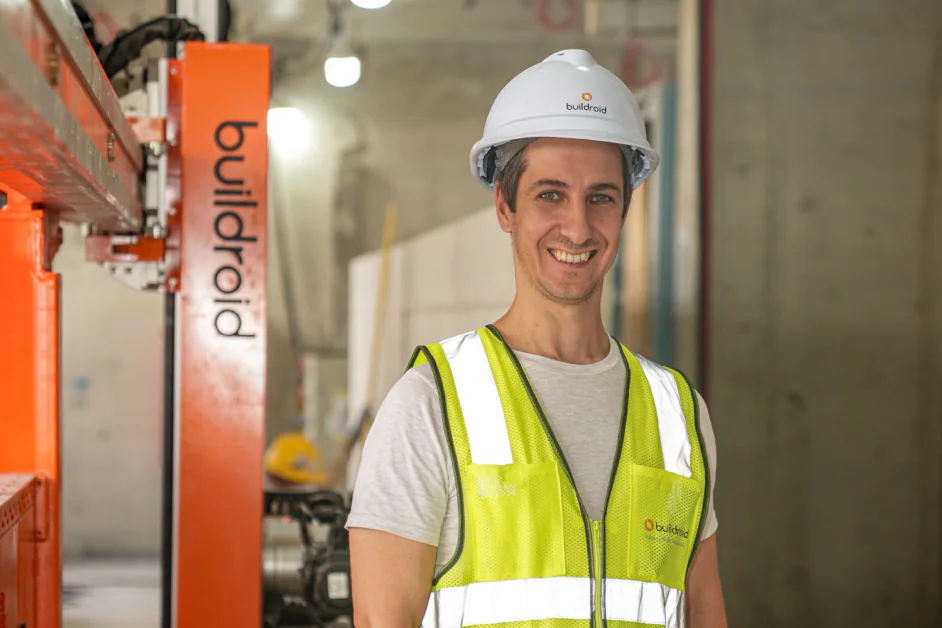
Anton Glance, co-founder and CTO at Buildroid AI, has more than 10 years of experience in AI, robotics, automation, and computer vision. Anton was overseeing the launch of 2 highly automated prefab factories at Mighty Buildings.
Together with Slava Solonitsyn, co-founder and CEO at Buildroid AI, they lead a team with over 12 years of experience in robotics, machine learning, digital architecture, and innovative construction technologies
Buildroid AI is building a simulation-first platform that links Building Information Models with AI-driven digital twins to automate construction work by coordinating multiple robots as a unified crew. The company has demonstrated a BIM-to-BUILD block-laying system and is expanding toward commercial deployments that streamline labour-intensive tasks. By validating robotic workflows in simulation before they reach the job site, Buildroid AI aims to boost productivity, reduce costs, and create a scalable foundation for automation across many construction trades.
You previously built Mighty Buildings into one of the most well-funded and visible contech startups, delivering more than 50 automated 3D-printed homes. What gaps or inefficiencies did you observe during that journey that ultimately convinced you to found Buildroid AI and pursue a robotics-driven approach to construction productivity?
At Mighty Buildings we followed an off-site prefab model, and we ran into structural market barriers. Prefab adoption in the U.S. is still under 6%, and introducing a new 3D-printing material took 3 years of compliance work across structural, fire, and acoustic standards. Because prefab absorbs full factory overhead – equipment, labor, space – combined with a non–mass-produced material, our product ended up ~20% more expensive than what the market would accept. Construction operates on extremely tight margins, so cost premiums kill adoption.
With Buildroid, we took the opposite path: no new materials, no new designs, no changes to code. We integrate directly into existing workflows and let robots handle the repetitive, labor-intensive tasks – removing industry friction instead of adding it.
How does your simulation-first model, which uses digital twins and BIM (Building Information Modeling), change how construction teams test, validate, and optimize robotic workflows before anything reaches the job site?
BIM defines what a building is; it does not describe how to build it. Even 4D-BIM only adds sequencing, not true constructability. Our BIM-to-BUILD simulation engine lets teams execute the whole construction process virtually inside a physically accurate digital twin – materials, machines, and site constraints behave like the real world.
Stakeholders can test hundreds of scenarios, validate buildability, measure productivity, and optimize workflows before touching the job site. The unique part: the simulation outputs verified, ready-to-run robot execution programs, closing the gap between digital design and automated physical construction.
Your platform supports over 40 different robot types. How do you achieve reliable coordination between such diverse hardware while maintaining flexibility for contractors?
Our AI planner sits at the core, combining HTN (Hierarchical Task Networks) for high-level sequencing and Behavior Trees for low-level task execution. Robots operate as capability-based agents – e.g., a block-laying robot “knows” it can place blocks but not apply plaster.
The planner optimizes task allocation, avoids site bottlenecks (like blocking pathways), balances workloads across multiple robots, and synchronizes supporting units such as material-handling bots. The result is a coordinated, self-adjusting robotic crew that behaves like a well-orchestrated human team.
Buildroid highlights productivity gains of up to 10x (6x) and cost savings up to 4x (3x). Which early case studies or technical benchmarks best demonstrate how those results are achieved?
Across three pilots – commercial, residential, and data-center projects – we observed:
- 6× productivity: a mason + helper typically produces 4–5 m²/day of blockwork; with a robot, output rises to ~30 m²/day.
- 3× cost efficiency: tasks requiring 12 workers to build 30 m²/day can be done with 2 workers + one robot using our platform.
These results came before deploying multi-robot workflows; once fleets are coordinated by one operator, overall project duration drops significantly.
Your first commercial application focuses on blockwork and partition-wall installation. What criteria do you use to determine which construction workflows are best suited for multi-robot automation next?
We prioritize workflows with (1) severe labor shortages, (2) repetitive manual strain, and (3) clear task decomposition for multi-robot collaboration.
In Dubai, where we launched, every partition block weighs ~30 kg (66 lb) and masonry demand far exceeds available skilled labor. One major contractor told us they would need to hire and train 6,000 masons next year just to meet workload.
Blockwork naturally decomposes into subtasks – material delivery, mortar application, alignment, reinforcement – making it ideal for specialized robots working together.
Next in our pipeline: plastering, the sequential step after blockwork, in partnership with a leading robotic vendor.
As you enter the U.S. market, what are the biggest regulatory, safety, and operational hurdles you anticipate, and how does the simulation-first approach help mitigate them?
OSHA requires robots to prove safe human-robot interaction even for pilot deployments. Certification typically takes 3+ months and is costly for startups that need rapid iteration.
We’re working with UL on a simulation-first safety approval framework. By proving that our digital twin matches real-world execution, we can validate edge cases, collision scenarios, and emergency behaviors virtually – dramatically reducing the need for lengthy lab testing and accelerating compliance timelines.
How do you see multi-robot workstreams evolving on complex construction sites once AI orchestration becomes more mature?
We expect construction sites to shift toward fully robotized crews with humans in supervisory roles. A single operator will oversee fleets of robots through our AI orchestration platform, which uses a digital twin to coordinate tasks in real time. Robots will handle production; people will handle oversight and exception management.
What breakthroughs in AI decision-making and workflow optimization are most critical for enabling reliable, autonomous job-site execution?
The next frontier is multi-agent physical AI – robots that make local decisions while cooperating as a system. This requires advancements in:
- decentralized planning and coordination
- robust perception under construction-site conditions
- adaptive task allocation as environments change
These capabilities will unlock reliable, semi-autonomous to fully autonomous operations.
As a repeat contech founder, what aspects of construction technology adoption do you think industry leaders still misunderstand, and how does Buildroid address those misconceptions?
Many startups try to change the materials, the process, or the building system itself – exactly the areas where construction is least flexible. The industry still builds today much like it did a century ago, and changing core methods takes years of regulatory, supply-chain, and cultural shift.
Buildroid avoids this friction. We increase productivity without changing materials or designs, focusing purely on how existing materials are installed.
Do you envision Buildroid becoming an ecosystem platform that third-party robots and contractors can build on, creating a unified operating layer for construction robotics nationwide?
Absolutely – that’s the long-term vision. But first we must prove end-to-end excellence in a single high-value workflow: wall construction. Once we perfect that blueprint, expanding to third-party robots and additional workflows becomes a natural ecosystem evolution.
Thank you for the great interview, readers who wish to learn more should visit Buildroid AI.



