
Brain Machine Interface
Researchers Tap AI to Help People With Neurological Conditions Power Electric Wheelchairs With Brainwaves

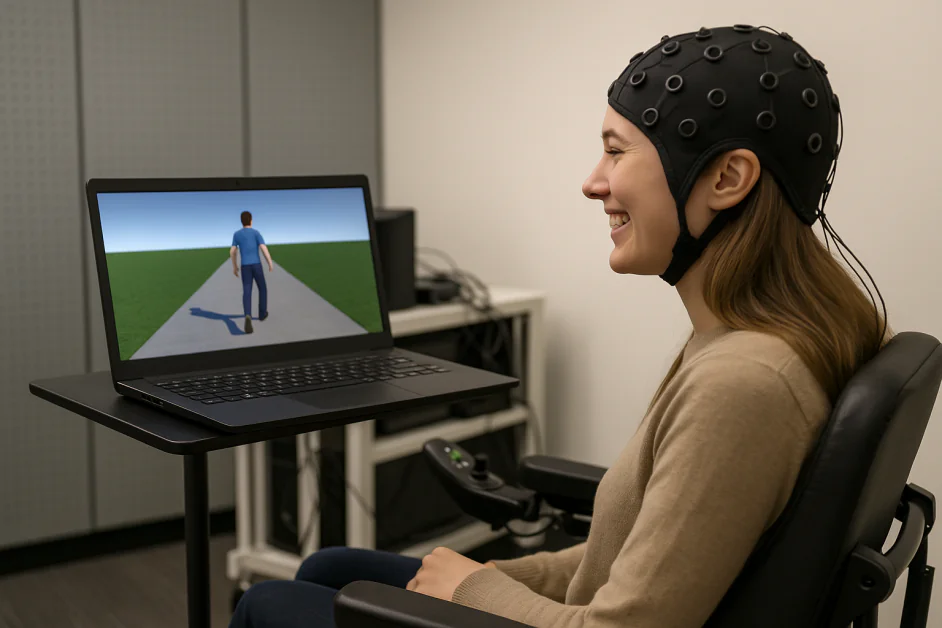
As soon as I sat down on the electric wheelchair, researchers plunked a helmet on my head with electron conductors that dug into my scalp. They made adjustments until a laptop connected to the helmet began to receive signals from my brain.
With the intent of detecting the faintest of brain waves and recognizing their patterns for prediction through artificial intelligence (AI), I was first instructed to practice imagined movement by controlling an avatar on a screen with just my thoughts, which would then be the basis for controlling the wheelchair.
It took a little practice, but eventually, the avatar moved simply by me thinking of clenching my left hand.
Even when I made a mistake – such as moving the avatar towards an obstacle rather than away from it – the researchers explained that the instruction was overridden by AI prediction and estimation technology, which by this point had recognized patterns in my brain waves that could help it accurately predict future instructions for the avatar.
Once the instrument had been trained on by brain waves, it was time to try and use my thoughts to control the electric wheelchair. I closed my eyes and concentrated on how it felt to move my left hand, which was resting, unmoving, on my leg. As I imagined making a clenched fist with my left hand, the wheelchair began to move left – my desired direction!
Despite not requiring a wheelchair in my daily life, the experience of powering the vehicle with my thoughts – assisted by AI – was inspiring given the potential it could have to improve the lives of people who suffer from severe spinal cord injuries or neurological conditions like Multiple Sclerosis, Cerebral Palsy, or Guillain Barré Syndrome.
These conditions often leave patients bedridden or dependent on nurses or family members to help move them around.
For years, scientists have strived to develop technology to help individuals affected by these conditions recover some of their mobility and bodily autonomy. In 2009, Toyota announced a wheelchair that could be controlled using Electro-encephalogram (EEG) signals; in 2023, researchers at Italy’s University of Padova developed brain-machine interface technology which allows fully-paralyzed individuals to drive electric wheelchairs using brainwaves; and other brainwave-powered wheelchair studies incorporate augmented reality, computer vision and offline calibration technology.
While innovations like these have overwhelmingly helped us come closer to bridging the mobility gap for individuals suffering from severe spinal and neurological conditions, researchers from NTT Research told me that many limitations still remain, especially when considering that brain waves are not necessarily the same across all people, nor across an individual’s life.
At its recent Upgrade 2025 conference in San Francisco, NTT Research showed off AI technology that they say can predict and complete disrupted brain wave signals, allowing for patients with even severe neurological conditions to be able to control electric wheelchairs.
“It is known that brain waves can vary due to various factors. However, our technology is designed to optimize the AI for each individual, so we believe it remains effective despite such variations,” Kengo Okitsu, a researcher who worked on the project, told me.
The brain’s electrical activity is recorded in alpha, beta, gamma, delta and theta waves, and much of their functional significance is still being debated. Beta and Mu rhythm alpha waves, ranging from 12 to 30 Hz and 8 to 10 Hz respectively, are connected to movement, suggesting planned and instructed movement.
Brain waves, however, aren’t consistent amongst the population. Individuals with cognitive impairments such as dementia and Alzheimer’s disease experience decreased brain wave activity and reactivity. Age can also hinder individuals’ ability to produce brain waves strong enough to power electric wheelchairs; and even psychiatric disorders like ADHD, schizophrenia and depression can impact EEG frequency.
Existing brainwave technology can’t practically keep up with all of these variations. Instead, the researchers are betting on AI to help complete and complement insufficient or inaccurate brain signals by recognizing brainwave patterns which will allow it to predict imagined body movement.
“Our technology will work for everyone because it is updated by AI continuously,” said Okitsu. “It focuses on collecting data for AI during actual brain-machine interface operation. So people can operate the avatar first, and then our technology updates with the help of AI.”
The researchers also pointed out that the relatively quick reaction time from converting a thought – such as clenching a fist – to an action – such as turning a wheelchair, is also aided by a photonics-based communications infrastructure called IOWN that allows for high-capacity, low latency data processing. The network uses photonic (light) rather than electrical signals for information transmission to speed up data transfer and processing.
The integration of these technologies into brainwave-controlled wheelchairs represents the leveraging of emerging technologies for the construction of more accessible mobility tools.
The project could mean a lifestyle evolution for both disabled people and their caregivers, who will both be provided with more freedom and autonomy.
