
Reports
Hack The Box Benchmark: AI-Augmented Teams Outperform Human Cybersecurity Analysts

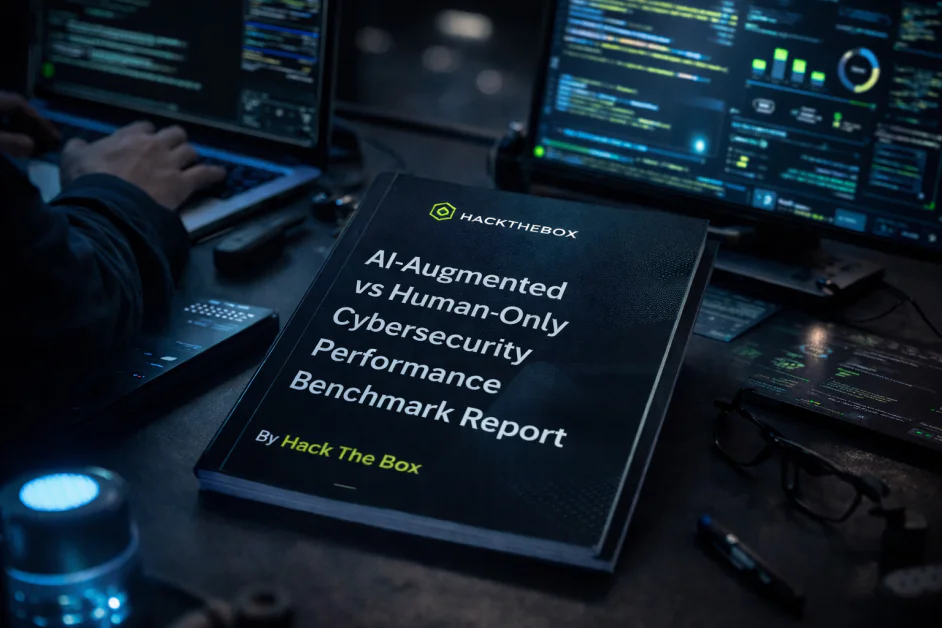
A new study from Hack The Box titled “AI-Augmented vs Human-Only Cybersecurity Performance Benchmark Report” finds that AI-augmented cybersecurity teams can significantly outperform human-only teams, with elite teams completing tasks up to 4.1 times faster. The findings are based on performance data from the NeuroGrid Capture the Flag (CTF) competition, one of the largest real-world benchmarks comparing agentic AI-assisted teams and traditional human teams performing cybersecurity tasks.
The benchmark analyzed data from the NeuroGrid Capture the Flag (CTF) competition, which included 1,337 human-only teams and 156 AI-agent teams registered, with 958 human teams and 120 AI teams actively attempting challenges across 36 cybersecurity challenges spanning nine technical domains and four difficulty levels.
The results highlight both the productivity gains of AI-augmented cybersecurity operations and the emerging workforce challenges organizations may face as automation reshapes how security teams operate.
AI-Augmented Teams Deliver Measurable Performance Gains
The benchmark demonstrates that integrating AI agents into cybersecurity workflows can dramatically increase output, particularly when paired with experienced human operators.
Key findings include:
- Up to 4.1x more output for elite AI-augmented teams compared with human-only teams
- 1.4x productivity improvement across all teams during the same time window
- 70% higher challenge solve rate for AI-augmented teams
- 27% solve rate for AI teams versus 16% for top human-only teams
- 3.2x higher overall solve-rate ratio across all participants
According to Hack The Box CEO and founder Haris Pylarinos, the results show that AI can dramatically increase operational speed but must still be paired with human oversight.
“AI can raise the bar of cybersecurity performance, but it does not eliminate the need for human expertise,” Pylarinos said. “Organizations must develop AI-fluent teams and human-in-the-loop workflows to safely unlock these benefits.”
Unlike synthetic benchmarks often used in AI evaluations, the competition used professional-grade cybersecurity challenges under real competition pressure, offering a more operationally realistic comparison between AI-assisted and human teams.
The Human-AI Hybrid Model Emerges as the Winning Strategy
While AI significantly accelerated performance, the study found that hybrid teams combining AI agents with human operators produced the strongest results overall.
In the competition:
- 73.3% of AI-augmented teams completed at least one challenge, compared with 46% of human-only teams
- AI agents often improved baseline productivity but still required human validation and strategic direction when facing complex tasks
For CISOs and security leaders, the report emphasizes that AI should be viewed primarily as a force multiplier, not a replacement for cybersecurity professionals.
AI’s Impact Varies Dramatically by Skill Level
One of the most important insights from the report is that AI affects cybersecurity practitioners differently depending on their experience level.
Early Career: The “Productivity Illusion”
For entry-level operators, AI can act as a competency bridge, helping them solve challenges they might otherwise struggle with. However, the report warns that this can create a false sense of productivity if junior analysts lack the expertise to verify AI outputs or guide agent workflows effectively.
In some cases, lower-performing AI-augmented teams were actually 12.5% slower, often getting stuck in inefficient loops when operators lacked sufficient oversight skills.
Mid-Career: The Sweet Spot for AI
The largest productivity gains occurred among mid-career analysts, particularly when tackling medium-complexity tasks.
In this category:
- AI advantage peaked at 3.89x performance improvement on medium-difficulty problems
- Mid-tier teams experienced 40–70% faster task completion compared with human-only counterparts
This suggests enterprises may see the most immediate return on AI investments by deploying agentic systems alongside mid-level analysts.
Elite Operators: Speed Advantage, Not Capability Replacement
Among top performers, the gap between AI-augmented teams and human experts narrowed significantly.
For example:
- The best human team solved all 36 challenges, while the best AI-augmented team completed 32 out of 36
- At the Top 5% performance tier, the solve-rate advantage shrank to 1.69x
However, AI still delivered a major advantage in speed, with elite AI-augmented teams solving challenges three to four times faster.
The “Difficulty Paradox” Reveals Where AI Struggles
The study also identified what researchers call a “difficulty paradox” in AI performance.
AI advantage increases with task complexity—up to a point:
- Very easy challenges: ~2.4x advantage for AI teams
- Medium challenges: 3.89x advantage, the peak performance zone
- Hard challenges: advantage drops to 2.97x, revealing limits in AI reasoning
Certain creative domains—such as coding and reverse engineering—showed near parity between elite humans and AI systems, highlighting areas where human intuition and novel reasoning remain critical.
Across domains, AI performance varied widely, ranging from 5.15x advantage in secure coding tasks to 1.68x in digital forensics.
A Potential Talent Pipeline Crisis
Beyond productivity gains, the report raises a long-term workforce concern: AI may disrupt the training pipeline that produces future cybersecurity experts.
Entry-level security tasks—traditionally used to train junior analysts—are increasingly automatable. AI teams significantly outperformed human teams on the easiest challenge tiers, suggesting that the work historically used to train new analysts may increasingly be handled by automation.
If organizations automate too much early-career work, the report warns they risk creating a “missing middle” in the talent pipeline, where fewer analysts develop the skills needed to become senior security experts.
Implications for Security Leaders
For CISOs and enterprise security leaders, the findings suggest that adopting AI tools is no longer optional.
Organizations that fail to integrate AI into their security operations may face adversaries who already leverage AI to accelerate attacks and exploit vulnerabilities faster than traditional teams can respond.
The report recommends a three-tier strategy for AI integration:
- Retrain entry-level roles to focus on AI governance and validation rather than manual tasks
- Deploy AI alongside mid-career analysts first, where productivity gains are highest
- Retain elite talent and pair them with AI copilots to accelerate incident response and advanced threat analysis
Ultimately, the report suggests that the future of cybersecurity will not be AI versus humans—but AI-augmented humans operating at machine speed.



