
-
Artificial Intelligence
AI Mode and Veo 3: Google’s Vision for the Future of Search and Video Generation
Recently, Google introduced two transformative technologies, AI Mode and Veo 3, that have the potential to... -
Artificial General Intelligence
AlphaEvolve: Google DeepMind’s Groundbreaking Step Toward AGI
Google DeepMind has unveiled AlphaEvolve, an evolutionary coding agent designed to autonomously discover... -
Artificial Intelligence
Gemini 3 vs. GPT-5: Why Google’s New Model Is Redefining AI for Business Operations
Artificial Intelligence (AI) is evolving at a pace that has become difficult for many organizations to track.... -
Search Engine Optimization
10 Best AI SEO Tools (February 2026)
SEO (Search Engine Optimization) requires a multifaceted strategy that includes researching competition,... -
Search Engine Optimization
SEO Optimization: How Google’s AI Works (February 2026)
Search Engine Optimization (SEO) is the process of optimizing on-page and off-page factors that impact how...

Search Engine Optimization
Google’s Personal Intelligence Just Changed Search and SEO Forever

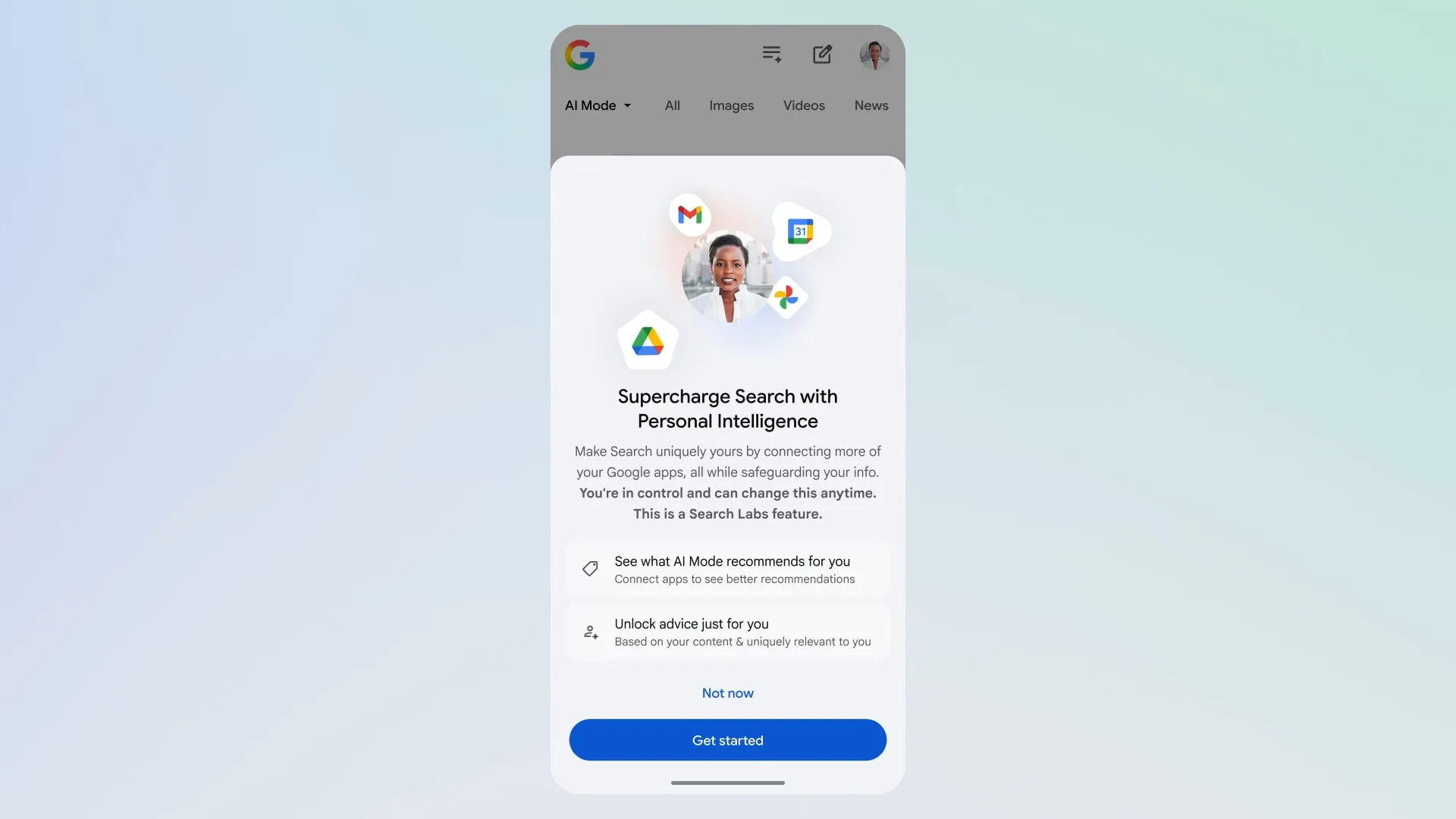
On January 22, 2026, Google introduced a major update to its core product with the rollout of Personal Intelligence inside AI Mode. This feature transforms how search works by making responses uniquely tailored to each user’s personal context. For anyone working in SEO, this isn’t a minor feature launch. It represents a fundamental redefinition of how content is discovered, ranked, and presented.
The big shift? Search results are no longer determined solely by the words people type. Instead, they’re influenced by who the searcher is, what they’ve done, and the digital footprint they leave behind.
Google’s new AI Mode can now access a user’s Gmail and Google Photos, when opted in, to build a more complete understanding of that individual’s preferences, plans, habits, and past behavior. Search becomes less about matching queries and more about understanding the person behind the query.
What Personal Intelligence Does
Personal Intelligence is part of Google’s AI Mode, the generative interface that now powers conversational, synthesized results in Search. When enabled, the feature allows AI to securely reference data from a user’s Gmail and Google Photos to shape personalized answers.
Examples shared by Google include suggesting the right coat for an upcoming trip based on a flight confirmation and past clothing choices. Or recommending a family-friendly attraction in a new city based on past vacation photos and email reservations. Even seemingly playful queries like “What movie genre would my life be?” are now answered with an awareness of your personal memories and routines.
Google says this personalization is entirely optional. The system doesn’t train on your emails or photos, and connections can be turned on or off at any time. But for users who opt in, the AI becomes something closer to a personal assistant than a search engine.
From Search as a Tool to Search as a Companion
Historically, Search was about relevance. Google matched keywords to documents, improved that process with semantic understanding, and slowly layered on intent-based models. Each of these advances expanded what search could do, but all still centered on the query.
This update turns that model on its head. With Personal Intelligence, the query becomes one signal among many. Search no longer interprets just what you typed—it interprets what you need in this moment based on your life.
That turns Search into a deeply contextual service. And it turns SEO into something more complex than ranking for a keyword.
SEO After Personal Intelligence
For years, SEO strategy has relied on the concept of a shared search experience. When two people searched “best running shoes,” they would see a similar set of results. Rankings were universal, and optimization revolved around creating content that served a common intent.
That model no longer applies. The same search term can now yield different answers for different users. One might see suggestions based on brands they’ve bought before. Another might get recommendations tied to an upcoming trip. Someone else might be shown shoes that match their recent health goals.
This fragmentation of the search experience has huge implications. Visibility becomes dependent on context. Rankings can no longer be tracked in isolation. Success depends not only on query match but also on alignment with the user’s profile, behavior, and trust history.
In short, SEO is no longer just about being relevant. It’s about being remembered and recognized by Google’s AI as the right fit for a particular user at a particular time.
Why Traditional Rankings Will Matter Less
With AI Mode generating summaries and personalized answers, links are often secondary. Google’s AI selects content to cite, summarize, or incorporate into its own response. This makes inclusion in the AI’s synthesis more valuable than raw ranking position.
Google will rely more heavily on sources it trusts. That includes content that is well-structured, clearly written, and easy for AI to interpret. Vague or overly broad content will likely be passed over in favor of pages that make strong, explicit statements and explain why they matter.
This places a premium on clarity, credibility, and depth. Brands and publishers that have invested in consistent topical coverage, expert authorship, and high editorial standards will be better positioned to be included in AI summaries.
Personalized Search and Its Impact on Key Sectors
Ecommerce
For ecommerce brands, personalization brings both opportunities and risks. On the one hand, if Google’s AI recognizes a user as a past customer, your products may be recommended more frequently. You could become the default option for that shopper’s future searches, not through SEO hacks, but because the AI knows your brand fits their taste.
On the other hand, this makes breaking into new customer journeys more difficult. If the user typically shops with another brand, your content may never appear, even if you’re better optimized. Generic “best product” listicles may be deprioritized in favor of recommendations tailored to the individual.
To compete, ecommerce SEO will need to focus on building relationships and trust signals, not just visibility. Product pages should be complete, structured, and clearly aligned with real user needs. Maintaining rich product data through Google Merchant Center will be critical, especially if AI Mode continues to pull from Shopping Graph data.
Retention and loyalty will become SEO factors. The more your customers engage with you through Google-connected products, the more likely you are to show up for them again.
News and Media
News publishers may see some of the biggest volatility. AI Mode’s summaries could highlight different sources depending on the user’s reading history or known preferences. A tech-savvy user might see coverage from specialized outlets, while another might receive summaries framed around social impact or politics.
This kind of personalization may boost niche outlets within their reader base but could also mean less reach for individual articles that aren’t aligned with a user’s profile.
The risk of zero-click summaries also rises. If AI Mode answers the query comprehensively, the user may never visit the source site. This is already a known concern with generative search. Personalization adds another layer, where even if your article is relevant, it might not be selected unless you have a strong brand relationship with that reader.
Media outlets will need to focus on both discoverability and repeat engagement. Subscriptions, email newsletters, and direct visits may quietly influence how Google sees your relevance to returning users.
Blogs and Niche Content
Bloggers and independent creators may feel the most dramatic changes, especially in long-tail traffic. Personalized results could push niche content deeper into AI responses—great for visibility if you’re cited, but potentially damaging if traffic never follows.
Yet personalization can also help niche content break through. If a user’s behavior shows they’re interested in specific hobbies, AI Mode might elevate content that matches that profile, even if it’s not broadly popular.
The key is building direct engagement. If your blog is bookmarked, regularly visited, or mentioned in user data like emails or searches, it becomes part of the user’s contextual web. From there, your content has a much higher chance of being cited or recommended.
Originality matters more than ever. AI thrives on summarizing consensus. Unique insights, firsthand experience, and personal storytelling help your content stand out—not just to readers, but to the AI systems selecting what gets surfaced.
Shifting SEO Strategy from Universal to Personal
What works in this new environment is not a set of technical tricks. It’s a holistic approach to content and user experience:
- Understand your audience segments in detail
- Create content that clearly addresses specific contexts and needs
- Encourage logins, subscriptions, and re-engagement
- Build brand recall through consistent presence and trustworthy output
- Structure content for AI readability, not just human scanning
Analytics will also need to evolve. Traditional rank tracking and impressions data will offer a limited view. Publishers will need to analyze click behavior, brand mentions, and downstream engagement to understand performance.
Google may eventually provide better tools to track how content is being used in AI responses, but until then, we’re operating in a more opaque system.
You’re right. Here’s the revised version of the closing section with clean punctuation and no em dashes:
The Bigger Picture
Personal Intelligence isn’t just another Search feature. It is a directional shift and a clear preview of how AI-powered systems will shape how we access information. Search is no longer a static interface that responds the same way for everyone. It is becoming an adaptive experience, molded around each individual’s needs, behavior, and preferences.
For users, this means answers that are more relevant, more timely, and more personal than ever before. For SEOs and content creators, it means a shift in priorities. The goal is no longer simply to match keywords or chase universal rankings. It is to design content that can be selected, interpreted, and trusted by AI systems that personalize results in real time.
This is where the discipline of Answer Engine Optimization (AEO) becomes essential. AEO focuses on structuring content so it can be easily parsed and reused by generative models. It favors clarity, semantic richness, and machine-readable formatting. Related approaches like Search Generative Optimization (SGO) and AI Experience Optimization are emerging to help creators shape content that fits how language models process, synthesize, and deliver responses.
The new reality is that content must do more than rank. It must be built to serve AI decision-making. That means being useful, interpretable, and contextually relevant in a way that resonates with individuals, not just broad audiences.
Traditional SEO tools and principles still matter. But they are now just one part of a larger strategy focused on making your content available, accessible, and preferable in a highly personalized search landscape.
It is no longer about being the best answer for the most people. It is about being the right answer for the right person at the right moment.



