Thought Leaders
From Record Keeping to Real-Time: The Digital Warehouse Brain


Walk into most warehouses today and you’ll find something strange: millions of dollars in robotics, sensors, and conveyor systems, and a piece of software in the back office that was designed before the iPhone existed.
The U.S. warehousing and storage industry has grown more than 50% over the past decade, driven by e-commerce and rising consumer expectations. Warehouses have become faster, denser, and more complex. But the systems used to run them haven’t kept up.
The Warehouse Management System, or WMS, is a customized database built around a single job: recording transactions. What came in, what went out, where it got put. That was a reasonable design when the job was data entry. But that’s not the job anymore. Today, the challenge isn’t capturing data—it’s making decisions in real time.
The gap between the screen and the floor
Traditional WMS platforms were built to record, not respond. Static dashboards create a lag between what’s happening on the floor and what a supervisor sees. SKU counts have exploded dramatically increasing operational complexity, while labor turnover in warehouses can exceed 40% annually.A few seconds lost per task can translate into millions of dollars annually for high-volume operations. Yet most facilities are still running on systems that can’t see or respond to those inefficiencies in real time.
The result: your team is making decisions with information that’s already out of date.
I use a simple test when I talk to operators: “Does your software tell you what happened, or what to do next?” Almost universally, the answer is: what happened. That’s the whole problem.
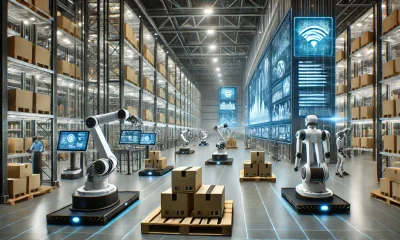
What warehouses need is something closer to air traffic control: a system that sees everything in real time, models what comes next, and surfaces decisions before they become emergencies. This is what a digital warehouse brain looks like: a system that continuously ingests signals from across the operation, understands what’s happening in context, and coordinates work in real time. Instead of waiting to be queried, an orchestration platform actively coordinates labor, inventory, equipment, and space.
The technology is ready now
A few years ago, this kind of platform would have been too expensive to operate and too unreliable to trust on a live floor. That’s changed.
Computer vision now gives an AI system real eyes on the warehouse: not just RFID pings and scan events, but actual visual understanding of what’s happening in a zone. Spatial intelligence can map traffic and congestion as they develop. Digital twins let you simulate a decision before you make it. And machine learning forecasting is mature enough that you can anticipate a staffing gap or an inbound surge before it hits.
Advances in cloud infrastructure and edge computing have also made it possible to process and act on this data in real time, at scale, and at a cost that’s finally viable for operators.
The infrastructure is there. The models are there. The only thing standing between most warehouses and this capability is the assumption that it’s still years away.
AI doesn’t replace operators, it changes what they do
Computer vision adoption in logistics has accelerated as costs have dropped significantly in the past five years – and over 70% of supply chain leaders say they are now investing in AI and automation, or will be by 2030.
The operators winning with these systems aren’t the ones who handed the vendor the keys and walked away. They’re the ones who kept operations in the loop, using AI for pattern recognition at scale and reserving judgment for people.
A system can flag that zone 4 is congested and recommend a reroute. It takes a human to notice that the congestion is there because two associates are having a visible conflict. That distinction matters.
A picker’s tasks shift dynamically based on real-time priorities and inventory levels, no floor memorization, no waiting for a supervisor to redirect. A supervisor sees exactly how long upcoming orders will take and where to rebalance labor before a bottleneck forms. The system understands the problem before it becomes one.
The interface has to change
Legacy WMS interfaces were built for database administrators: rows, columns, filters, forms. That model made sense when the job was data entry. It’s completely wrong for how a modern warehouse operates.
At the same time, the pressure on warehouses has never been higher. Same-day and next-day delivery expectations are becoming the norm, compressing fulfillment windows from days to hours. What used to be a planning problem is now a real-time execution problem. Systems that operate on delay are fundamentally incompatible with that reality.
The right interface is the warehouse itself. A live visual model of the floor, where inventory is, where workers are, where congestion is building, that updates in real time and surfaces insights without being asked. You shouldn’t have to run a query to find out what’s wrong.
Every decision an orchestration platform facilitates gets encoded. The platform learns your facility, your SKU patterns, your labor rhythms, your seasonal surges. Over time, it becomes institutional memory that compounds, available to anyone, at any time, regardless of turnover.
Instead of knowledge living in people’s heads, it becomes embedded in the system. This creates a persistent layer of operational intelligence that improves over time, rather than resetting every time a team changes.
The authority still stays with people: operators overseeing the system, intervening when the situation calls for human judgment. But the knowledge lives in the platform, available to anyone who needs it, at any time.
The transition from record-keeping systems to real-time orchestration won’t happen overnight. But the direction is clear. As complexity increases, the cost of operating without real-time intelligence will only grow.
The organizations that move first – or those that embrace visibility, orchestration, and AI-driven decision-making – will define the next standard for warehouse operations.
We’re moving from systems that record the past to systems that shape the future. And for the first time, we have the tools to build a true digital brain for the warehouse.