
Interviews
Dr. Jaime Bland, Co-Founder and CEO of Aquila Health – Interview Series

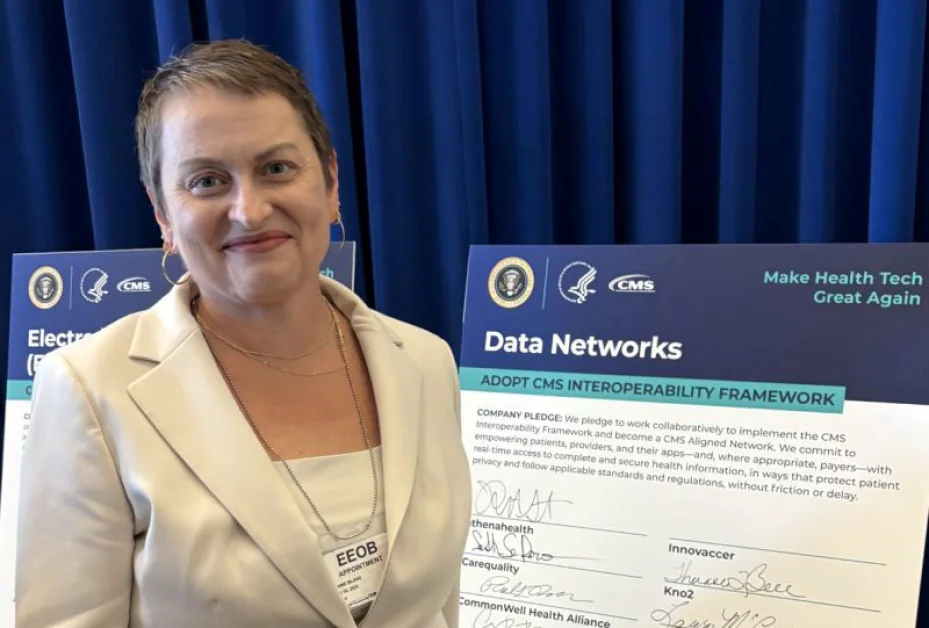
Dr. Jaime Bland, Co-Founder and CEO of Aquila Health, is a healthcare technology leader focused on addressing one of the industry’s most persistent challenges: fragmented and inaccessible data. She co-founded Aquila Health to build a unified data infrastructure that enables healthcare organizations to move beyond siloed systems, leveraging machine learning and structured analytics to generate actionable insights while maintaining clinical oversight. Her work centers on improving interoperability, enabling population-level health intelligence, and supporting earlier detection of emerging health threats through integrated clinical, claims, and genomic data systems.
Aquila Health is an AI-driven healthcare data platform designed to unify disparate data sources into a single, interoperable system that supports both operational efficiency and advanced analytics. The platform ingests high-volume healthcare data formats such as HL7 and FHIR, enabling seamless integration across hospitals, public health systems, and other stakeholders. By combining structured machine learning approaches with a human-in-the-loop validation model, Aquila focuses on delivering reliable insights for population health management, anomaly detection, and real-time decision-making, rather than relying solely on opaque AI systems. This positions the company at the intersection of data infrastructure and applied AI, where improving data quality and accessibility is foundational to unlocking the full potential of healthcare intelligence.
You led CyncHealth through massive growth, scaling interoperability across millions of patient records and multiple states, before founding Aquila Health. What key limitations or systemic failures did you encounter during that journey that ultimately pushed you to build Aquila from the ground up?
At CyncHealth, we spent years building the infrastructure to connect healthcare organizations across Nebraska and Iowa. We connected over 1,100 care sites and millions of patient records, spanning a population of over five million lives.
What we kept running into, though, was that connecting systems and actually making the data usable are two very different problems. For example, we worked to create an opioid overdose dashboard that coordinated data we received from multiple sources. It took months with hundreds of FTE hours and coordination across many stakeholders to make this single data point understandable in a public health and healthcare context. And after all of that, the picture was still incomplete.
That experience was the seed for Aquila. The legacy way of connecting interfaces without understanding the completeness and quality of the data export will not meet the need with the advancements in AI we’ve seen in recent years. When AI can accomplish in hours what used to take a team months, and do it with higher quality at a fraction of the cost, you have to use that knowledge to rebuild from a new foundation. That is what we did with Aquila, we are focusing on modern tools that decrease the cost of connecting so that we can focus on completing the whole picture of health- not just data derived from traditional EHI sources, the whole picture.
Aquila recently emerged from stealth with a platform focused on unifying fragmented healthcare data into a single, AI-ready layer. What were the core technical breakthroughs that made this possible now, versus even a few years ago?
AI capabilities have driven this shift nearly entirely.
I spent years watching skilled engineers manually reconcile data standards, one source at a time. It worked, but that model can never scale. You could not hire your way out of it fast enough to keep up with the volume and variety of data healthcare generates.
What is different now is that AI can do the normalization work continuously at the data layer as information moves through the system. It is not a batch process that runs overnight. It happens in near-real time. That changes what is possible for clinicians and public health teams, because the data they need is structured and validated (made usable) before it reaches them.
Clinicians are used to making decisions without the full patient picture. Public health is used to drive programs without recent data to back it up. Aquila is changing the landscape and providing the speed that makes effective data-driven decision-making possible across all of healthcare.
We built TREUE™ as the framework that organizes EHR-derived clinical data, laboratory, public health, claims, pharmacy, and social data into a unified structure. The AI does not replace good data governance; it makes good data governance scalable for the first time.
You’ve emphasized that the real challenge in healthcare AI isn’t the models, but the data itself. What are the most critical gaps in today’s healthcare data infrastructure that prevent AI from delivering meaningful outcomes?
The industry is talking about the AI model, but the model is not the hard part.
The hard part is that a patient can walk into three different facilities in a single day and appear as three different people in three different systems. The labs do not match the clinical notes. The payer record has a different identifier than the hospital record and public health uses an entirely different identifier. By the time you sort all of that out manually, the clinical window has closed.
Strong technical connections cannot fix records that arrive incomplete or out of sequence. AI cannot detect a pattern that is not in the data, and it cannot make a reliable recommendation from a record that is missing half the historical ore current information of what it should contain.
The gap is not processing power, it is trust in the underlying data. That is what has to be solved first, and solving it at scale is where AI can actually earn its place.
Aquila positions itself as the “data preparation layer” before AI ingestion. Can you walk us through what that layer actually does in practice, especially when dealing with highly heterogeneous inputs like clinical records, claims data, and real-time feeds?
Using the example from earlier, consider what arrives when a patient encounter generates data. You get an HL7 message from the hospital, a claims record from the insurer, a lab result from a reference lab using a different identifier, and a public health report filed on an entirely different timeline. None of these were designed to be reconciled with each other.
Our preparation layer, TREUE™, is what sits between those inputs and any downstream analytics or AI application. Its job is to evaluate each record as it arrives, match identities across sources, normalize formats, and flags what is missing or inconsistent before the data moves further.
In practice, this means a clinician looking at a patient is working from a record that has been validated and aligned across sources, rather than manually reconciling four different system views during a care encounter. For public health teams, it means outbreak signals are not delayed by data that arrived in different formats from different jurisdictions.
It is infrastructure work. It is not glamorous, but nothing downstream works without it.
Interoperability standards like Fast Healthcare Interoperability Resources (FHIR) and United States Core Data for Interoperability (USCDI) have been around for years, yet fragmentation persists. What’s still missing from a standards perspective, and how is Aquila addressing those gaps differently?
FHIR and USCDI gave the industry a shared language for exchanging data. That was important progress. But a shared language for sending data is not the same thing as data that behaves consistently once it arrives.
Here is the gap: healthcare data does not come from one domain. Clinical systems, public health registries, labs, and social data sources each have their own governance requirements, timelines, and definitions of what a field means. FHIR does not tell you how to reconcile a social determinants dataest with a clinical record from a different jurisdiction.
What TREUE™ adds is a unified framework for how data from all those domains can be organized and validated together, while still respecting the governance rules that apply to each source. The result is data you can actually analyze across domains, not just data that has been successfully transmitted.
Aquila operates in high-consequence environments where failure isn’t an option. How do you design AI systems that balance real-time performance with strict requirements around governance, auditability, and trust?
You have to build governance into the architecture before you write the first line of application code. It should not be a layer you add afterward.
In healthcare and government environments, the decisions being informed by this data affect patient care, outbreak response, and how public resources get allocated. Every action taken on the data has to be traceable, and access has to be tightly controlled. The system has to meet the compliance requirements of the environments it operates in.
For Aquila, that means operating within government-grade cloud infrastructure, zero-trust access controls, and security practices aligned with HIPAA and federal standards. We have active contracts underway with state government, federal agencies, and healthcare organizations, and those environments have very different compliance requirements that the platform has to meet simultaneously.
The human-in-the-loop component is just as important. AI can surface signals, but clinical experts validate anomalies before they inform operational decisions. The technology makes finding those signals faster. It does not replace the judgment of the people who have to act on them.
Your platform supports secure, on-device AI deployment and data sovereignty. How important is decentralization becoming in healthcare AI, especially given rising concerns around data privacy and regulatory compliance?
It is becoming essential, and I think the industry is only beginning to reckon with why.
Healthcare organizations operate under strict privacy obligations. Sensitive patient data cannot simply be centralized and processed in a shared environment. Different states have different rules. Federal agencies have different rules. International health data has yet another set of constraints. Any architecture that requires moving sensitive data to a central location is going to run into those walls repeatedly.
The direction that actually works is generating insights closer to where the data already lives. Organizations can contribute to shared analysis without giving up control over their underlying data. That is what federated models allow.
Our platform is built to operate in that kind of regulated, decentralized environment – governance that travels with the data rather than being applied at a single point. It is a harder architecture to build, but it is the one that is actually compatible with how healthcare data governance works in practice.
Many AI startups lean heavily into black-box models, yet Aquila incorporates human-in-the-loop validation. Where do you see the line between automation and human oversight in clinical AI systems?
I started my career as a staff nurse. That experience shapes how I think about where AI belongs in a clinical setting, and where it does not.
AI is very good at finding patterns in large datasets. It is not good at knowing what a pattern means for a specific patient with a specific history in a specific community context. That is still a human judgment call.
The right role for AI in clinical systems is to surface signals that a human might miss at volume, not to replace the clinical reasoning that follows. At Aquila, anomalies and insights flagged by the system go to clinicians and domain experts for review before they drive operational decisions. The technology tells you where to look, and the professional tells you what it means.
Where I think the line belongs: automate the detection, keep the interpretation with people who are accountable for the outcome.
Aquila is working across public health, government systems, and regulated industries. How do the requirements for AI infrastructure differ between these environments compared to traditional enterprise AI deployments?
In a typical enterprise AI deployment, you are usually working within one organization’s data environment, one set of governance rules, one compliance framework.
Public health and government environments are structurally different. You are coordinating across multiple jurisdictions, multiple agencies, multiple clinical settings, each operating on different reporting timelines and under different legal frameworks. A hospital in one state, a public health agency in another, a federal program with its own data requirements. All of those need to exchange data and generate insights without any single entity having uncontrolled access to another’s records.
The infrastructure has to support high-volume processing while maintaining strict auditability across all of those boundaries. It has to integrate with legacy healthcare messaging formats, because those systems are not going away. And it has to operate reliably in environments where downtime is not just a business problem, it is a patient safety problem.
That complexity is why we started Aquila with those environments rather than the traditional enterprise market. If you can build infrastructure that works here, it works everywhere.
AI capabilities continue to advance faster than governance frameworks. What responsibilities do founders and platform builders have to ensure these systems are deployed ethically and safely from day one?
I think the responsibility is straightforward, even if meeting it is not. If you are building AI that affects clinical decisions or public health outcomes, you do not get to treat governance as a product roadmap item you will get to eventually. It has to be designed from the start.
What that means practically is every action on the data has to be auditable. The models have to be interpretable enough that a clinician can understand why a signal was flagged. Clinical experts have to be part of the review process, not an afterthought. And the organization has to be honest about what the system can and cannot reliably do.
I have spent my career in environments where data failures have real consequences for real people. That shapes how I think about this. The capabilities are advancing fast, and the accountability for how they are deployed cannot be allowed to lag behind. Founders who build these systems have to hold that standard for themselves, not wait for regulation to impose it.
Thank you for the insightful discussion. Readers interested in exploring the platform and its approach to healthcare data infrastructure can learn more by visiting Aquila Health.



