AI Fundamentals
What Is DevSecOps? Principles, Workflow, and Best Practices

 Add Unite.AI to your preferred sources on Google
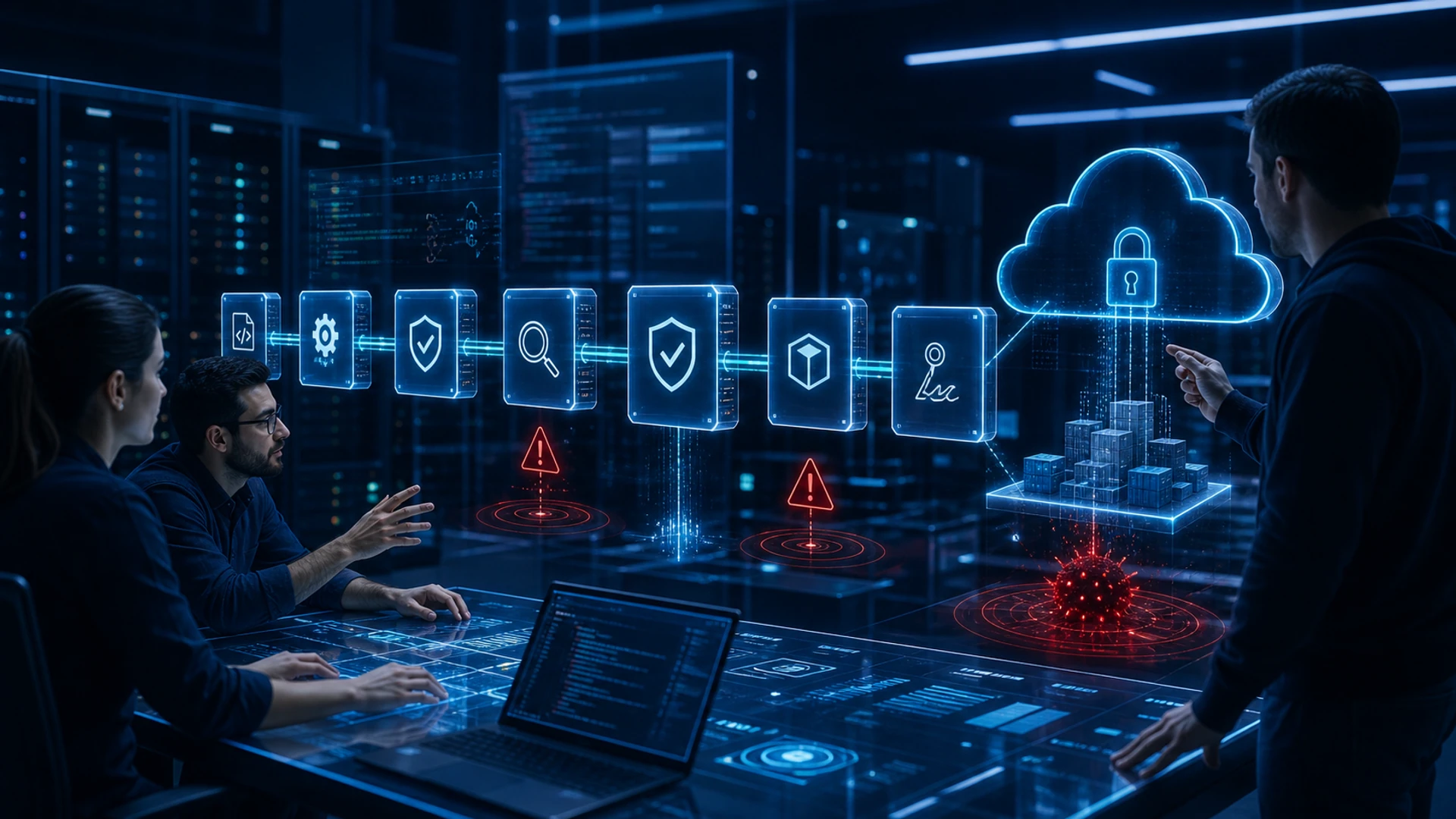
DevSecOps integrates security practices into software planning, development, delivery, and operations. The aim is not to add a final security gate to DevOps; it is to make secure defaults, rapid feedback, evidence, and shared responsibility part of the delivery system.
Tools are only one layer. Effective DevSecOps also needs threat-informed requirements, trained teams, a maintained software inventory, protected build infrastructure, risk-based review, vulnerability response, and metrics tied to real outcomes.
Key takeaways
- Define security requirements and threat assumptions before implementation.
- Give developers fast, actionable feedback in the tools they already use.
- Protect source, dependencies, builds, artifacts, credentials, and deployment identities as one supply chain.
- Use automation to enforce policy consistently, with expert review for context-dependent risk.
Shift left and operate right
Early design reviews, threat modeling, secure coding standards, and tests reduce expensive rework. This is commonly called shifting left. Operating right complements it with production configuration, telemetry, runtime protection, incident response, and learning from real failures.
Security work should be proportional to risk. An internet-facing authentication service needs different controls from an internal static page. Cybersecurity specialists help teams interpret findings instead of turning every scanner warning into an equal-priority task.
A secure delivery pipeline
A typical pipeline checks source changes, secrets, dependencies, infrastructure code, containers, and application behavior. Builds should be reproducible where practical, artifacts signed, provenance recorded, and deployment environments separated through scoped identities.
Automated gates need documented exceptions and expiry. Blocking on noisy rules drives workarounds; ignoring findings creates hidden debt. Calibrate policies against exploitability, exposure, asset value, and available mitigations.
Software supply-chain controls
Maintain an inventory of direct and transitive components, monitor advisories, verify sources, pin critical dependencies, and generate a software bill of materials when it supports customer or response needs. Protect the build service because it can change every downstream artifact.
Third-party code does not transfer accountability. Teams need a process to assess, update, isolate, or replace dependencies. IT operations and development should share ownership for supported versions and emergency patches.
People, evidence, and improvement
Security champions can connect central expertise with product context, but they need time and authority. Training should use the organization’s actual stack and incident history. Executives must fund remediation rather than measure teams only by release speed.
Track lead time for critical fixes, recurrence, escaped vulnerabilities, coverage of high-risk components, exception age, build integrity, and incident impact. Scanner counts alone reward activity, not safer software.
Threat modeling and secure design
Threat modeling identifies assets, trust boundaries, attacker goals, misuse cases, and mitigations before code is complete. Data-flow diagrams show where user input, credentials, third-party services, build systems, and production data cross boundaries. The output should become backlog items and tests, not a document that is filed away.
Secure design includes strong identity, least privilege, safe defaults, input and output validation, encryption, isolation, rate limits, and recoverable failure. Eliminate classes of defects through frameworks and platform primitives rather than asking every developer to remember the same low-level rule.
For AI-enabled software, include prompt injection, untrusted model output, data poisoning, model and dataset provenance, insecure tool use, sensitive information disclosure, and excessive autonomy. The model is one dependency inside a larger attack surface; application authorization must remain authoritative.
Pipeline controls and evidence
Protect source repositories with reviewed changes, branch controls, signed commits where appropriate, and monitored administrator access. Build workers should be ephemeral or hardened, isolated from production credentials, and able to fetch only approved dependencies. Separate the authority to change source from the authority to deploy.
Static analysis inspects code without executing it; dynamic testing observes a running application; software-composition analysis tracks dependencies; infrastructure and container scanners inspect deployment artifacts. Findings should include location, rule, severity, confidence, ownership, and a remediation path. Suppressions need justification and expiration.
Artifact provenance records how, where, and from which inputs software was built. Signatures and attestations help a deployment policy verify expected origin. They do not prove that the code is safe, so provenance complements testing, review, and runtime controls.
Vulnerability and incident response
A vulnerability-response process must receive disclosures, triage exposure, identify affected versions, create and test fixes, coordinate release, and communicate with customers. An SBOM can accelerate scoping but only if component identities and deployed versions are accurate.
Production security signals should connect to service ownership and incident automation. Preserve evidence, rotate compromised credentials, patch or mitigate, validate recovery, and look for related weaknesses. Post-incident actions should change designs, tests, defaults, and training instead of merely blaming the person who introduced the final defect.
Executives need risk and outcome metrics: critical exposure time, recurrence, percentage of protected builds, dependency support status, remediation reliability, and customer impact. Targets that reward zero reported vulnerabilities create concealment; a healthy program finds, fixes, and learns quickly.
Worked example: securing a containerized service delivery path
A developer starts from an approved repository template with branch protection, dependency policy, secret scanning, and a minimal base image. Pull requests run tests, static analysis, infrastructure checks, and software-composition analysis. The build occurs in an isolated runner, produces an immutable artifact, signs it, generates an SBOM and provenance attestation, and pushes only to a controlled registry. Secrets are injected at runtime, not copied into code, images, or CI logs.
Admission policy verifies signature, provenance, allowed registry, vulnerability exceptions, least-privilege settings, and environment constraints before deployment. Runtime controls restrict network and filesystem access, while observability links changes to service behavior. A critical vulnerability triggers triage based on reachability, exploitability, exposure, and compensating controls—not automatic production disruption from a scanner score alone. Emergency changes use time-limited approval and are reviewed afterward.
Measure remediation time, vulnerable exposure, secret incidents, policy bypasses, dependency freshness, signed artifact coverage, and developer wait time. Test the pipeline against a compromised dependency, stolen credential, tampered artifact, and unavailable scanner. DevSecOps succeeds when secure delivery is repeatable and fast enough to use; a collection of blocking tools without ownership, threat modeling, and feedback merely shifts risk into exceptions and shadow workflows.
Release governance should define who can approve risk exceptions, what evidence is required, how long an exception lasts, and how it is revoked. Keep development, build, and production identities separate, rotate signing material, and audit privileged pipeline changes. Back up critical configuration and verify recovery of the delivery system itself. A compromised CI/CD control plane can distribute trusted malicious artifacts faster than a conventional server intrusion, so it belongs inside the threat model and incident plan.
Practical implementation checklist
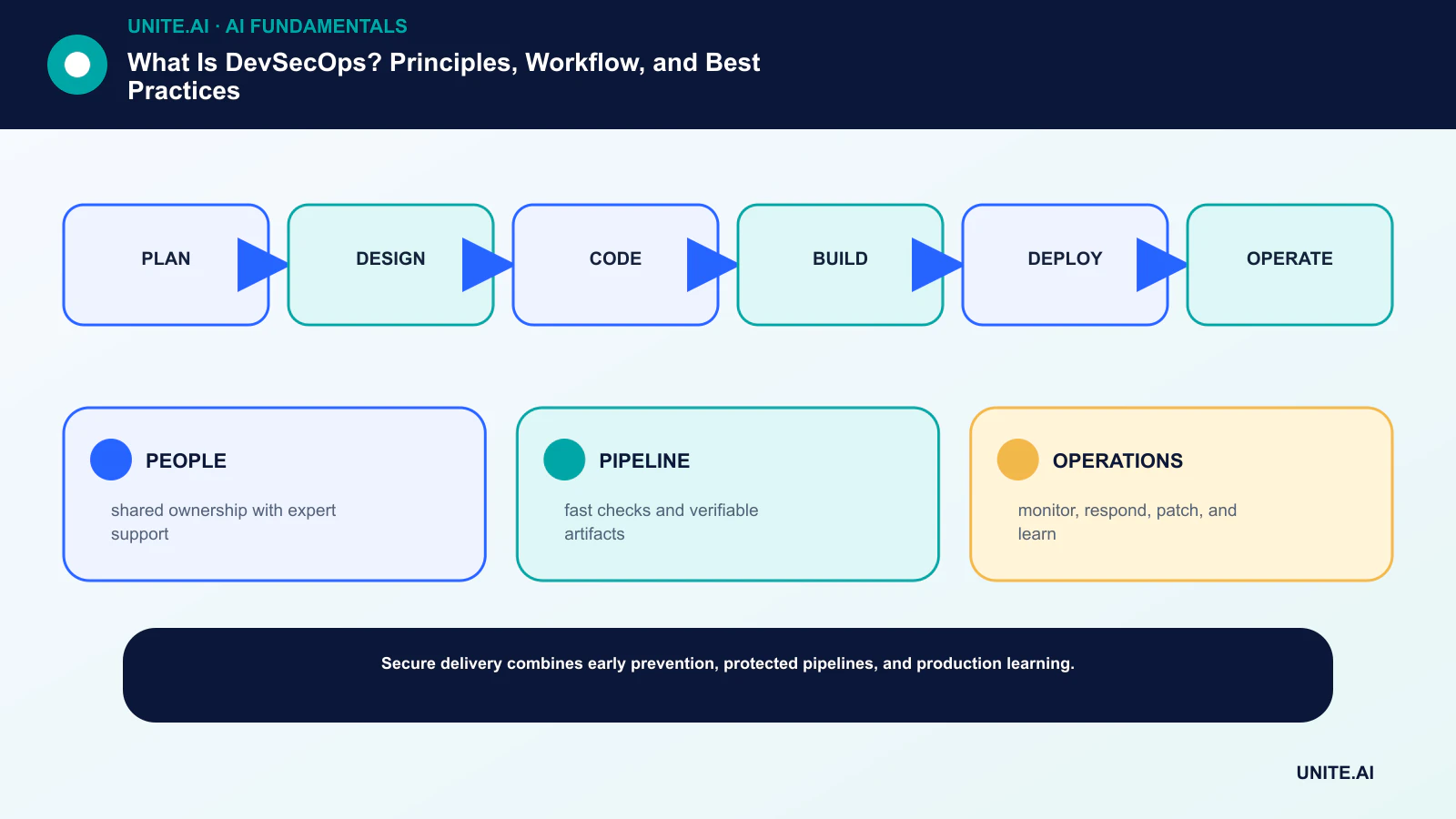
Turn the concept into a bounded, testable workflow: plan → design → code → build → deploy → operate. Name an accountable owner, document the data and dependencies, establish a simple baseline, set acceptance and stop criteria, test representative failures, and define monitoring, rollback, and review before expanding scope. Record versions and assumptions so another team can reproduce the result and understand what changed.
Before launch, run a documented readiness review with the people who build, operate, secure, and are affected by the system. Test normal cases, boundary conditions, dependency failures, and misuse; preserve the evidence and unresolved risks. Define who can approve release, change a threshold, override an output, or stop operation. Revisit the decision after real-world data arrives, because a technically successful pilot does not guarantee reliable performance at broader scale.
- PEOPLE: shared ownership with expert support.
- PIPELINE: fast checks and verifiable artifacts.
- OPERATIONS: monitor, respond, patch, and learn.
Frequently asked questions
Is DevSecOps a product or toolchain?
No. Tools support it, but DevSecOps is an operating approach that joins people, process, technology, evidence, and accountability across the software lifecycle.
Does shifting security left replace runtime security?
No. Design and build controls prevent many issues; production monitoring, response, patching, and recovery remain essential.
Primary references