
Tools
ChatGPT Just Became a Creative Suite

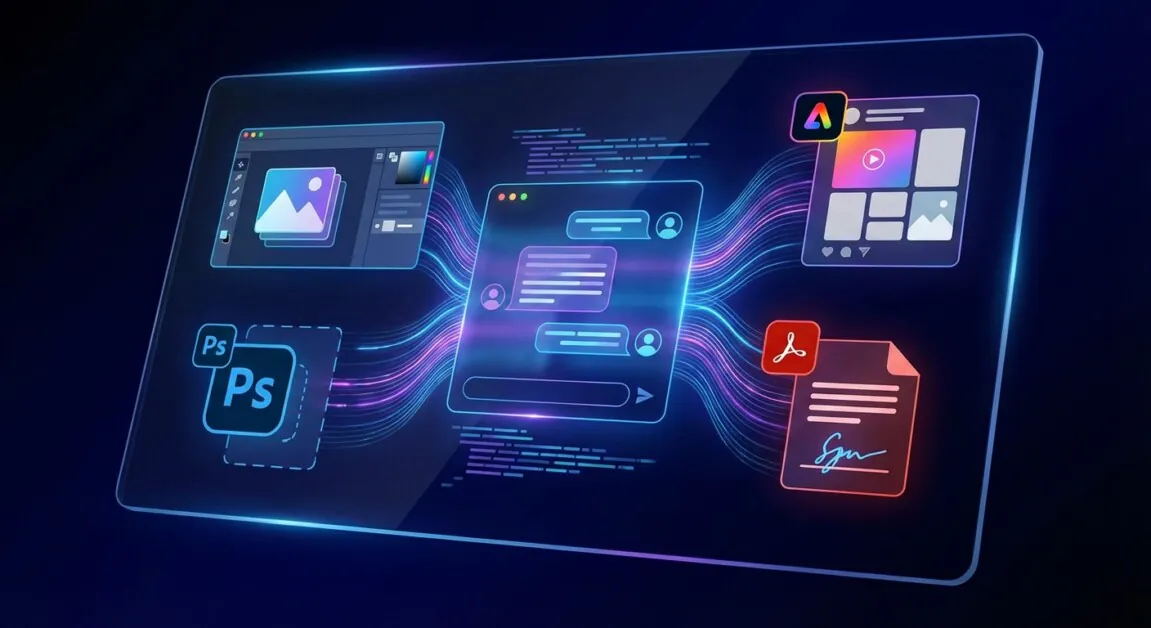
Adobe’s integration of Photoshop, Express, and Acrobat into ChatGPT marks a turning point for how we think about AI assistants. The partnership, announced December 10, transforms ChatGPT from a text-based tool into something closer to an operating system for creative work.
For ChatGPT’s 800 million weekly users, the integration means professional image editing, document manipulation, and design creation are now a prompt away. No subscriptions to Adobe’s Creative Cloud. No learning curve for complex software. Just describe what you want, and industry-standard tools execute your vision.
What This Actually Does
The technical implementation is more sophisticated than a simple plugin. Adobe built these integrations using the Model Context Protocol (MCP), the same standard that Google, Microsoft, and other major platforms have adopted for connecting AI systems to external tools.
Photoshop inside ChatGPT handles real image editing—not the AI-generated approximations that have proliferated across consumer tools. Users can adjust exposure, apply professional effects like motion blur and halftone, and edit specific parts of an image while preserving quality. The sliders and adjustments are the same ones professional photographers use.
Express brings Adobe’s template library to natural language requests. Ask for a birthday card, event poster, or social media graphic, and the system generates options from professional designs that users can customize through conversation. Acrobat enables PDF editing, merging, text extraction, and format conversion—tasks that typically require paid software or clunky workarounds.
The integration is free for all ChatGPT users globally, available on desktop, web, and iOS.

Image: Adobe
The Strategic Calculation
Adobe’s decision to give away capabilities that power its subscription business deserves scrutiny. The company isn’t being generous—it’s making a calculated bet about where creative work is heading.
The logic works like this: most people who edit a photo once a month or convert a PDF occasionally will never pay $55 monthly for Creative Cloud. By meeting these users inside ChatGPT, Adobe captures a market segment it could never monetize directly. Some percentage of those users will eventually need more than ChatGPT can offer, at which point they’ve already learned Adobe’s tools.
For OpenAI, the value proposition is equally clear. ChatGPT has dominated text-based AI, but competitors have been chipping away at adjacent categories. Canva built a massive user base for design. Various startups have specialized in document handling. Adobe integration lets ChatGPT compete across all these verticals simultaneously.
The partnership also positions ChatGPT more directly against Google’s Gemini, which has tight integration with Google Workspace but lacks Adobe’s creative tools. After the Atlas browser launched in October, this Adobe deal accelerates OpenAI’s evolution from chatbot company to platform provider.
What Changes for Creative Professionals
The immediate impact falls hardest on the cottage industry of simple creative services. Quick photo touch-ups, basic PDF manipulation, social media graphic creation—these tasks that might have gone to freelancers or junior designers can now be handled conversationally.
But the more interesting question is what happens to the definition of “creative professional” itself. When anyone can execute a design concept through conversation with an AI, the value shifts entirely to having the concept in the first place. Technical execution becomes table stakes.
This doesn’t eliminate the need for professional designers—complex projects still require expertise that conversation alone can’t replace. But it does change what “entry-level” creative work looks like. The floor rises, and everyone operating at that floor becomes interchangeable with a prompt.
AI graphic design tools have been proliferating for years, but Adobe’s presence inside the world’s most popular AI assistant brings this shift to a different scale. When 800 million people can access professional editing tools through conversation, the market for basic creative services contracts significantly.

Image: Adobe
The Broader Pattern
Adobe isn’t the first major software company to integrate with ChatGPT. Following October’s announcement of partnerships with Spotify, Canva, Figma, Expedia, and others, OpenAI has been steadily transforming ChatGPT into a universal interface layer that sits on top of specialized services.
The pattern suggests where this is heading. If you can edit photos, create documents, book travel, and manage files through a single conversational interface, the individual applications behind those capabilities become invisible infrastructure. Users don’t need to know they’re using Photoshop any more than they need to know which server farm processed their query.
This is good for users, at least in the short term. It’s excellent for OpenAI, which becomes increasingly difficult to displace as more of daily digital life routes through ChatGPT. It’s potentially dangerous for software companies that become commoditized backends to someone else’s interface.
Adobe is betting it’s better to be an early partner shaping how this works than a holdout eventually forced to integrate on worse terms. Given the leverage OpenAI has built with 800 million weekly users, that’s probably the right calculation.
What Comes Next
The Adobe integration is free, but it won’t stay that way for every capability. OpenAI has been experimenting with consumption-based pricing and AI presentation tools suggest a model where basic features remain free while advanced capabilities require premium tiers.
Expect this pattern to accelerate. As more services integrate with ChatGPT, the platform becomes more valuable, which attracts more integrations—a flywheel effect that’s difficult to disrupt once it reaches critical mass.
For users, the near-term benefits are clear: professional creative tools accessible through conversation, no learning curve, no additional cost. The longer-term question is whether concentrating so much capability in a single interface creates dependencies that eventually prove costly.
For now, ChatGPT users can blur backgrounds, create birthday cards, and merge PDFs by asking nicely. That alone represents a meaningful change in what AI assistants can do—and what we should expect them to do going forward.



