Thought Leaders
AI’s Increasingly Important Role in Weather Modeling

 Add Unite.AI to your preferred sources on Google

When Hurricane Melissa spun up unexpectedly in the Atlantic earlier this month, traditional forecasting models were caught off guard by its rapid intensification. Yet weather models using artificial intelligence had already detected subtle atmospheric cues, such as small pressure anomalies and sea-surface temperature patterns, that hinted at the storm’s explosive potential nearly a full day earlier.
For decades, meteorologists have relied on numerical weather prediction models, powerful physics-based systems that simulate temperature, pressure, and wind to anticipate how the atmosphere will behave. These models, though sophisticated, are also slow and resource-intensive, requiring vast data inputs and supercomputing power to produce a single forecast.
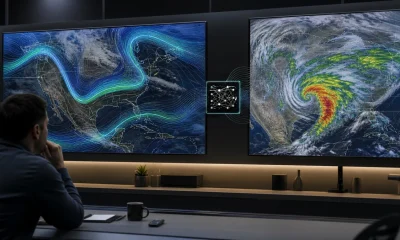
Now, AI is changing that approach. Machine learning systems are transforming how meteorologists model, predict, and communicate risks, delivering forecasts in minutes instead of hours and revealing patterns that even advanced equations can miss.
From Equations to Algorithms
AI is reshaping the forecasting landscape by augmenting traditional models. Instead of solving equations for every swirl of air or shift in pressure, machine learning models learn directly from decades of atmospheric data, recognizing patterns that correspond to real-world weather outcomes.
This shift offers three main advantages:
- Speed: AI models generate forecasts in minutes instead of hours.
- Cost-efficiency: Cloud-based systems reduce dependency on expensive hardware.
- Accuracy: Especially for short-term or localized events like thunderstorms and heat waves.
AI can also discover relationships in data that humans or physics-based equations may not fully see. Subtle correlations buried in terabytes of weather data can reveal early indicators of storm formation, heat anomalies, or pressure changes that defy linear modeling. These insights, surfaced by deep learning, are expanding the limits of meteorological understanding.
The rise of AI in weather forecasting couldn’t have come at a more critical time. Over the past five years, the United Sates has averaged 23 $1 billion weather disasters annually, more than double the average of the previous 25 years.
These events have caused major economic losses and human casualties, prompting governments and industries to accelerate investment in more accurate, data-driven forecasting tools. According to Market.US, the Global AI-Based Weather Modelling Market will experience robust year-over-year growth of 22%, reaching an overall increase of nearly 500% by 2034.
As a result, weather volatility has evolved from a background concern into a strategic business risk. Across sectors, including aviation, utilities, energy, logistics, and live events, organizations increasingly recognize that weather directly affects their bottom line, driving a need for faster, smarter, and more informed operational decisions.
The AI Advantage on Weather Models
Organizations are turning to AI-based weather models for several reasons. First, the models generate forecasts considerably faster, enabling timely responses to rapidly evolving weather conditions. This can be critical in situations where real-time updates make strategic sense. Logistics operators, for example, can reroute shipments ahead of storms, reducing delays and costs.
Second, they improve forecast accuracy, especially for short-term and localized events like thunderstorms or urban heat islands. Machine learning models have been shown to identify early signs of atmospheric instability up to 48 hours earlier than traditional systems, helping communities evacuate quicker in emergency situations.
AI models can operate with lower computational costs when deployed on cloud platforms, making advanced forecasting accessible to smaller institutions and developing countries. The European Centre for Medium-Range Weather Forecasts estimates AI models reduce energy use by 1,000 times for making a forecast.
AI can model conditions that trigger extreme weather events and use probability forecasting to predict a range of possible outcomes. By analyzing vast datasets and identifying patterns, AI improves the speed and precision of forecasts for rapid-onset events like flash floods, hurricanes, and severe storms.
In recent years, AI-based models such as Google DeepMind’s GraphCast and Nvidia’s FourCastNet have transformed weather prediction with their ability to learn from large amounts of weather data and produce highly accurate predictions of future weather. FourCastNet’s new model claims to deliver forecasting accuracy that surpasses leading conventional ensemble models and rivals the best diffusion-based methods, while producing forecasts 8 to 60 times faster than these approaches.
Real World Impact
Precise AI-driven weather forecasting is already reshaping industries.
Farmers receive hyper-local weather data to optimize irrigation, planting schedules, and harvest timing. Weather conditions also dictate the arrival and impacts of pest cycles. AI models can combine forecasts for humidity, temperature and rainfall with biological models to prepare tactics that will kick in during the precise windows when pests inflict the most damage.
The energy sector uses AI models to predict wind and solar output with greater accuracy, helping grid operators balance supply and demand and avoid blackouts. According to DTN analysis,
integrating AI weather models with utility infrastructure data can halve outage durations and enable utilities to deploy repair crews with greater precision during severe weather.
Refinery operators can anticipate temperature drops hours in advance to adjust supply chains and reduce downtime. AI models also can predict weather-related grid stress before it happens, giving energy managers a chance to perform preemptive maintenance ahead of time.
Supply chains are extremely sensitive to weather risk. AI-driven weather forecasts can feed into logistics platforms to help managers anticipate and avoid bad weather zones and dynamically reroute shipments. Weather data gives logistics companies the ability to examine very specific scenarios. They can create contingency plans and pivot quickly to make decisions that improve their bottom lines and, in some cases, even save their operations.
Building the Next Generation of Forecasting Engines
The convergence of AI, GPU acceleration, and cloud scalability marks a pivotal turning point in meteorology, sparking new collaborations built on each participants’ strengths. I expect in the next decade we will see another technological leap in forecasting with quantum computing and physics-informed neural networks. PINNs is a hybrid approach that combines the efficiency and pattern-recognition capabilities of deep learning with traditional physics-based models, PINNs are already used for specific applications, but full operational deployment holds transformational capabilities.
Future advances will also extend beyond the data center. Edge-deployed AI models embedded in drones, sensors, and satellites will deliver instant, localized analyses directly from the field.
Multimodal forecasting systems will merge radar data, satellite imagery, and textual information to build a more comprehensive and adaptive view of Earth’s climate. These innovations will elevate decision-making from reactive to proactive, marking a true shift from forecast to foresight.
As AI-informed forecasting matures, it will become a strategic advantage, empowering businesses, communities, and emergency managers not only to withstand extreme weather but to become more weather resilient.