
Thought Leaders
AI Infrastructure Is Broken. Tokens Are Becoming the New Measure of Value.

 Add Unite.AI to your preferred sources on Google
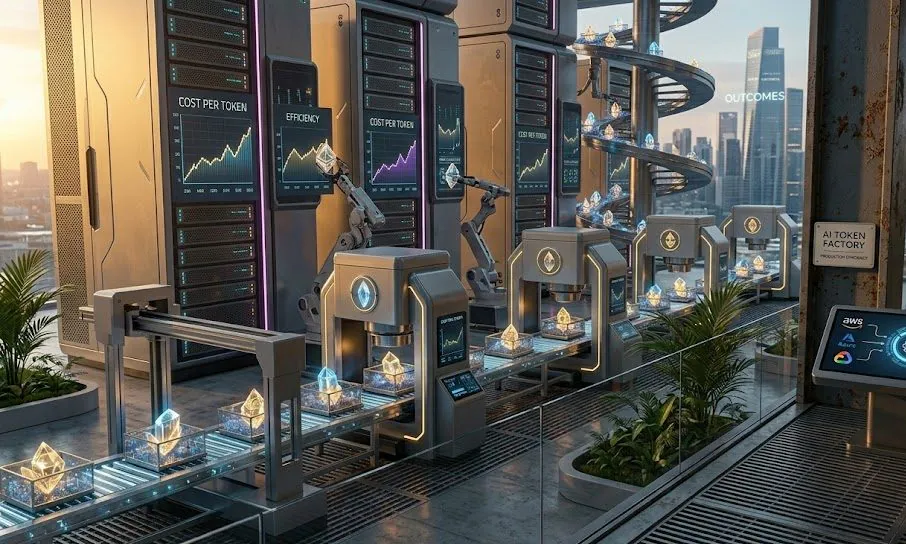
The AI industry has a measurement problem.
For years, success has been defined by access to compute, such as who has the most GPUs, the largest clusters, or the fastest training runs. Billions have been poured into infrastructure to win this race.
But as AI moves from experimentation to production, that model is starting to break.
Enterprises aren’t buying GPUs. They’re not even buying inference capacity. They’re buying outcomes like summaries, recommendations, decisions, content. In other words, they’re buying tokens.
Yet most AI infrastructure is still designed as if compute is the end goal. It isn’t.
The real unit of value in AI is the token. And the companies that recognize this shift early will define the next era of the market.
The rise of the AI token factory
If tokens are the product, then AI infrastructure needs to behave like a production system, not a science project. That’s where the concept of the AI token factory comes in.
An AI token factory is not simply another software layer in the stack. It’s a rethinking of the stack itself. Instead of optimizing for isolated model performance or raw hardware utilization, it focuses on one outcome: efficient token production at scale.
That means abstracting infrastructure complexity, allocating workloads dynamically across heterogeneous environments, and optimizing continuously for throughput, latency, utilization, and cost per token.
Today’s model is essentially GPU rental with extra steps. Organizations provision expensive hardware, stitch together fragmented tooling, and hope utilization eventually justifies the investment.
A token factory flips that equation entirely. It delivers outputs, not infrastructure, and treats efficiency as the core design principle from day one. This isn’t incremental progress. It’s a shift from infrastructure as capacity to infrastructure as production.
Why the old model can’t hold
The current AI infrastructure model isn’t just inefficient. It’s increasingly unsustainable.
GPU scarcity exposed the first cracks. Demand continues to outpace supply, forcing organizations into fragmented, multi-vendor deployments. What started as a temporary workaround has quickly become the norm: heterogeneous environments stitched together without a unifying operational layer.
The problem is that most existing stacks were never built for this reality. They don’t optimize effectively across architectures, adapt in real time, or provide clear visibility into performance and cost.
As a result, complexity compounds faster than scale.
Every new model, framework, accelerator, or cloud platform introduces another layer of operational overhead. Teams spend enormous amounts of time managing orchestration, compatibility, routing, scheduling, and observability issues instead of improving outcomes.
What should be a scaling advantage quickly becomes a coordination problem.
At the same time, the economics are becoming harder to ignore. Early AI deployments could mask inefficiencies behind growth and experimentation. That window is closing.
Executives are now asking more difficult questions: Why are inference costs so unpredictable? Why is GPU utilization still so low? Why are organizations paying premium prices for hardware that often sits idle? Why is it so difficult to tie infrastructure spend to business outcomes?
The answer is simple: The system was designed for access, not efficiency.
From compute-centric to token-centric architecture
The shift to token factories is both philosophical and architectural.
First, the market is moving from GPU-as-a-service to outcome-as-a-service. Customers don’t want to manage infrastructure; they want guaranteed results. The logical end state is consumption based on outputs, not resources.
Second, fragmented stacks are giving way to unified control planes. In a heterogeneous environment, visibility and control are everything. Token factories provide real-time insight into usage, cost, and performance, and the ability to act on it. Organizations need to understand: Who is generating tokens? At what cost? On which hardware? Under which workloads? And with what level of efficiency? Without those answers, optimization becomes guesswork.
Finally, the industry focus is shifting from execution to continuous optimization. The challenge is no longer simply running models, but running them intelligently, as organizations determine: Which workloads belong on which hardware? How do you maximize throughput while controlling cost? How do you prevent runaway token usage?
Token factories treat these questions as first-order problems, not afterthoughts.
Why today’s AI delivery model falls short
The traditional AI stack (spanning hardware vendors, cloud platforms, inference services) was built primarily for rapid growth, not systemic efficiency.
Each layer adds value but also cost, abstraction, and operational fragmentation. The result is a system with stacked margins, limited transparency, and increasing vendor lock-in. Organizations end up optimizing within silos instead of across the system.
Token factories fundamentally challenge that model.
By decoupling hardware from value delivery, they enable end-to-end optimization. Workloads can move fluidly across environments. Architectures can evolve without requiring massive rewrites. Efficiency becomes measurable, manageable, and continuously improvable.
This is how enterprises and emerging neo-clouds can compete more effectively with hyperscalers. Not by matching their scale, but by outperforming on efficiency.
Who gets to win
Perhaps the most disruptive aspect of this transition is who it empowers. You don’t need to own a data center or even GPUs to operate a token factory.
What matters is control over orchestration, optimization, and delivery. That opens the door to a much broader set of players:
- Enterprises with large, persistent AI workloads.
- Neo-cloud providers optimizing for specific verticals or use cases.
- Infrastructure vendors moving up the stack.
In this model, competitive advantage doesn’t come from hoarding compute. It comes from producing tokens better, faster, and cheaper than anyone else.
The new battleground: Cost per token
The next phase of AI competition will not be won on model quality alone. It will be won on efficiency. More specifically, cost per token.
Who can deliver equivalent or better outputs at a fraction of the cost? Who can scale without runaway infrastructure spend? Who can turn AI into a predictable, margin-positive business?
These are not infrastructure questions. They are production questions that require a production mindset.
The future isn’t built on GPUs
GPUs aren’t going away, but they are no longer the story. Tokens are.
Organizations that remain focused on compute face rising costs and diminishing returns. Those that shift to token-centric systems will unlock a fundamentally different model, one that aligns infrastructure with outcomes and cost with value.
AI token factories are not a distant concept. They are an inevitable evolution of the market. The only real question is who builds them first and who gets left behind.



