
Thought Leaders
AI Screening Interviewers Are a Force Multiplier for HR

For decades, HR teams have worked to change internal perceptions about the role their department plays in business operations. Rather than being seen as a cost center, HR leaders want their department to be recognized as a true strategic partner, a team that plays a fundamental role in driving growth and achieving business success.
It’s a recognition that high-performing HR teams deserve, and rapidly evolving enterprise AI tools like AI screening interview agents provide a new opportunity to secure it. AI is already capable of handling many high-volume HR tasks, and applying it judiciously gives HR professionals more time to focus on work that requires experience, nuance and judgment.
At the same time, HR leaders rightly have concerns about the possibility that AI could perpetuate biases in employment decision-making, including judgments about recruiting and hiring. Here’s a look at the current state of play in AI uptake, best practices for AI deployment and an overview of how AI can benefit job candidates and companies alike.
The Case for Strategic AI Deployment in HR
Companies have invested tens of billions in AI, but MIT research indicates 95% haven’t seen a return on their investment (PDF). That could be due to a lack of focus. Harvard Business Review calls this phenomenon the “experimentation trap.” Experimentation can lead to innovation, but it must be grounded in real business opportunities.
Deploying AI strategically is the key to success for HR implementations. If an HR team rolls out multiple AI tools simultaneously, they could find themselves spread too thin with a deployment that is essentially a mile wide and an inch deep. This approach could make showing clear results difficult, undermining the team’s bid to demonstrate value.
Understanding the data, identifying where gaps are and applying AI in a targeted way is a better approach. A report published in Human Resources Director last year suggests that many HR teams have settled on recruiting as a popular AI use case — in just two years, the use of AI in recruiting rose by more than 400%.
HR leaders who are looking for ways to demonstrate value can use AI screening interviews to rank candidates for faster onboarding. This allows them to get higher quality candidates into place more quickly. In that way, HR can prove impact in terms of higher customer satisfaction and productivity, which drives progress toward business goals.
How to Guard Against Bias in AI Tools
While AI can be a gamechanger in managing high-volume recruiting tasks, HR leaders are right to be cautious about bias risks. It’s not a new concern — Amazon discontinued use of a recruiting engine that disadvantaged women 10 years ago. Workday is currently facing a class action lawsuit from plaintiffs who alleged its AI-driven applicant screening tool disproportionately rejects people over age 40.
That’s why human oversight and frequent auditing are essential. But it’s important to keep in mind that biases in AI can be identified and corrected by adjusting algorithms or retraining with better data. It’s harder to remove ingrained prejudices in people or to account for other factors that affect the judgment calls we make on the job.
As humans, we carry our experiences with us into every decision we make. It’s human nature to gravitate toward people who share similar experiences and outlooks, and our decision-making processes aren’t completely transparent, even to ourselves.
By contrast, AI’s underlying processes can be made transparent. It’s imperative to guard against perpetuating human biases in algorithms and test programs on an ongoing basis to ensure they remain free of bias, but AI has the potential to enable unbiased evaluation.
AI has no inherent preferences regarding gender, appearance, age, etc. With careful oversight and thoughtful guardrails, AI can move hiring practices toward a true meritocracy, where candidate quality and interview responses generate reliably fair outcomes. That’s an exciting prospect.
AI Interviews Have Advantages for Jobseekers and Employers
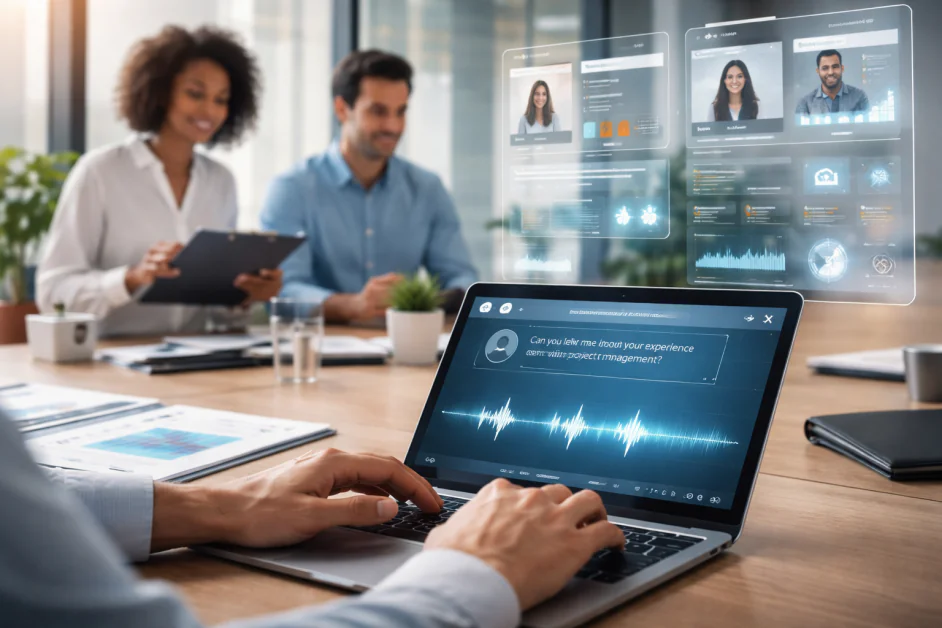
The technology is relatively new, so it’s no surprise that people have mixed feelings about AI handling initial screening interviews. An interview with an AI agent feels impersonal to some job candidates, whereas it feels freeing for others, especially for people who typically feel anxious about answering pointed questions in a high-stakes situation.
Interpersonal social cues might lead jobseekers to tell an interviewer what they want to hear, but when an AI agent is conducting the screening interview, that’s less likely to be a factor, so interview responses are potentially more honest.
Another aspect of AI interviews that is an advantage for everyone is that AI agents are always available. So, a jobseeker who has difficulty scheduling time during business hours can set up an AI interview at a time that works for them.
This flexibility on timing works for employers too since it widens the pool of available candidates, giving highly qualified but busy people a shot at the job by not requiring them to take time off for a screening interview. Meanwhile, AI screening interview tools can reduce a pile of hundreds of applications down to a manageable number so that employers can conduct follow-up interviews for the most highly qualified jobseekers.
AI as an HR Force Multiplier
An AI interview tool that has been trained on the right data to judge candidates solely on the quality of their responses can be a force multiplier for the HR team. The human touch is still important, but AI is fully capable of handling screening interviews, augmenting HR’s capabilities so the humans in the department can focus on more advanced tasks.
HR professionals are frequently challenged to do more with less. With AI agents, they now have the tools to deliver more, to step up and be the strategic business partner their counterparts in other business units need to fulfill their objectives.
Will AI displace HR professionals eventually? That’s doubtful since humans’ capacity for meaningful interpersonal communication and long-term, contextualized strategic planning remain essential. But as Nvidia CEO and co-founder Jensen Huang said of people who don’t adapt to the new workplace reality of AI, “You’re not going to lose your job to an AI, but you’re going to lose your job to someone who uses AI.”
The bottom line is that with proper guardrails and human oversight, AI-powered HR tools can help HR professionals vet more candidates more quickly and expedite putting the best people in the right jobs. In other words, AI can help HR professionals do their jobs more efficiently, and that’s good for the HR team — and great for the business.



