
Thought Leaders
AI is Not Replacing Nurses – It’s Freeing Them to Care for Patients

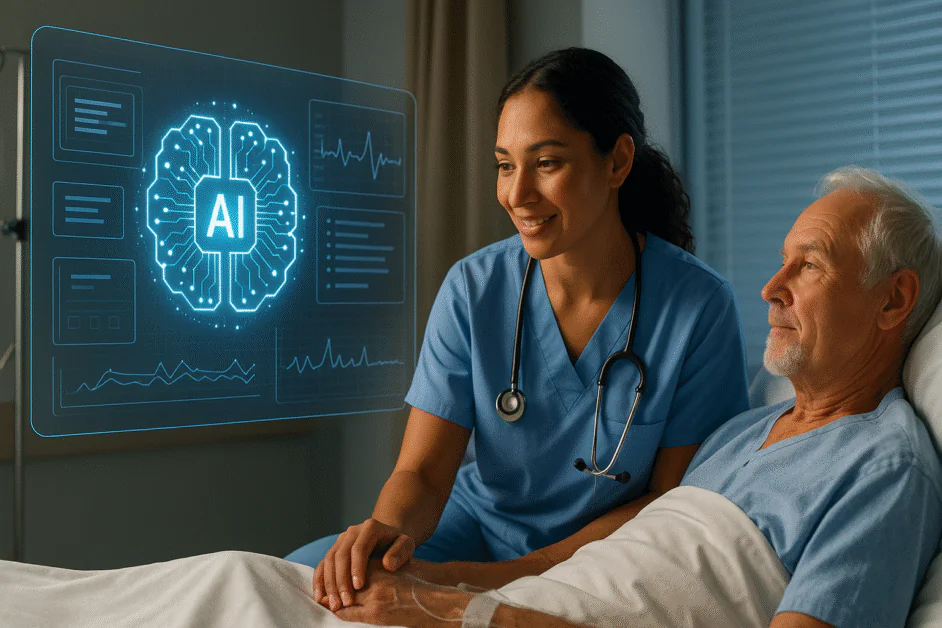
The hospital we’re used to – either the one we visit during a trip to the emergency room or the one we pass through for annual office visits or diagnostic tests and scans – has gotten an artificial intelligence (AI) upgrade. Every interaction with healthcare, from digital messaging, office visit transcription, or even identification of subtle changes in lab results, is being filtered through the lens of AI. And with AI in the healthcare market projected to reach $187.7 billion by 2030, it would be naive to think that AI in our hospitals is a fad or just a passing trend.
The introduction of AI is transforming both the patient experience and the expectations for new nurses. Rather than spending time switching between the bedside and the computer for charting, nurses now have AI assistants that can handle tasks like documenting patient care and streamlining workflows. AI can turn a doctor’s visit notes into a complete patient report, write instructions and summaries for when a patient leaves the hospital, alert nurses if a patient’s condition is changing in subtle ways, and check medications for allergies or duplicates to prevent mistakes.
New research validates how common this is becoming. In fact, knowing how to apply AI in practice is no longer a ‘nice to have’ for nurses. Hiring leaders now consider AI-assisted charting an essential skill, with adoption expectations rising from 26% three years ago to 69% today. That’s a 165% increase. The same study found that 66% of hospitals are using AI for documentation, and 60% are using it for clinical decision making. AI is here to stay.
The goal of implementing AI in nursing is not to replace nurses, but rather to help bring back the human touch by giving nurses more time to focus on care and letting technology do the small stuff. Nurses spend nearly half their day charting, and AI can reduce this time, freeing them for patient care. However, the challenge is that nurses can’t simply be expected to learn this or know how to leverage this technology on their own.
Training’s Technological Upgrade
Today’s nursing education and training need to match the expectations of the hospital that new graduates are walking into. The reality is that there is often a steep learning curve. One in four hiring leaders say that new grads need more guidance than experienced staff when using AI documentation, and 15% of new graduates struggle with AI-enabled documentation or decision-support tools. This tells us that new nurses aren’t getting enough of that experience in school. And the onus is on educators and hospitals to prepare them for more immediate success in the workplace – especially with new technology, like AI, changing the game.
In the classroom, students should be encouraged to embrace experiential learning and AI-powered technology. Simulation supported by technology, like virtual reality (VR), is powerful. Students can practice skills, including AI-enabled documentation, in safe, repeatable scenarios. The more we can introduce and familiarize students, the more likely they are to enter the workforce as ready, adaptable nurses. Another way nursing schools can help their students be more hirable is by partnering with hospitals. Nine in 10 hospitals say they are interested in partnering with local nursing schools – a large opportunity for students to see what is expected of them firsthand and for universities to show how AI and new technologies are actually being leveraged on the job.
Hospitals are also using VR simulation to support ongoing training, including AI competency. For example, Grande Ronde Hospital, a 25-bed facility in Oregon, uses VR simulation to support its nurse residency program. Nurses can practice and refresh skills on demand, simulating scenarios they might not encounter often in a small hospital, or remediating areas identified as performance gaps for just-in-time training. This immersive training prepares nurses to work with technology. And the result: a 96% nurse retention rate and more competent, confident staff.
AI as a Partner, Not a Problem
While story after story is published about AI taking jobs, nursing is one where 52% of hiring leaders aren’t overly concerned. They rate nursing as “highly secure” over the next decade. AI may assist in healthcare, but it can never perform procedures, bandage wounds, or provide the empathetic reassurance that only nurses can offer. The same can be said for the nursing education pipeline.
Nursing educators are at the heart of the learning experience, right alongside the learner. AI is not a colleague, not a competitor, and not the one making decisions. It’s a tool, and “it” is designed to assist them. With AI taking on some of the operational load, educators can spend more time debriefing, coaching, and building clinical judgment skills. This directly translates to better-prepared graduates.
AI Funnels Time Back To Patients
Nurses who embrace AI can provide even better care, especially in hospitals where staffing is stretched thin. According to the Health Workforce Analysis published by the Health Resources and Services Administration (HRSA), federal authorities project a shortage of more than 63,700 full-time registered nurses by 2030. The bottom line here is that nurses can use all the help and time back that they can get. By handing the hours spent on administrative tasks over to AI, nurses can focus more on what truly matters: their patients.
This is a call to empower nurses and help them gain confidence in using AI as a supportive tool. That confidence starts in school, where educators and hospitals can integrate technology like immersive VR simulation into nursing education from day one. When new nurses gain experience and comfort with AI early, they form a strong partnership with the technology that enhances rather than replaces their work. As AI continues to evolve, it will remain a vital part of the hospital unit, but the heart of nursing will always stay human, dedicated to caring, connecting, and helping people.



