AI Fundamentals
Off-the-Shelf vs. Custom Machine Learning Models

 Add Unite.AI to your preferred sources on Google

Choosing a machine-learning solution is rarely a simple buy-versus-build decision. The real continuum runs from a hosted API or packaged model, through prompting, retrieval and fine-tuning, to a fully custom architecture trained on organization-specific data.
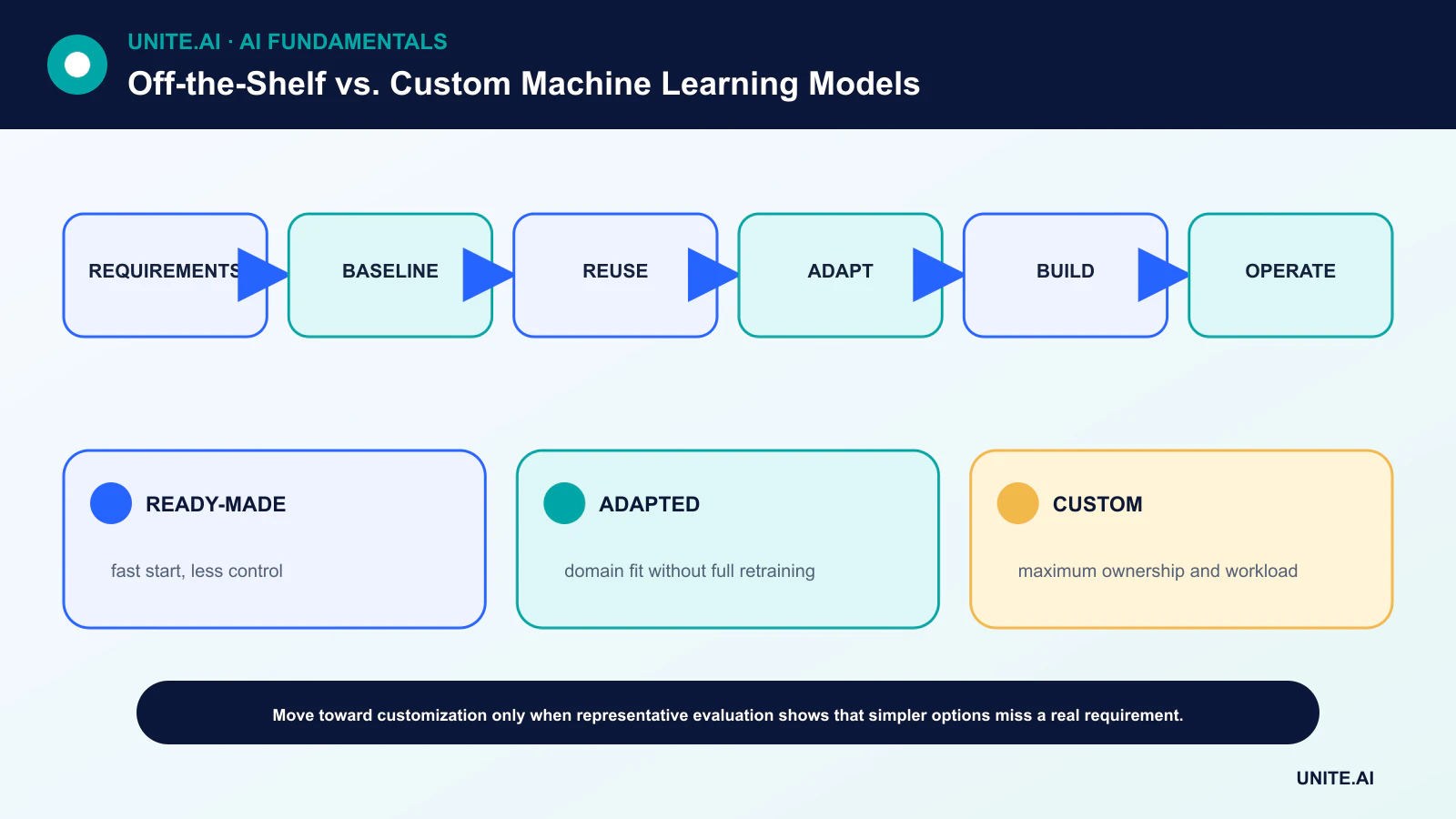
The best option is the least complex approach that meets a verified product requirement. A custom model can create control and differentiation, but it also creates an ongoing obligation to operate data pipelines, evaluations, monitoring, security, updates and rollback.
Key takeaways
- Start with a measurable task, a non-ML baseline and acceptance thresholds.
- Evaluate candidate models on representative private data rather than public benchmark scores alone.
- Include integration, latency, review, retraining and incident costs in total cost of ownership.
- Prefer reversible stages: baseline, retrieve or prompt, fine-tune, then train from scratch only when evidence supports it.
Define the decision before choosing a model
Specify the user, decision, input, output, error costs, latency budget, traffic pattern and escalation path. Determine whether a deterministic rule or search system solves enough of the problem. Google’s Rules of ML recommends simple baselines and trustworthy infrastructure before complex modeling.
Create an offline evaluation set that reflects production, including rare and adversarial cases. Where decisions affect people, define subgroup checks and human-review rules. These gates make comparisons concrete instead of turning architecture choice into preference.
The reuse and adaptation continuum
A hosted API offers fast integration and managed scaling but limited control over model internals, versions and data handling. An open pretrained model increases deployment control. Retrieval or prompt engineering can add domain context without changing weights.
Fine-tuning or parameter-efficient adapters can specialize behavior. Training from scratch is justified only when the data, objective, scale or ownership requirement cannot be met through reuse. Transfer learning often captures most of the value with substantially less data and compute.
Quality, control and lock-in
Measure task quality, calibration, latency, throughput, availability and failure consistency. A vendor model may improve automatically but can also change behavior; a self-hosted model can be pinned but requires the team to manage upgrades and vulnerabilities.
Contractual terms should address data retention, training use, regional processing, intellectual property, service levels, export paths and deprecation. Portability improves when the application separates model-specific adapters from business logic and stores reproducible evaluation artifacts.
Privacy, safety and operations
Map every data flow and threat boundary. Sensitive inputs may require private networking, on-premises inference or edge AI. Self-hosting does not automatically make a system safe; it transfers security and compliance responsibility to the operator.
Production ownership includes observability, drift checks, abuse monitoring, incident response and rollback. The operating team must be able to answer which model, prompt, data version and policy produced a result.
Use staged evidence, not ideology
Run a time-boxed benchmark with the same dataset and acceptance criteria across options. Estimate engineering time, annotation, accelerator usage, vendor fees, review labor, failure costs and the expected cadence of change.
Choose the simplest candidate that clears the gates, then re-evaluate as requirements or prices change. Customization is valuable when it produces measured benefit or necessary control—not merely because a bespoke model sounds strategically important.
Requirements and total-cost comparison
An off-the-shelf model, API, or packaged system provides prebuilt capability with vendor support and faster initial deployment. A custom model is trained or substantially adapted for a specific task, data, and operating environment. The choice begins with requirements: target outcome, quality by subgroup and edge case, latency, throughput, availability, explainability, data residency, update control, integration, security, and failure consequence. A generic benchmark or demo cannot answer whether a product meets those requirements.
Total cost includes evaluation, data preparation, labeling, integration, licenses or usage, infrastructure, monitoring, review, incident response, upgrades, and exit. Off-the-shelf lowers initial engineering but can create variable cost, lock-in, behavior changes, and limited observability. Custom development adds data and MLOps responsibility and may still depend on pretrained weights and vendors. Model cost should be measured per successful task at required quality, not per token or training run alone.
Evaluation, procurement, and adaptation
Build a representative private test set before vendor selection and run every candidate under identical prompts, preprocessing, thresholds, and operating limits. Include ambiguous, adversarial, unsupported, multilingual, and high-consequence cases. Measure accuracy, calibration, latency, cost, refusal, security, and human workflow impact. Test API outages, rate limits, regional behavior, and version change. Vendor claims require documentation for training, rights, privacy, retention, subprocessors, safety, support, and incident notification.
Adaptation options form a spectrum: configuration, retrieval, prompting, fine-tuning, parameter-efficient updates, custom heads, or training from scratch. Use the least complex method that meets evidence. Retrieval is appropriate for frequently changing knowledge; tuning can shape format or domain behavior; deterministic code should handle exact rules. Validate combined systems because a strong base model can still fail through poor retrieval, permissions, or integration.
Lifecycle and exit planning
Hosted products can change or disappear, while custom models become technical debt without owners. Version dependencies, monitor behavior and outcomes, define retraining or reevaluation triggers, and maintain rollback. Preserve data and interfaces needed to migrate, negotiate deletion and export, and avoid exposing one vendor’s proprietary schema throughout the application. The best choice may be hybrid: commercial capability for commodity tasks and custom components where domain performance, control, or risk creates durable value.
Worked example: choosing a document-extraction model
A company creates a private test set of invoices across suppliers, languages, scans, handwriting, and edge cases, then compares a managed API, open pretrained model, adapted model, and rules baseline. It scores field accuracy, monetary error, unsupported documents, latency, throughput, privacy, residency, integration, and cost per correctly processed invoice. Vendor demos and public benchmarks do not replace this matched evaluation.
The selected hybrid uses a commercial OCR service with local validation and human review for low confidence or high amounts. Contracts define retention, subprocessors, updates, and deletion; the architecture preserves source files and an exit path. A shadow period detects schema and supplier gaps. Monitoring separates OCR, extraction, validation, and reviewer corrections. If vendor behavior changes, the team can freeze, switch, or move more work to its custom component without rewriting the financial workflow.
Implementation evidence and operational readiness
A production decision needs more than a successful demonstration. Define the intended users, operating environment, inputs, outputs, dependencies, owner, and the consequence of each important failure. Establish a reproducible baseline and a versioned evaluation set before tuning. Test ordinary cases, boundary conditions, malformed or missing input, distribution shift, dependency outage, misuse, and the groups or environments most likely to be underserved. Measure task quality together with calibration or uncertainty, latency, throughput, resource cost, accessibility, privacy, and security. Record every transformation and threshold so an independent reviewer can reproduce the result and distinguish evidence from an attractive prototype.
Before launch, assign authority for release, exceptions, changes, rollback, and retirement. Use a staged rollout, preserve a safe fallback, and verify monitoring with deliberately injected failures. Operational telemetry should reveal input quality, output behavior, model or rule version, dependency health, human overrides, and confirmed outcomes without collecting unnecessary sensitive data. Define alert thresholds and a response owner, then review real-world evidence after deployment rather than assuming offline performance will persist. Reevaluate whenever data sources, users, models, vendors, policies, hardware, or objectives change. A maintained system also needs documented recovery, incident learning, deletion and retention procedures, and a clear point at which it should be disabled or replaced.
Frequently asked questions
When should a team train a model from scratch?
When pretrained or hosted options cannot meet validated requirements and the team has sufficient proprietary data, compute, expertise and long-term operational capacity.
Is an off-the-shelf model maintenance-free?
No. Integration, evaluation, version changes, monitoring, privacy controls and fallback behavior remain the adopter’s responsibility.
Primary references