AI Fundamentals
FinOps 101: A Beginner’s Guide to Cloud Financial Operations

 Add Unite.AI to your preferred sources on Google

FinOps is an operational framework and cultural practice for maximizing the business value of technology through collaboration among engineering, finance, product, procurement and leadership. It connects technical usage with cost, value and timely decisions.
FinOps is not simply a cost-cutting team. Spending more can be correct when it improves a valuable service; spending less can be harmful when it reduces reliability or slows growth. The goal is accountable tradeoffs using shared data.
Key takeaways
- Allocate technology usage and cost to accountable scopes such as products, teams or environments.
- Use unit economics—cost per transaction, customer or model inference—to connect spend with value.
- Separate usage optimization from rate optimization and include reliability, security and sustainability constraints.
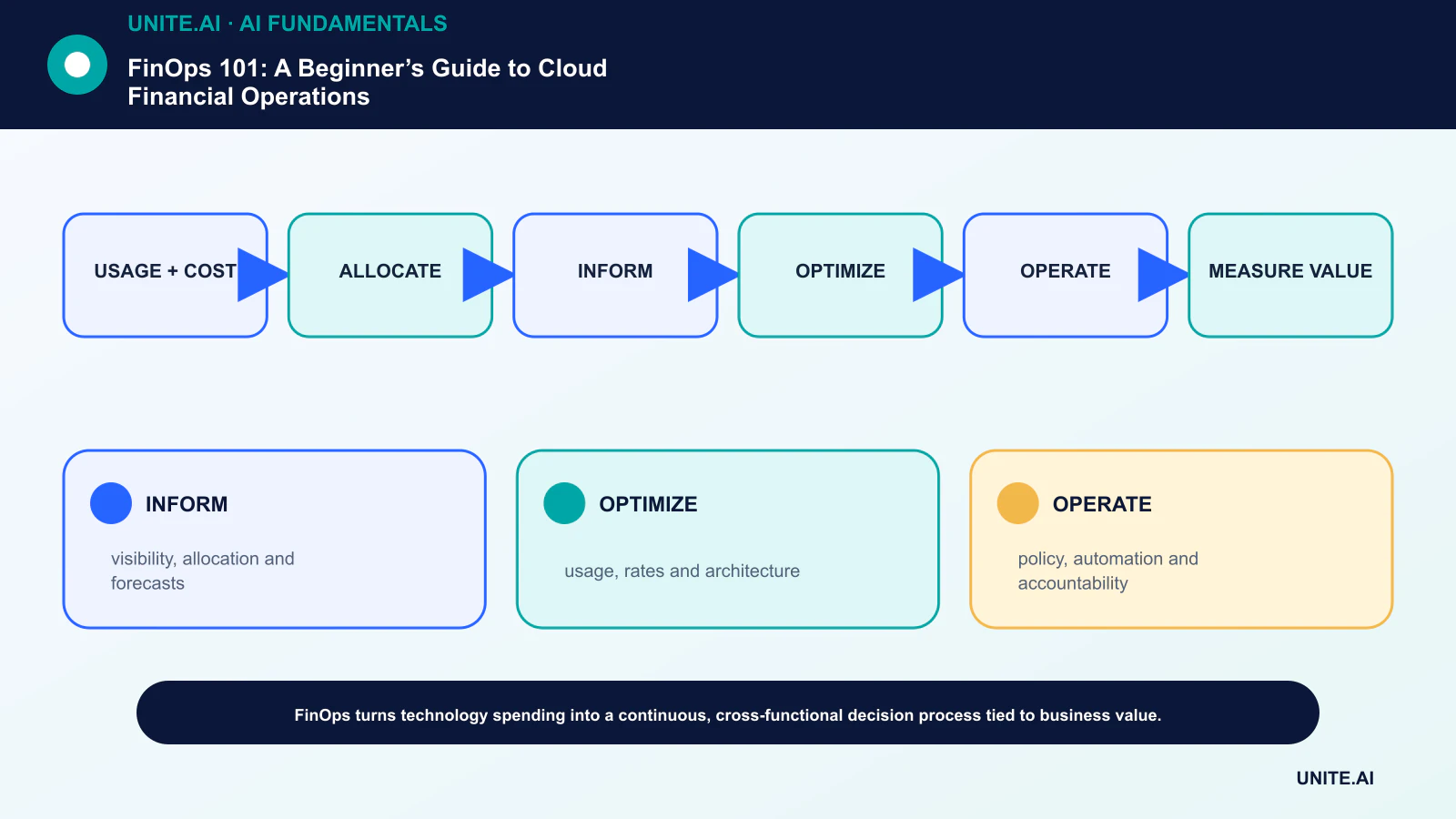
- Inform, Optimize and Operate form a continuous cycle rather than a one-time savings project.
Create shared scopes and cost data
A scope is a defined segment of technology spending aligned to a business construct. Tags, accounts, projects and billing exports help allocate direct cost, while shared platforms require documented allocation rules.
Data should be timely, accurate enough for the decision and reconcilable with invoices. Unallocated and shared cost should remain visible rather than being forced into false precision. Connect cost changes to deployments, traffic and architectural decisions.
Inform with forecasts and unit economics
Dashboards explain where usage and cost occur; forecasts estimate future demand; budgets express an agreed plan. Anomaly management detects unexpected changes quickly, but an anomaly may be legitimate growth rather than waste.
Unit metrics divide cost by a value-related outcome. For AI, examples include cost per successful task or thousand verified inferences. Pair financial metrics with quality and latency so teams do not optimize toward cheap failure.
Optimize usage and rates
Usage optimization removes idle resources, rightsizes workloads, schedules flexible jobs and changes architecture. Rate optimization uses commitments, reservations, negotiated pricing and licensing strategy to pay less for necessary usage.
Commitments create forecast risk, and aggressive rightsizing can reduce headroom. Evaluate reliability, security, engineering effort and the carbon implications of placement. Measurements from AI carbon-footprint work can complement cost data.
Operate through policy and automation
Policies define ownership, approved services, data retention, commitment authority and escalation thresholds. Automation can enforce tags, stop abandoned environments or notify owners, but destructive actions need safeguards and exceptions.
Integrate FinOps with DevOps so engineers see cost during design and delivery, not only after the invoice. Review results, update forecasts and feed lessons into the next Inform phase.
Apply FinOps beyond public cloud
The FinOps Foundation’s current framework covers broader technology scopes including SaaS, licensing, data centers and AI. The same principles—shared data, accountable decisions and value measurement—apply, though billing and allocation mechanisms differ.
Start with a high-value problem and a small number of capabilities. A mature practice is not the one with the most dashboards; it is the one that makes faster, better tradeoffs and verifies the outcome.
FinOps principles and the cloud cost model
FinOps is a cross-functional practice that helps engineering, finance, procurement, and product teams make timely decisions about variable cloud value and cost. It is not a one-time cost-cutting exercise. Cloud bills combine usage, rates, commitments, regions, tiers, data transfer, support, licenses, and taxes. Allocation maps those charges to accountable products, teams, environments, or customers through accounts, subscriptions, projects, tags, labels, and shared-cost rules.
The FinOps cycle is often described as inform, optimize, and operate. Inform creates trustworthy allocation, unit economics, budgets, and forecasts. Optimize removes waste, rightsizes, schedules nonproduction, improves architectures, and manages commitments. Operate embeds cost feedback into planning and engineering. Central governance supplies standards and tooling, while product teams own tradeoffs with reliability, security, performance, and roadmap. Finance validates accounting and forecasting; procurement manages commercial terms.
Metrics, commitments, and optimization
Total spend is incomplete. Unit metrics—cost per transaction, customer, model inference, build, or stored record—connect consumption to value and reveal whether growth is efficient. Track amortized commitment cost, realized savings, waste, forecast error, allocation coverage, and anomaly response. Avoid targets that encourage teams to shift cost, underprovision reliability, or delete useful observability. Cost estimates need currency, time window, and inclusion rules.
Reserved capacity and savings commitments lower rates in exchange for term and usage risk. Model baseline demand, growth, seasonality, and service portability before buying. Rightsizing should use sustained CPU, memory, I/O, latency, and redundancy, not average CPU alone. Spot capacity suits interruptible workloads with checkpoint and retry. Storage lifecycle and data transfer often need architectural changes. Every optimization should pass performance, recovery, and security tests.
Governance and cloud–AI workloads
Budgets and anomaly alerts need owners and actionable thresholds. Showback informs teams; chargeback assigns financial responsibility but needs stable allocation. Automate policy with exceptions and expiry, and review unused resources, orphaned commitments, and duplicated tools. AI introduces accelerator scarcity, variable token use, large data movement, and experiments with uncertain value. Measure cost per successful quality-qualified task and include failed runs and review. FinOps succeeds when cost becomes a design signal without reducing the safety or customer value of the service.
Worked example: reducing an AI service’s unit cost
A team defines the unit as cost per successfully resolved support case at required quality. Billing, token, model, cache, retrieval, review, and infrastructure data are allocated to the service. Analysis shows long prompts, repeated document context, retries, and a large model on simple classifications drive cost. A smaller router, permission-aware cache, bounded context, and batch embedding reduce expense while preserving an unchanged private evaluation set.
The rollout compares quality, refusal, latency, escalation, and customer outcome as well as spend. Budgets and anomaly alerts have service owners; commitments are purchased only for stable baseline load. Cost allocation and model versions appear in dashboards, and security or observability is not disabled to hit a target. The team reports savings per resolved case rather than lower price per token, because a cheap model that causes retries and review can raise total cost and user burden.
Implementation evidence and operational readiness
A production decision needs more than a successful demonstration. Define the intended users, operating environment, inputs, outputs, dependencies, owner, and the consequence of each important failure. Establish a reproducible baseline and a versioned evaluation set before tuning. Test ordinary cases, boundary conditions, malformed or missing input, distribution shift, dependency outage, misuse, and the groups or environments most likely to be underserved. Measure task quality together with calibration or uncertainty, latency, throughput, resource cost, accessibility, privacy, and security. Record every transformation and threshold so an independent reviewer can reproduce the result and distinguish evidence from an attractive prototype.
Before launch, assign authority for release, exceptions, changes, rollback, and retirement. Use a staged rollout, preserve a safe fallback, and verify monitoring with deliberately injected failures. Operational telemetry should reveal input quality, output behavior, model or rule version, dependency health, human overrides, and confirmed outcomes without collecting unnecessary sensitive data. Define alert thresholds and a response owner, then review real-world evidence after deployment rather than assuming offline performance will persist. Reevaluate whenever data sources, users, models, vendors, policies, hardware, or objectives change. A maintained system also needs documented recovery, incident learning, deletion and retention procedures, and a clear point at which it should be disabled or replaced.
Frequently asked questions
Who owns cloud cost in FinOps?
Ownership is shared. Engineering influences architecture and usage, finance provides planning and reconciliation, and product and leadership connect spending to value.
Is FinOps only for large companies?
No. Smaller teams can begin with clear ownership, budgets, anomaly alerts and a regular review cadence before adopting specialized tooling.
Primary references