AI Fundamentals
What is Few-Shot Learning?

 Add Unite.AI to your preferred sources on Google

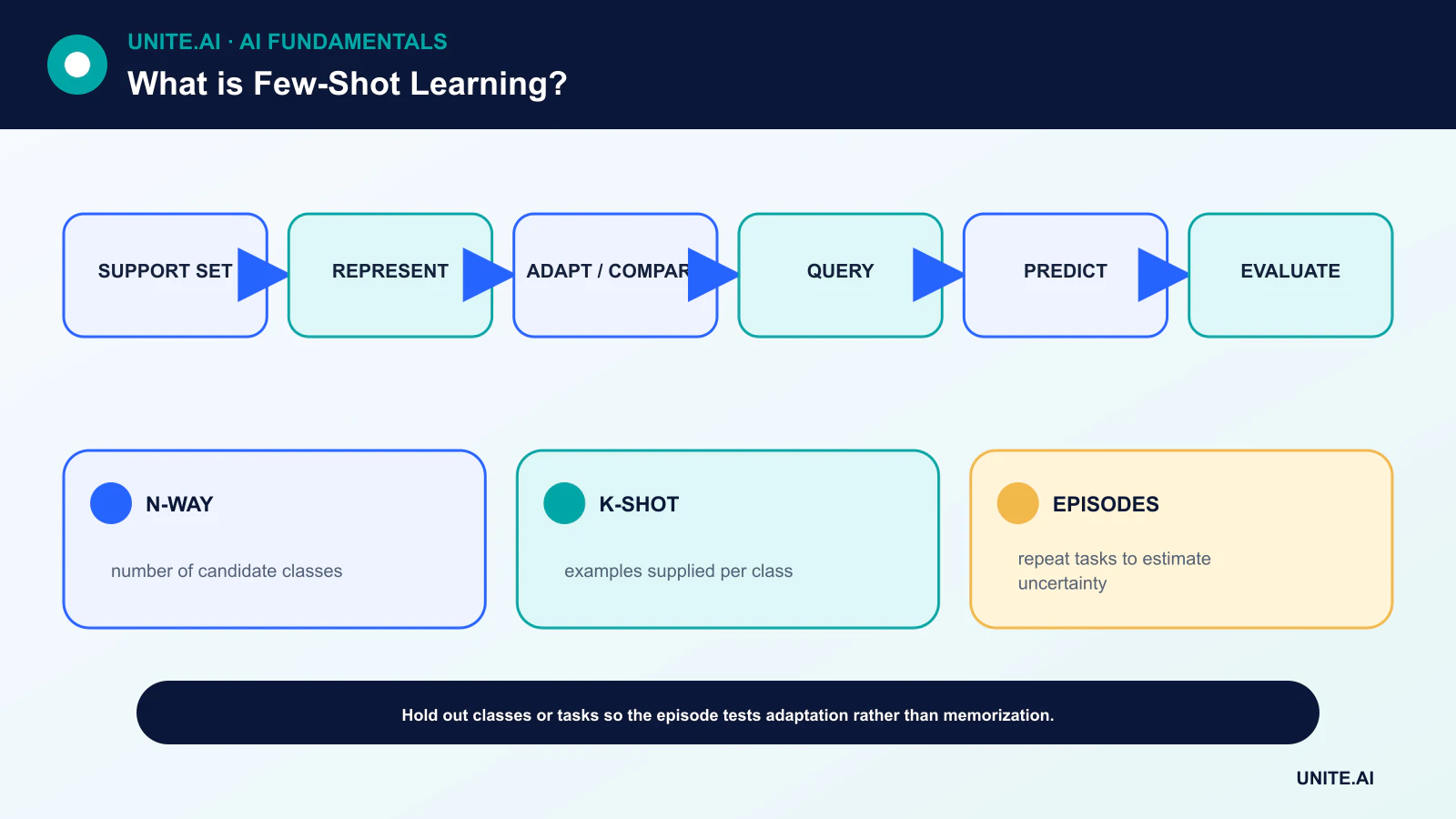
Few-shot learning studies how a model can adapt to a new task or class from only a small number of labeled examples. In classical benchmarks, an episode supplies a support set—such as five classes with one or five examples per class—and asks the model to classify unseen queries.
The term is also used for in-context learning, where a pretrained language model receives a few demonstrations in its prompt without updating parameters. These settings share a low-example goal but use different adaptation mechanisms and require different evaluation designs.
Key takeaways
- N-way K-shot describes N classes and K labeled support examples per class.
- Metric-learning methods compare queries with learned representations of support examples.
- Meta-learning optimizes across many tasks so that a new task can be learned quickly.
- Few examples magnify label errors, leakage, class ambiguity and uncertainty, so baselines and confidence reporting matter.
Episodes, support sets and query sets
A few-shot episode separates a small labeled support set from a query set used for evaluation. During meta-training, the model sees many such episodes. Strong evaluation holds out entire classes, tasks or domains so the test episode measures adaptation rather than memorization.
Report accuracy distributions across many episodes rather than one convenient sample. Compare with simple nearest-neighbor and linear baselines; a sophisticated method that cannot beat a well-trained representation plus a basic classifier may not justify its complexity.
Metric learning and prototypes
Matching networks and related methods embed support and query examples into a space where nearby vectors should share a label. Prototypical networks average the support embeddings for each class and classify a query according to distance from those class prototypes.
This connects few-shot learning to representation quality. A pretrained deep-learning model may already organize relevant features well, while a mismatched representation can make every distance misleading.
Optimization-based meta-learning
Model-Agnostic Meta-Learning searches for parameters that can adapt with a small number of gradient steps. Other methods learn an optimizer, an initialization or a parameter update rule. The outer loop evaluates post-adaptation performance across tasks.
Meta-learning assumes useful structure is shared between training and target tasks. When the target distribution differs sharply, rapid adaptation can fail. Validation should vary shots, classes, domains and task difficulty instead of treating one benchmark as universal.
Transfer learning and data-level strategies
Transfer learning is often the strongest practical starting point: freeze a pretrained encoder, train a small head, then fine-tune selectively if enough data exist. Data augmentation can introduce invariances, but unrealistic synthetic examples may amplify bias or create shortcuts.
Active learning can prioritize which examples to label, while semi-supervised learning can use additional unlabeled data. These are complementary strategies, not synonyms for few-shot learning.
Few-shot prompting is different
A transformer can infer a pattern from demonstrations placed in its context. No persistent parameter update is required. Order, wording and label balance can materially change the output, and examples can consume a large share of the context window.
Use a representative evaluation set, version every prompt and demonstration, and test zero-shot, few-shot and fine-tuned alternatives. A tiny support set does not support strong population-wide claims, especially for rare or safety-critical cases.
Few-shot learning paradigms and task construction
Few-shot learning aims to perform a task from very few labeled examples. In metric-based methods, an encoder maps examples into a space where nearest prototypes or neighbors represent classes. Optimization-based meta-learning trains an initialization or update rule for rapid adaptation. Transfer learning fine-tunes a pretrained model on a small target set. In-context learning supplies examples in a prompt without updating weights. These mechanisms differ, so claims should specify whether parameters change, what prior training occurred, and how examples are selected.
Evaluation should separate training and test classes, tasks, subjects, or domains according to the claimed generalization. An N-way K-shot episode contains N classes and K support examples per class, plus query examples for scoring. Repeated episodes estimate variance from support selection. For prompting, example order, label wording, format, and demonstration similarity can materially change results. Compare with zero-shot, nearest-neighbor, linear-probe, and ordinary fine-tuning baselines using the same representation and data budget.
Data quality, uncertainty, and negative transfer
With few examples, mislabeled or atypical cases have outsized influence. Define annotation rules, inspect each support item, and preserve an unknown or abstain outcome. Data augmentation and synthetic examples can help only when they preserve the task and add realistic variation. A pretrained model may transfer shortcuts or bias from its source domain. Test out-of-domain cases, rare groups, and sensitivity to removing one support example. Report confidence intervals across tasks and random seeds, not one favorable prompt.
Active learning can ask for labels on informative cases, while semi-supervised methods use unlabeled data under additional assumptions. Retrieval can select relevant demonstrations dynamically but must avoid test-label leakage. Adaptation can overfit quickly, so constrain updates, use regularization, and validate on separate examples. For high-stakes tasks, a few labels rarely justify autonomous decisions; use the model to prioritize or assist review until sufficient outcome evidence exists.
Production operation
Version the base model, embedding or prompt template, demonstrations, label schema, and adaptation parameters. Protect examples because prompts or gradients can expose sensitive records. Monitor performance as classes and language change, and refresh support examples through governed review rather than automatic self-labeling. Few-shot learning reduces the labeled target requirement by exploiting prior structure; it does not eliminate the need for representative evaluation, careful task definition, domain expertise, or a safe fallback when the new task lies outside that prior.
Worked example: few-shot classification for a new product
A support team needs routing labels for a product with only five reviewed examples per issue. It compares nearest prototypes in a pretrained embedding, a linear head, parameter-efficient fine-tuning, and in-context prompting. Product families, customers, and later messages are kept out of meta-training and model selection. Repeated support-set sampling reports class recall, calibration, variance, and sensitivity to one mislabeled demonstration.
Low-confidence and unsupported messages route to general support, and reviewers correct labels through a governed queue. Examples are de-identified, versioned, and never selected from the final test set. Monitoring tracks new vocabulary, class rates, correction, and disagreement. When enough labels accumulate, the few-shot system is compared with ordinary supervised training. Rapid setup is useful, but it does not justify automation if performance remains unstable or if the new product differs substantially from prior task families.
Implementation evidence and operational readiness
A production decision needs more than a successful demonstration. Define the intended users, operating environment, inputs, outputs, dependencies, owner, and the consequence of each important failure. Establish a reproducible baseline and a versioned evaluation set before tuning. Test ordinary cases, boundary conditions, malformed or missing input, distribution shift, dependency outage, misuse, and the groups or environments most likely to be underserved. Measure task quality together with calibration or uncertainty, latency, throughput, resource cost, accessibility, privacy, and security. Record every transformation and threshold so an independent reviewer can reproduce the result and distinguish evidence from an attractive prototype.
Before launch, assign authority for release, exceptions, changes, rollback, and retirement. Use a staged rollout, preserve a safe fallback, and verify monitoring with deliberately injected failures. Operational telemetry should reveal input quality, output behavior, model or rule version, dependency health, human overrides, and confirmed outcomes without collecting unnecessary sensitive data. Define alert thresholds and a response owner, then review real-world evidence after deployment rather than assuming offline performance will persist. Reevaluate whenever data sources, users, models, vendors, policies, hardware, or objectives change. A maintained system also needs documented recovery, incident learning, deletion and retention procedures, and a clear point at which it should be disabled or replaced.
Frequently asked questions
Is one-shot learning the same as few-shot learning?
One-shot learning is the special case with one labeled support example per class or task. Zero-shot learning uses no labeled target examples.
Does few-shot learning eliminate the need for data?
No. It shifts dependence toward pretraining data, related tasks, representations and assumptions. The target labels are few; the total learning history is usually large.
Primary references