AI Fundamentals
What is Generative AI?

 Add Unite.AI to your preferred sources on Google

Generative AI refers to models that learn patterns in data and produce new text, images, audio, video, code or other representations when conditioned on instructions or examples. The output is synthesized from a probability model; it is not retrieved intact from a database, although retrieval tools can supply external evidence.
Different model families generate in different ways. Autoregressive transformers predict a sequence one token at a time, diffusion models iteratively denoise a sample, and generative adversarial networks learn through a contest between a generator and discriminator.
Key takeaways
- Generation is conditional sampling from a learned distribution, not guaranteed factual recall.
- Transformers, diffusion models, GANs and variational autoencoders make different tradeoffs.
- Retrieval and tools can ground a system, but their outputs and permissions still require validation.
- Risk management spans data, model, interface, deployment, monitoring and content provenance.
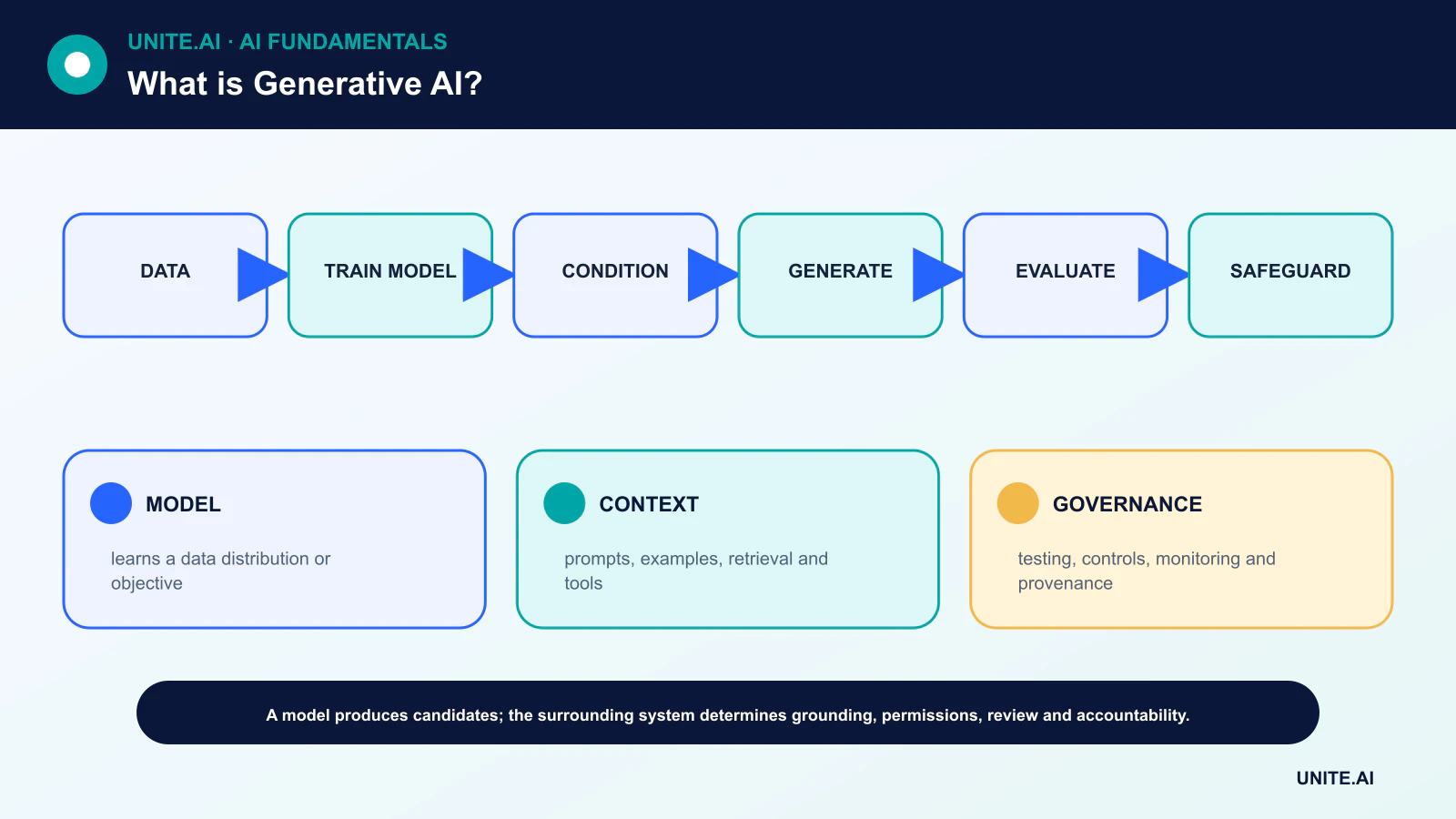
How generative models learn
Training objectives reward a model for predicting or reconstructing patterns in examples. A language model estimates the next token; a diffusion model learns to reverse a noise process; a variational autoencoder learns a structured latent distribution and decoder.
This training creates statistical generalization, but it can also reproduce biases, memorize uncommon sequences or fail outside the data distribution. Dataset documentation, deduplication, privacy controls and held-out evaluation therefore matter before deployment.
Major architecture families
Autoregressive transformers dominate text and support multimodal sequences. Diffusion models are widely used for high-fidelity image and audio generation. GANs can create sharp samples and controllable image systems but can be difficult to train.
Variational autoencoders provide latent-variable modeling and efficient representations, sometimes serving inside larger generative pipelines. Real products often combine several models with retrieval, filters, tools and deterministic code.
Conditioning, sampling and control
A prompt, class label, image, audio clip or structured record can condition generation. Sampling parameters alter diversity and determinism. Lower temperature can concentrate token probabilities, but it does not make an incorrect answer true.
Control improves when the system uses explicit schemas, constrained decoding, reference material and validation. Prompt engineering changes context; fine-tuning changes parameters; retrieval supplies external information. Each addresses a different failure mode.
Evaluation is application-specific
Text systems may need factuality, task completion, citation support, toxicity and calibration tests. Image or audio systems may need fidelity, semantic alignment, diversity, identity safety and perceptual review. Pair automated metrics with representative human evaluation.
Build a versioned evaluation set that includes ordinary, rare, adversarial and policy-relevant cases. Track latency, cost and refusal behavior as well as output quality. A demo selected by its creator is not evidence of population-level reliability.
Risks, safeguards and provenance
Important risks include hallucination, prompt injection, harmful content, impersonation, insecure tool use, privacy leakage, copyright disputes, automation bias and opaque supply chains. NIST’s Generative AI Profile organizes actions across governance, content provenance, pre-deployment testing and incident disclosure.
Use least-privilege tools, input/output controls, human review for consequential decisions, logging, rollback and user reporting. Watermarks or content credentials can add signals, but no single detector or label establishes truth. The broader synthetic-media workflow must preserve context and accountability.
Model families and generation mechanisms
Generative AI models estimate or learn a process that can produce new text, images, audio, video, code, or structured data. Autoregressive models predict the next token or element; diffusion models learn to reverse a noise process; variational autoencoders learn probabilistic latent variables; GANs train a generator against a discriminator. Multimodal systems connect representations across media. The output is sampled from learned statistical structure conditioned on prompts, context, tools, or other inputs—not retrieved as a guaranteed fact.
Foundation models are pretrained on broad data and adapted through prompting, retrieval, fine-tuning, preference optimization, control networks, or task-specific heads. Tokenizers, encoders, decoders, latent spaces, and sampling settings shape results. Temperature and candidate filtering trade determinism and diversity. Longer prompts provide context but can conflict, distract, or contain malicious instructions. Retrieval can ground changing knowledge, while deterministic code should handle exact calculations and rules.
Evaluation, provenance, and rights
Evaluate by task: factual correctness and citation for answers, execution and security for code, fidelity and diversity for media, and human outcome for creative assistance. Include refusal, calibration, latency, cost, languages, accessibility, and adversarial tests. A fluent or photorealistic output can be wrong. Preserve model, prompt, seed, source evidence, tool calls, and postprocessing for reproducibility. Separate retrieval quality from generation so a polished answer cannot conceal missing evidence.
Training and outputs raise copyright, license, consent, privacy, publicity, and confidentiality questions. Establish provenance and permitted use for input data; prevent users from exposing secrets; test memorization; and provide reporting and removal processes. Synthetic media should carry durable provenance or disclosure where feasible, especially when it can be mistaken for evidence. Do not use likeness, voice, or style in ways that violate rights or deceive.
Deployment controls
Treat model output as untrusted input. Validate schemas, sanitize code and files, isolate execution, authorize every tool externally, limit cost and rate, and require confirmation for consequential actions. Monitor failures, abuse, drift, and user corrections, with rollback and a non-generative fallback. Document intended and prohibited use. Generative AI expands the interface for creating and transforming information, but reliability and accountability come from the surrounding data, evaluation, security, provenance, and human decision process.
Worked example: a generative product-description assistant
A retailer lets editors generate draft descriptions only from approved product attributes and brand guidance. The prompt includes structured facts, while retrieval provides current policy. Output must follow a schema and is validated against source values; unsupported dimensions, safety claims, or certifications cause rejection. Evaluation covers factual accuracy, style, duplication, multilingual quality, accessibility, latency, and editor correction, compared with templates and manual writing.
Editors approve every publication and can see source fields. The model has no ability to change price, inventory, or publish directly. Prompts and product data are protected from injection, and confidential supplier notes are excluded. Monitoring tracks unsupported claims, edits, complaints, cost, and provider versions. Generated text is stored with provenance. The system saves drafting time only if corrections and review do not erase the benefit and product truth remains governed by authoritative data.
Implementation evidence and operational readiness
A production decision needs more than a successful demonstration. Define the intended users, operating environment, inputs, outputs, dependencies, owner, and the consequence of each important failure. Establish a reproducible baseline and a versioned evaluation set before tuning. Test ordinary cases, boundary conditions, malformed or missing input, distribution shift, dependency outage, misuse, and the groups or environments most likely to be underserved. Measure task quality together with calibration or uncertainty, latency, throughput, resource cost, accessibility, privacy, and security. Record every transformation and threshold so an independent reviewer can reproduce the result and distinguish evidence from an attractive prototype.
Before launch, assign authority for release, exceptions, changes, rollback, and retirement. Use a staged rollout, preserve a safe fallback, and verify monitoring with deliberately injected failures. Operational telemetry should reveal input quality, output behavior, model or rule version, dependency health, human overrides, and confirmed outcomes without collecting unnecessary sensitive data. Define alert thresholds and a response owner, then review real-world evidence after deployment rather than assuming offline performance will persist. Reevaluate whenever data sources, users, models, vendors, policies, hardware, or objectives change. A maintained system also needs documented recovery, incident learning, deletion and retention procedures, and a clear point at which it should be disabled or replaced.
Frequently asked questions
Is generative AI the same as a large language model?
No. LLMs are one class of generative model. Generative AI also includes image, audio, video and structured-data systems built with several architectures.
Does a model copy its training data?
It usually synthesizes from learned patterns, but memorization and near-duplication can occur. Privacy and provenance risks must be evaluated rather than assumed away.
Primary references