AI Fundamentals
What is Edge AI & Edge Computing?

 Add Unite.AI to your preferred sources on Google

Edge computing places computation near the devices and physical processes that produce data. Edge AI runs machine-learning inference—and sometimes training or adaptation—on a sensor, phone, vehicle, gateway or local server instead of sending every input to a distant cloud.
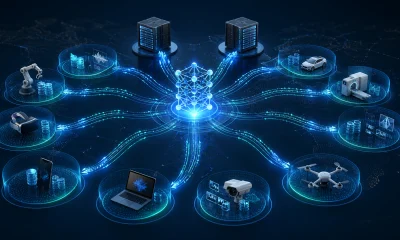
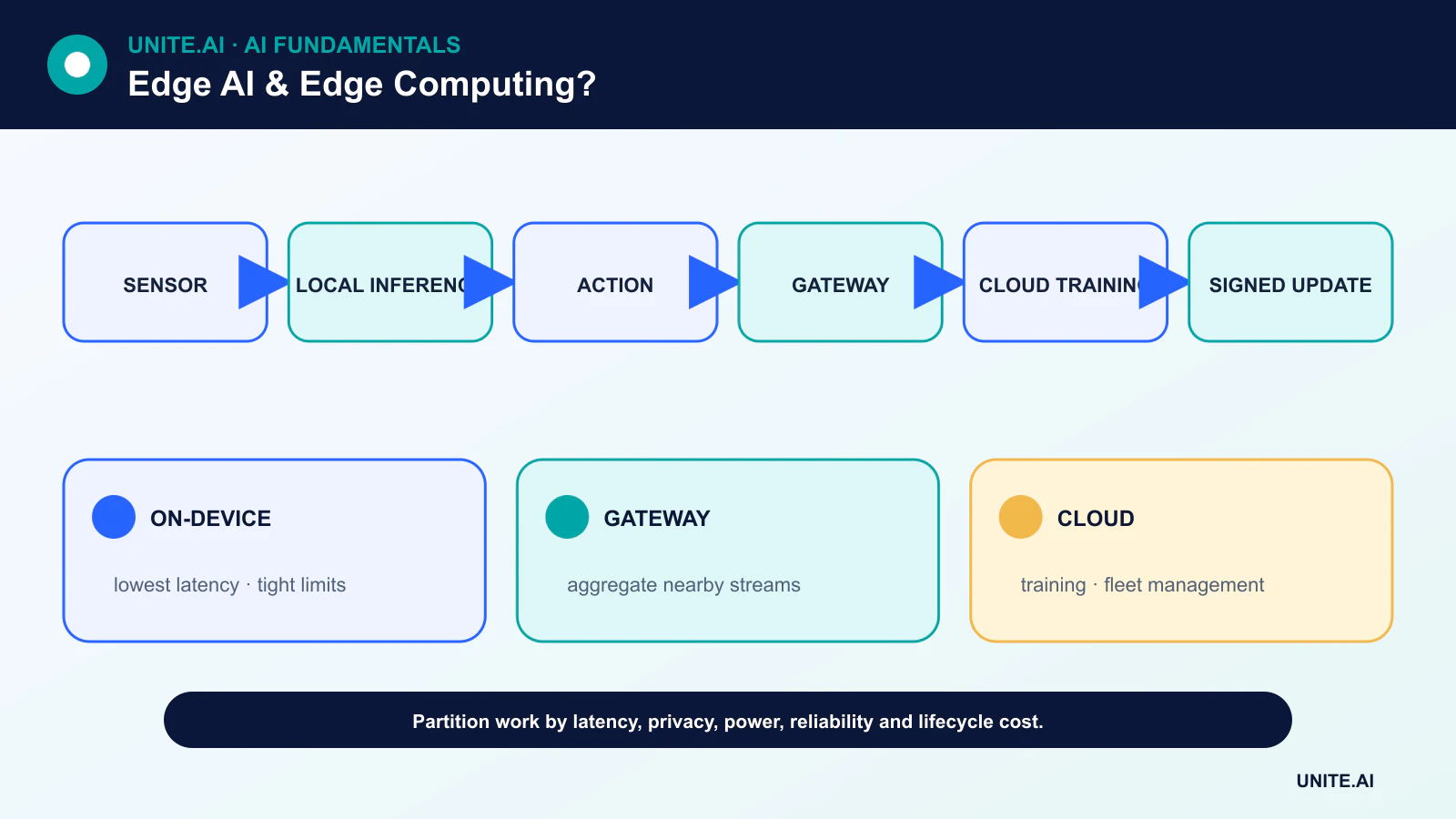
The architecture is usually a continuum rather than an edge-versus-cloud choice. Immediate decisions can stay local while the cloud supports fleet management, aggregate analytics, model training and long-term storage.
Key takeaways
- Edge AI can reduce latency, bandwidth use and raw-data transfer, but it does not automatically guarantee privacy.
- Memory, power, thermal limits and accelerator support shape the deployable model.
- Quantization, pruning and distillation trade model size and speed against accuracy and robustness.
- Secure updates, telemetry, rollback and hardware diversity are core parts of the system.
The edge–cloud continuum
A sensor may run a tiny threshold model, a nearby gateway may combine several streams, and a regional server may perform heavier inference. The cloud can train models and distribute signed updates. Partitioning depends on latency, connectivity, energy, data sensitivity and maintenance.
For industrial control, milliseconds and offline operation can justify local inference. For a low-frequency business prediction, centralized computation may be simpler and more observable.
Hardware and model constraints
Edge devices range from microcontrollers with kilobytes of memory to phones and servers with NPUs or GPUs. The model must fit storage and RAM, meet real-time deadlines, stay within thermal limits and use supported operators.
Benchmarking should include preprocessing, data movement and wake-up cost—not just kernel throughput. Batch size is often one, and sustained performance can differ from a short laboratory run.
Compression and optimization
Quantization represents weights and activations with lower precision. Pruning removes parameters or structures. Knowledge distillation trains a smaller student to imitate a larger teacher. Operator fusion and memory planning can further reduce latency.
Compression can change accuracy, calibration and subgroup performance. Teams should validate the converted artifact on target hardware rather than assuming the original floating-point model’s metrics still apply.
Privacy, federated learning and security
Local inference can keep raw audio, images or sensor records on the device, but metadata, embeddings and telemetry may still be sensitive. Federated learning can coordinate distributed training, with its own privacy and poisoning risks.
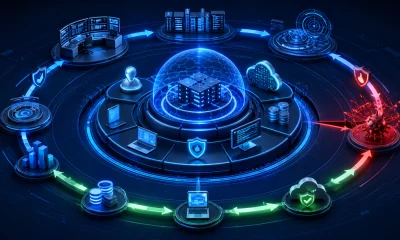
Edge fleets expand the attack surface. Secure boot, signed models, least-privilege services, encrypted communication and timely updates belong in the cybersecurity design. Physical access and long-lived unsupported devices must be assumed.
Monitoring and fleet operations
A local model still needs observability. Devices can report privacy-conscious aggregate metrics, version, health, latency and rejection rates. Sampling selected inputs for review requires explicit consent and retention controls.
Rollouts should use canary groups and automatic rollback. The system must handle incompatible hardware, interrupted updates and model drift. A device that cannot receive security fixes may need to be removed from service.
Edge architecture and workload placement
Edge computing processes data near its source—on a sensor, device, gateway, vehicle, retail site, or local server—rather than relying entirely on a distant cloud. Edge AI places model inference or sometimes training in that environment. Placement should follow latency, connectivity, bandwidth, privacy, resilience, energy, and management needs. A hybrid design may perform immediate detection locally, send selected events to a regional system, and use the cloud for fleet analytics and model training.
Hardware ranges from microcontrollers and NPUs to GPUs and rugged servers. Models are exported, quantized, pruned, distilled, or compiled for available operators and memory. Preprocessing and sensor I/O can dominate latency, while heat or battery limits sustained throughput. Benchmark the complete pipeline on the exact device under realistic concurrency, temperature, and power modes. A headline TOPS figure does not reveal operator fallback, memory transfers, or deployed accuracy.
Fleet security, updates, and observability
Distributed devices expand the attack surface and may be physically accessible. Use secure boot, signed firmware and models, hardware-backed identity where possible, encrypted communication, least privilege, network segmentation, and protected secrets. Updates need staged rollout, compatibility checks, anti-rollback policy where appropriate, interrupted-update recovery, and a known-good image. Inventory device, sensor, firmware, runtime, and model versions so an incident can be scoped quickly.
Connectivity is intermittent, so buffer data with bounded storage, sequence events, make retries idempotent, and define offline behavior. Observability should capture health, latency, power, input summaries, predictions, confidence, and confirmed outcomes without transmitting unnecessary raw data. Clock drift, sensor failure, and local storage exhaustion can invalidate results. Remote commands and debugging channels require stronger authorization because they can become fleet-wide control paths.
Responsible deployment
Local processing can reduce transfer but does not automatically protect privacy; raw inputs, embeddings, and logs may still remain on the device or sync later. Minimize retention and disclose cloud fallback. Test model drift across sites and environmental conditions, with a safe default when confidence or sensor health degrades. Edge AI is valuable when local constraints are real, but it transfers responsibility for lifecycle, security, and quality to a large heterogeneous fleet that must be designed and maintained as one system.
Worked example: edge AI for a remote safety camera
A remote site detects whether a restricted gate is open while machinery operates. The edge device processes video locally for low latency and transmits only events and permitted thumbnails. Data covers weather, night lighting, dirt, vibration, and empty scenes. The model is quantized and benchmarked end to end on the target device for detection, false alarms, latency, energy, and sustained thermal behavior.
Secure boot, signed updates, device identity, and segmented networking protect the fleet. Camera blockage, storage exhaustion, clock drift, network loss, and model timeout produce health alarms and a safe equipment rule independent of AI. Updates roll out to a small group with automatic rollback. Monitoring collects minimal health and outcome data, and site staff can inspect and override. Local inference reduces transfer but does not remove privacy, retention, or physical-security obligations.
Implementation evidence and operational readiness
A production decision needs more than a successful demonstration. Define the intended users, operating environment, inputs, outputs, dependencies, owner, and the consequence of each important failure. Establish a reproducible baseline and a versioned evaluation set before tuning. Test ordinary cases, boundary conditions, malformed or missing input, distribution shift, dependency outage, misuse, and the groups or environments most likely to be underserved. Measure task quality together with calibration or uncertainty, latency, throughput, resource cost, accessibility, privacy, and security. Record every transformation and threshold so an independent reviewer can reproduce the result and distinguish evidence from an attractive prototype.
Before launch, assign authority for release, exceptions, changes, rollback, and retirement. Use a staged rollout, preserve a safe fallback, and verify monitoring with deliberately injected failures. Operational telemetry should reveal input quality, output behavior, model or rule version, dependency health, human overrides, and confirmed outcomes without collecting unnecessary sensitive data. Define alert thresholds and a response owner, then review real-world evidence after deployment rather than assuming offline performance will persist. Reevaluate whenever data sources, users, models, vendors, policies, hardware, or objectives change. A maintained system also needs documented recovery, incident learning, deletion and retention procedures, and a clear point at which it should be disabled or replaced.
Frequently asked questions
Is edge AI always faster than cloud AI?
No. Local inference avoids network delay but may run on weaker hardware. The full pipeline and reliability requirements determine latency.
Can edge AI work without internet access?
Yes, if the model, preprocessing and decision logic are local. Updates, synchronization or cloud-dependent features may be unavailable.
Primary references