AI Fundamentals
What Is TinyML? Machine Learning on Microcontrollers

 Add Unite.AI to your preferred sources on Google
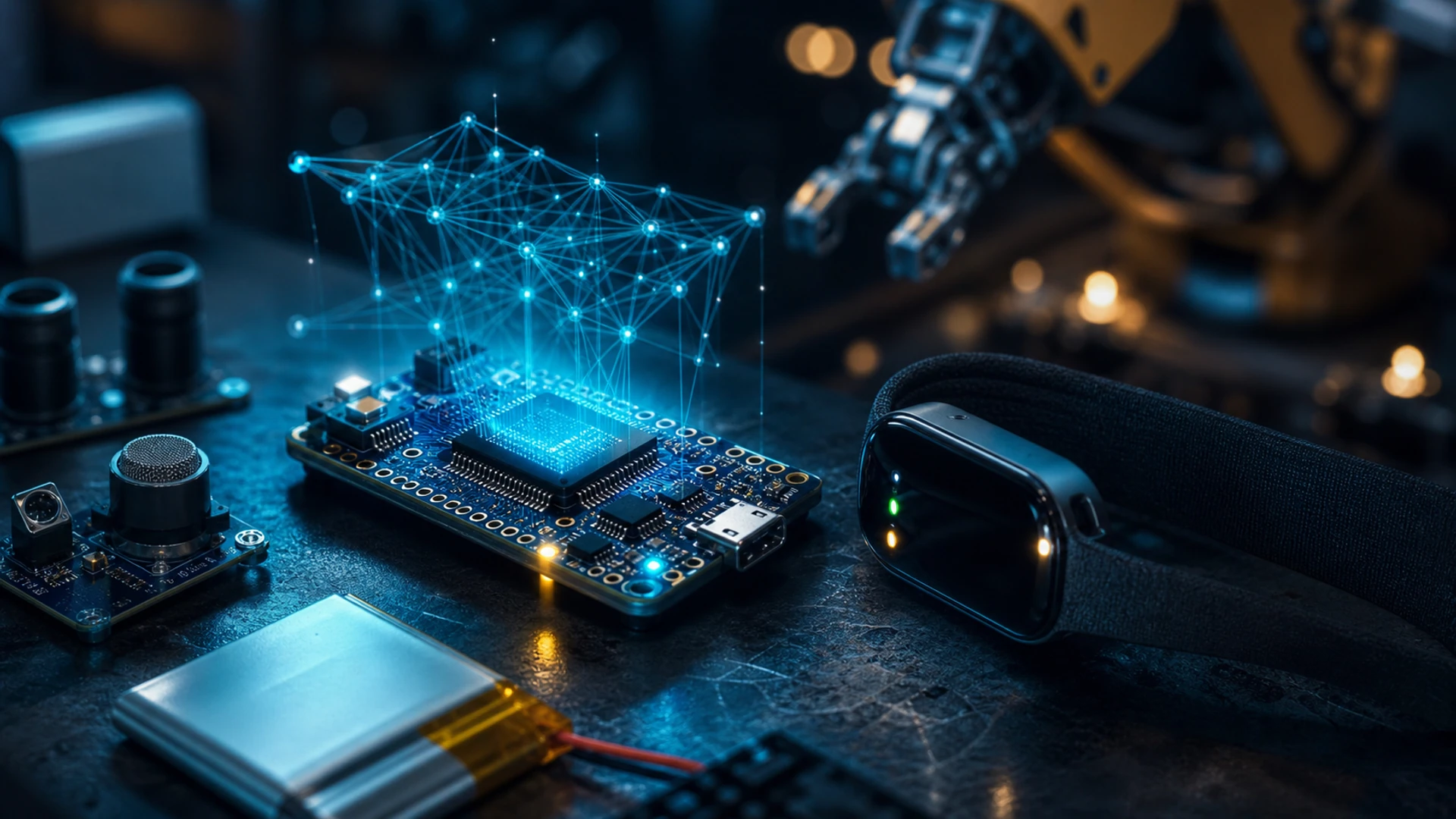
TinyML brings machine-learning inference to highly constrained devices such as microcontrollers, small digital signal processors, and low-power sensors. These systems may have kilobytes or megabytes of memory, strict energy budgets, no continuous network connection, and real-time deadlines.
The value is not simply a smaller model. Processing near the sensor can reduce latency, bandwidth, and exposure of raw data while enabling products that operate for long periods on batteries or harvested energy.
Key takeaways
- TinyML is defined by the complete hardware-and-software budget, not by one model-size threshold.
- Quantization, compact architectures, optimized kernels, and careful buffering make deployment possible.
- On-device inference can improve privacy, but secure updates and data governance still matter.
- Benchmark accuracy together with latency, peak memory, energy, duty cycle, and robustness.
The TinyML stack
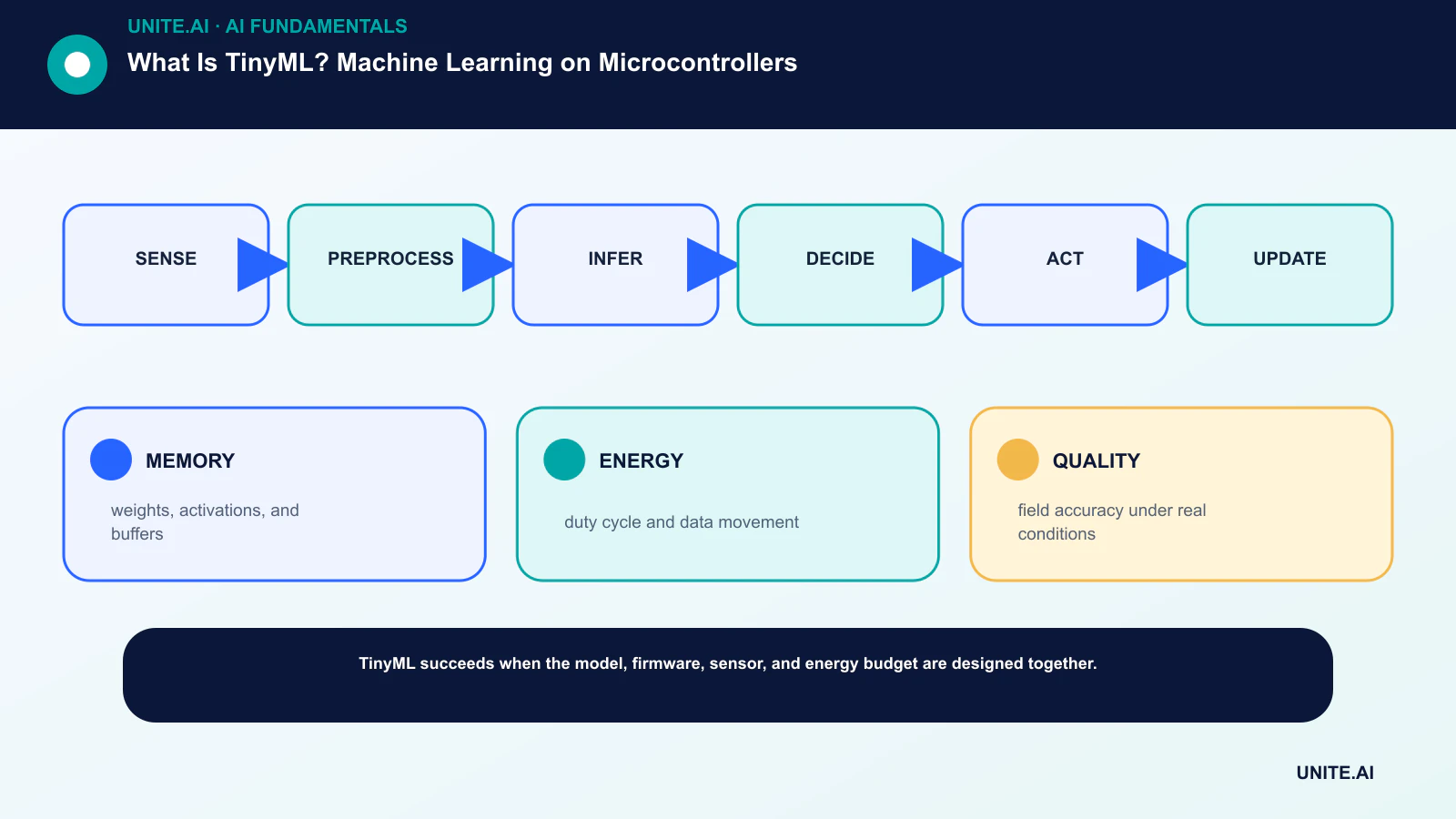
A sensor captures audio, motion, vibration, imagery, or another signal. Firmware preprocesses it into features or tensors; a compact model runs through an embedded runtime; application logic decides whether to wake a larger system or act locally.
This is a constrained form of edge AI. Hardware may include an MCU, memory, sensor interfaces, and sometimes a neural accelerator. Every buffer, operator, and copy competes for limited resources.
Make the model fit
Quantization replaces high-precision values with smaller integer representations. Pruning, distillation, feature engineering, and architecture search can reduce computation or storage. Operator support in the target runtime constrains which models are practical.
Training often happens on larger hardware, then the model is converted and compiled for the device. Transfer learning can reduce data needs, but the final artifact must be evaluated after conversion because numerical changes can alter accuracy.
Data and environmental shift
Laboratory recordings rarely represent every microphone, mounting position, temperature, vibration pattern, accent, or background condition. Collect data from representative devices and environments, keep train and test sources independent, and include ‘none of the above’ cases.
A false trigger can waste energy or annoy a user; a missed anomaly can be costly. Select thresholds using the real error costs, and monitor field performance through privacy-preserving summaries or sampled diagnostics where appropriate.
Measure the whole device
Model operation counts do not equal product performance. Report wake frequency, preprocessing time, inference latency, peak RAM, flash use, average and peak power, thermal behavior, and battery impact under an explicit duty cycle.
Plan signed firmware and model updates, rollback, device identity, and vulnerability response. Tiny devices may remain deployed for years, so maintainability is part of model quality. Cybersecurity controls cannot be deferred because the device is small.
Memory and compute budgeting
Flash stores firmware, model weights, and constants; RAM holds sensor buffers, intermediate activations, and runtime state. Peak activation memory can exceed weight size, especially in early convolutional layers. Memory planners reuse buffers whose lifetimes do not overlap, while streaming features avoid storing an entire signal window.
Operation count is an initial estimate, but kernel efficiency depends on tensor shape, alignment, instruction support, and memory access. A depthwise convolution may reduce arithmetic yet run poorly on hardware without an optimized kernel. Benchmark the compiled model on the target board, not only in a desktop profiler.
Duty cycling dominates many products. The sensor and MCU may sleep, wake for a cheap trigger, run a small model, and activate a radio or larger processor only when needed. Measure the whole duty cycle, including sensor, conversion, preprocessing, wake-up, inference, communication, and idle leakage.
Model development and conversion
Start with the deployment constraints and collect representative sensor data. Preprocessing used in training must match fixed-point or embedded implementation exactly. Differences in sample rate, windowing, color conversion, normalization, or feature extraction can cause a model to fail even when conversion succeeds.
Post-training quantization calibrates ranges from representative samples; quantization-aware training simulates lower precision during learning. Per-channel weight scales often preserve convolutional quality better than one scale. Unsupported operations may be rewritten, approximated, or moved to a slower fallback, each requiring new evaluation.
Compression should be hypothesis-driven. Pruning unstructured weights may not speed a dense embedded kernel; structured channel removal is easier for hardware to exploit. Distillation transfers behavior from a larger teacher but can transfer its bias and mistakes. Compare with signal-processing and threshold baselines.
Applications, field testing, and maintenance
Common TinyML tasks include keyword spotting, wake-word detection, gesture recognition, vibration anomaly detection, occupancy, acoustic events, and simple vision. The model may serve as a gate rather than the final decision, conserving bandwidth while sending uncertain or important cases to a more capable system.
Field tests should span device tolerances, sensor aging, mounting, battery state, temperature, weather, users, and background interference. Track false triggers per hour or missed events per operating cycle, not only balanced test accuracy. A threshold chosen in the lab may need product-specific calibration.
Plan for signed over-the-air updates, rollback, model-version telemetry, and long support periods. If updates are impossible, use conservative models and document expected environmental drift. Decommissioning must revoke device credentials and address stored data, not simply stop selling the product.
Worked example: a TinyML vibration monitor
A small accelerometer on a motor samples vibration under normal loads and known fault conditions. The device windows the signal, removes offset, computes compact time- or frequency-domain features, and runs an anomaly detector or classifier. Sampling rate must capture relevant bearing and shaft frequencies without overwhelming memory or power. Labels should come from verified inspections, not merely from an alarm that may itself be wrong.
Training occurs on a workstation, followed by quantization, conversion, and compilation for the target microcontroller. Measure model flash, peak RAM, execution time, energy, and accuracy on the physical device. Integer arithmetic and operator availability can change outputs from the training model. Test sensor orientation, mounting, temperature, voltage, component variation, and real background vibration, not only curated laboratory files.
The deployed device needs calibration, secure firmware updates, version reporting, fail-safe behavior, and a plan for drift. It may transmit only a health score or selected features to save energy and protect raw data, but local false alarms still create maintenance cost. Use a staged threshold, require persistence, and combine model evidence with operating state. TinyML is most valuable when local latency, privacy, connectivity, or energy constraints justify its engineering limits.
Production testing should include power-cycle recovery, clock drift, sensor disconnects, corrupted input, memory exhaustion, and interrupted updates. Define what happens when the model cannot run or confidence collapses: a safe default, an explicit fault indicator, or a conventional rule may be preferable to a silent guess. Track fleet hardware and firmware versions so a newly observed error can be isolated to a device revision, environment, or model release.
Practical implementation checklist
Turn the concept into a bounded, testable workflow: sense → preprocess → infer → decide → act → update. Name an accountable owner, document the data and dependencies, establish a simple baseline, set acceptance and stop criteria, test representative failures, and define monitoring, rollback, and review before expanding scope. Record versions and assumptions so another team can reproduce the result and understand what changed.
Before launch, run a documented readiness review with the people who build, operate, secure, and are affected by the system. Test normal cases, boundary conditions, dependency failures, and misuse; preserve the evidence and unresolved risks. Define who can approve release, change a threshold, override an output, or stop operation. Revisit the decision after real-world data arrives, because a technically successful pilot does not guarantee reliable performance at broader scale.
- MEMORY: weights, activations, and buffers.
- ENERGY: duty cycle and data movement.
- QUALITY: field accuracy under real conditions.
Frequently asked questions
Is TinyML the same as mobile AI?
Not exactly. Mobile devices are edge systems with comparatively large processors and memory. TinyML focuses on much tighter embedded and microcontroller-class constraints.
Can TinyML models learn on the device?
Most deployments train elsewhere and infer on-device. Limited adaptation is possible, but memory, energy, stability, privacy, and rollback make on-device training harder.
Primary references