AI Fundamentals
What Are Large Language Models (LLMs)?

 Add Unite.AI to your preferred sources on Google

A large language model (LLM) is a neural network trained on large collections of sequences to predict tokens or related language objectives. Most current LLMs use transformer architectures and can generate, classify, summarize, translate, retrieve, and transform language through a common interface.
An LLM is not a database or a guaranteed reasoner. Its output is a conditional prediction shaped by training data, post-training, context, tools, and decoding. Fluency can coexist with factual error, uncertainty, bias, or unsafe behavior.
Key takeaways
- Tokenization converts text into discrete units; embeddings and attention build contextual representations.
- Pretraining learns broad patterns, while fine-tuning and preference methods shape task behavior.
- Retrieval and tools can add current evidence or actions, but require separate permissions and validation.
- Evaluate the deployed system for quality, groundedness, safety, latency, cost, and drift.
Tokens, transformers, and pretraining
Text is divided into tokens. A transformer maps them into vectors, mixes information through attention and feed-forward layers, and produces a probability distribution over the next or missing token.
Self-supervised objectives create training signals from raw sequences. Scale in parameters, data, and compute can improve loss predictably over ranges, but dataset quality, architecture, optimization, and evaluation determine what capabilities emerge in practice.
Post-training and inference
Instruction tuning uses demonstrations; preference optimization can make outputs better match human judgments or a policy. At inference, a prompt and conversation history define context, while temperature and sampling settings influence variability.
RLHF and similar methods shape behavior rather than installing a complete fact checker. The model may still generate a plausible but unsupported answer.
Retrieval, tools, and agents
Retrieval-augmented generation supplies passages selected from an external collection. Tool calling lets application code query databases, calculate, search, or act. These patterns separate some knowledge and execution from model weights.
The application must validate tool arguments, enforce permissions, preserve citations, and treat retrieved content as untrusted input. Vector similarity search helps retrieval but does not prove that a passage supports the answer.
Limitations and evaluation
LLMs can hallucinate, expose memorized content, follow malicious instructions, reproduce bias, and fail on tasks that appear similar to training examples. Long context does not guarantee that every fact is used or reconciled correctly.
Evaluate on representative private tasks with documented prompts and versions. Measure support by sources, refusal, calibration, security, subgroup outcomes, human workload, latency, and cost. Monitor after release because models, data, and user behavior change.
Training data and model development
Pretraining corpora combine web pages, books, code, academic material, conversations, and licensed or curated sources. Pipelines detect language, remove duplicates, filter quality and unsafe content, handle personal data, and choose mixture weights. These choices shape knowledge, language coverage, style, bias, and memorization.
Optimization processes batches of token sequences and minimizes prediction loss with gradient descent. Distributed training splits data, model tensors, pipeline stages, or experts across accelerators. Checkpointing, numerical stability, network communication, and fault recovery become major engineering concerns at scale.
Evaluation during training tracks loss and capability suites, but benchmark contamination can inflate results. Hold out time periods and proprietary tasks, search for overlap, and report exact prompts, decoding, tools, and scoring. A model can improve average loss while regressions appear in safety or a low-resource language.
Context windows, decoding, and inference
At inference, the key–value cache stores attention projections for earlier tokens so they need not be recomputed at every step. Cache memory grows with layers, sequence, batch, and representation. Quantization and paging reduce pressure but can change quality or latency.
Greedy decoding selects the highest-probability token; temperature rescales probabilities; top-k and top-p restrict the candidate set; beam search tracks several sequences. The best strategy depends on whether the task values determinism, diversity, structured output, or sequence likelihood. Always validate schema after generation.
Long context increases the amount of available information, not guaranteed recall or reasoning. Position, distractors, contradictions, and prompt structure affect use. Retrieval can select a smaller evidence set, while summarization compresses history at the risk of losing detail. Measure performance across context length and location.
Adaptation, deployment, and economics
Full fine-tuning updates all parameters; parameter-efficient methods update adapters or low-rank matrices; continued pretraining adapts domain distribution; instruction and preference tuning shape responses. Retrieval is often better for frequently changing facts, while tuning is better for behavior and task format. The methods can be combined.
Deployment choices include hosted APIs, managed endpoints, self-hosted open weights, on-device models, and hybrids. Compare data handling, version control, latency, throughput, regions, availability, model portability, support, and total cost. Self-hosting transfers responsibility for security, scaling, updates, and abuse monitoring.
Cost per token is incomplete. A weak model may require retries, longer prompts, more review, or expensive errors. Measure cost per successfully completed task at a required quality and risk level. Use caching, batching, smaller routed models, and deterministic code where they improve the complete workflow.
Worked example: grounding an LLM in enterprise documents
A document assistant should begin with a permission-aware corpus, stable document identifiers, version and effective dates, parsable structure, and an evaluation set of answerable, unanswerable, ambiguous, and conflicting questions. Retrieval indexes chunks and metadata, but chunk size and overlap must match document structure. Search quality is measured independently before generation so a fluent model cannot hide missing evidence.
At runtime, authenticate the user, filter retrieval by access, retrieve and rerank evidence, construct a bounded prompt, generate a cited answer, and validate required output. The model should state when sources conflict or do not support an answer. Tool use and external actions require separate authorization. Protect against instructions embedded in retrieved documents by treating content as data rather than higher-priority system policy.
Evaluate retrieval recall, citation precision, answer correctness, groundedness, refusal, latency, and cost across roles and document types. Track model, prompt, index, parser, and corpus versions for every test. In production, log evidence IDs and feedback without exposing private text, monitor newly unanswerable questions after content changes, and maintain a safe fallback. An LLM interface does not replace records management, access control, or accountable subject-matter review.
Capacity planning should model prompt and output length distributions, concurrent users, cache behavior, tool latency, and retry rates. Streaming improves perceived latency but complicates moderation and cancellation because unsafe or incorrect content can reach the user before the full response is checked. Set token and tool budgets, isolate tenants, protect provider credentials, and rehearse failover between model versions without silently changing the behavior users depend on.
Practical implementation checklist
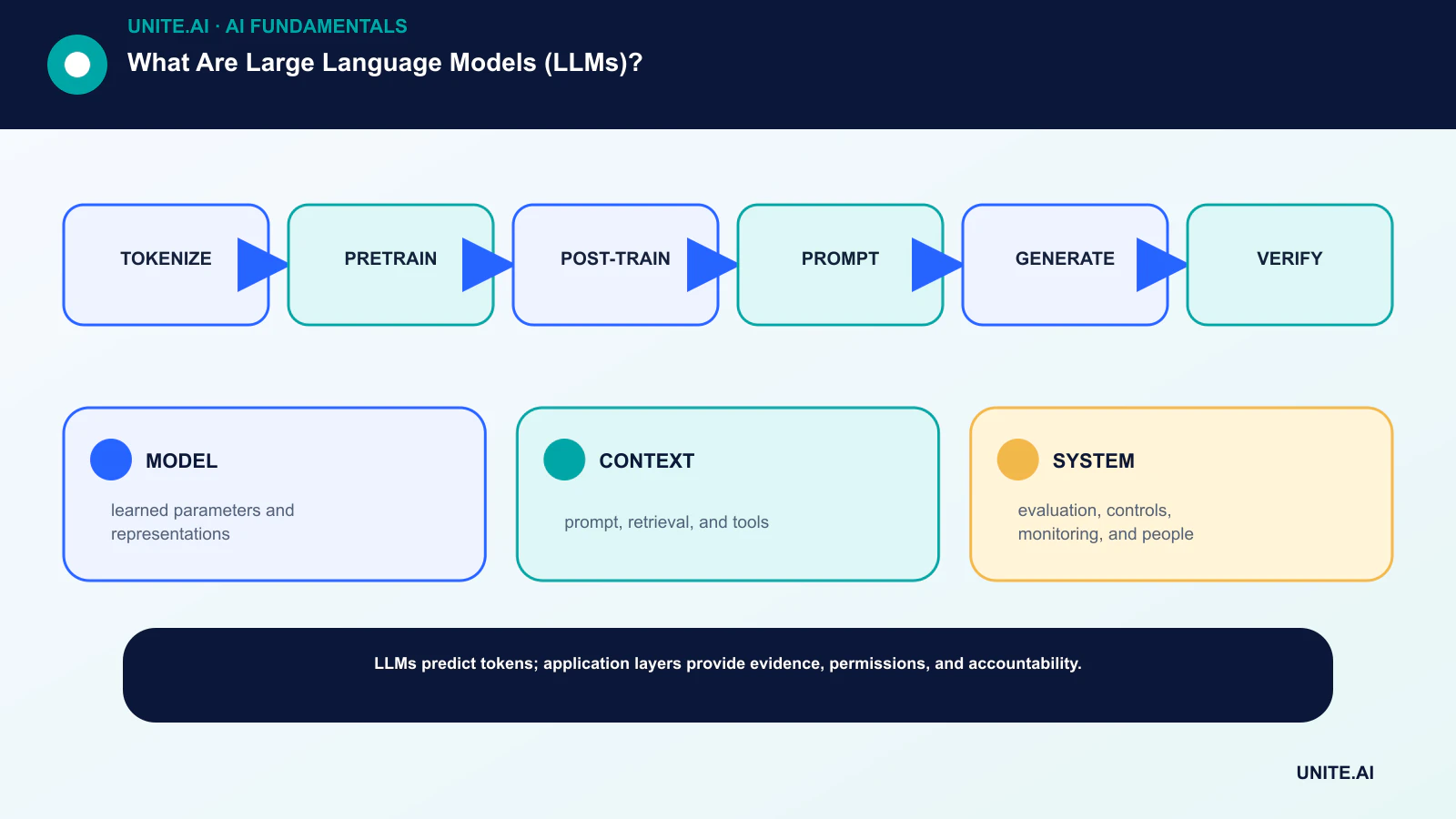
Turn the concept into a bounded, testable workflow: tokenize → pretrain → post-train → prompt → generate → verify. Name an accountable owner, document the data and dependencies, establish a simple baseline, set acceptance and stop criteria, test representative failures, and define monitoring, rollback, and review before expanding scope. Record versions and assumptions so another team can reproduce the result and understand what changed.
Before launch, run a documented readiness review with the people who build, operate, secure, and are affected by the system. Test normal cases, boundary conditions, dependency failures, and misuse; preserve the evidence and unresolved risks. Define who can approve release, change a threshold, override an output, or stop operation. Revisit the decision after real-world data arrives, because a technically successful pilot does not guarantee reliable performance at broader scale.
- MODEL: learned parameters and representations.
- CONTEXT: prompt, retrieval, and tools.
- SYSTEM: evaluation, controls, monitoring, and people.
Frequently asked questions
Why are LLMs called large?
There is no universal parameter threshold. ‘Large’ refers to scale relative to earlier language models, including parameters, training data, compute, and breadth of use.
Do LLMs understand language?
They build useful internal representations and display complex behavior, but the word ‘understand’ has several meanings. Performance should be demonstrated task by task rather than inferred from fluency.
Primary references