Thought Leaders
How Edge AI Is Redefining Stadium and Venue Security Ahead of the 2026 FIFA World Cup

 Add Unite.AI to your preferred sources on Google
As global anticipation builds for the 2026 FIFA World Cup, millions of fans will soon fill stadiums across North America, bringing with them the excitement – and unpredictability – of massive live events. For venue operators, the challenge is clear: how to protect tens of thousands of people in real time without compromising the celebratory, seamless experience fans expect.
It’s a balancing act. On one hand, maximum safety requires comprehensive screening, surveillance, and situational awareness. On the other, long queues, invasive security checks, or slow entry processes can quickly turn fan excitement into frustration. Edge AI is emerging as the key to reconciling these opposing forces by delivering proactive, intelligent security that’s contactless, efficient, and cost-effective.
The Real-Time Security Challenge
Most stadiums still rely on a patchwork of legacy systems including siloed cameras, on-premises servers, and manual monitoring. These setups are costly to operate, difficult to scale, and, most critically, often incapable of generating real-time intelligence. In a stadium of 60,000+ fans, even a few seconds of delay in detecting a weapon, altercation, or crowd surge can mean the difference between prevention and crisis.
Cloud-based AI systems offer analytical power, but depend on stable, high-bandwidth connectivity – a resource that can collapse under the strain of tens of thousands of fans streaming and posting. Latency or connectivity failures can delay security response times just when they’re needed most.
That’s where Edge AI can make a difference. By processing data directly where it’s captured – on the camera itself via AI vision processors or the network video recorder (NVR) via an embedded AI accelerator – Edge AI eliminates the need to send large video streams to the cloud, cutting delays and making proactive, real-time security possible.
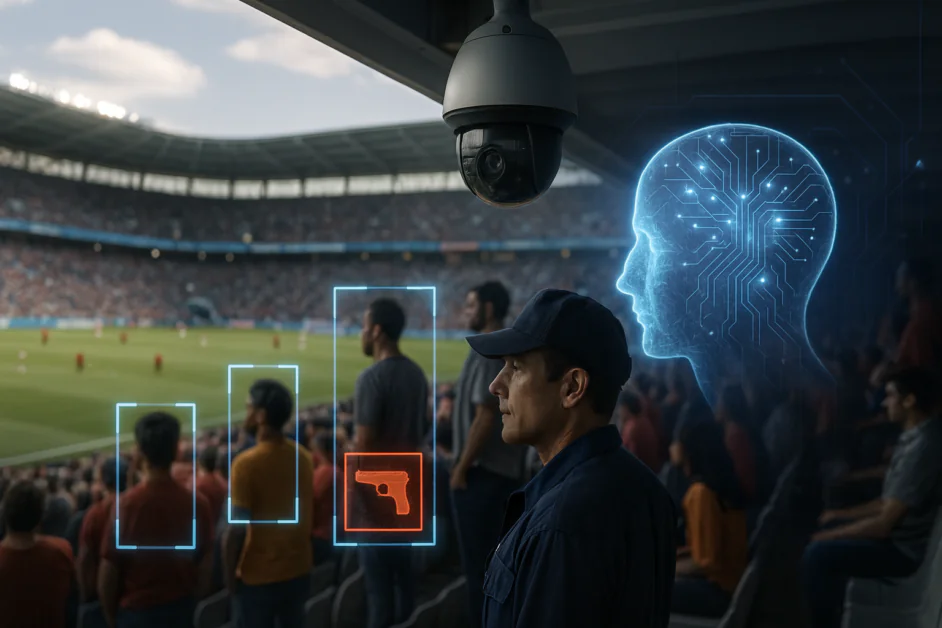
Edge AI enables stadiums to detect concealed weapons or suspicious behavior in real time without forcing fans through hours-long queues. Systems can monitor crowd flow to prevent bottlenecks, identify altercations or medical emergencies the moment they occur, and provide data on occupancy that operators can use to improve layouts and traffic management.
The result is a no-contact, frictionless experience for event attendees. Fans can move more freely through edge AI-enhanced checkpoints, where systems continuously scan for threats in the background. And security teams can confidently intervene only when necessary, keeping lines shorter and spirits high.
Hybrid AI Architectures: A Unified Path Forward
Of course, few venues can afford to completely rebuild their security infrastructure – but Edge AI offers multiple pathways to modernization. Operators can retrofit existing infrastructure with AI accelerators at the NVR or gateway level, deploy in-camera vision processors for faster, on-device analytics, or even combine both approaches. This layered strategy gives stadium operators the flexibility to scale gradually while maintaining consistent intelligence across the facility.
Modernization also means rethinking how edge and cloud systems work together. Edge AI provides the immediacy of detecting and classifying threats in real time, directly where data is generated. The cloud then adds depth and scale: checking against databases to identify potential suspects, or reviewing event-triggered clips with larger AI models to confirm or reject detections.
Together, this hybrid model ensures that even during network disruptions or bandwidth overloads, critical threat detection continues uninterrupted at the edge. Once connectivity is restored, cloud systems can process aggregated data for long-term insights, training models, and refining detection accuracy.
Beyond Safety: The Operational and Financial Impact
The advantages of AI-driven security extend far beyond immediate threat detection. A frictionless, contactless screening experience reduces queues and crowding – improving guest satisfaction while minimizing staffing costs. In a high-stakes environment where a single disruption can cost millions in lost revenue or reputational damage, the ROI of proactive, always-on situational awareness is undeniable. Edge AI protects not only people, but also the long-term financial health and operational resilience of venues.
Some venues are already realizing these benefits. Ohio’s Nationwide Arena retrofitted its existing camera infrastructure with a powerful, camera-agnostic video management system powered by Hailo’s AI accelerators, enabling real-time situational awareness and seamless system integration across the venue. The result is a modern, unified platform capable of proactive alerts and centralized management for all 350 cameras.
Smarter Systems, Stronger Teams
Edge AI doesn’t replace human security personnel, but rather empowers them to deliver a safer and more efficient security experience. Smart cameras equipped with AI can continuously monitor every corner of a venue, surfacing anomalies a human might miss. Automated alerts and recommendations transform raw footage into actionable intelligence, enabling teams to apply their judgment and presence with greater precision.
The 2026 World Cup will test the limits of venue technology and security readiness across North America. Edge AI offers a proven path forward: delivering protection at scale, operational efficiency behind the scenes, and a fan experience that feels seamless. Most importantly, it empowers the human teams who stand on the front lines of security, ensuring they have the intelligence and tools to protect what matters most.