AI Fundamentals
What Is a Mixture-of-Experts Model? Sparse AI Explained

 Add Unite.AI to your preferred sources on Google

A mixture-of-experts (MoE) model contains multiple parameterized expert networks and a router that selects a small subset for each input or token. Because only selected experts execute, the model can increase total parameter capacity without activating every parameter on every forward pass.
Sparse activation does not make computation or memory free. MoE systems must store and move many parameters, balance tokens across experts, coordinate devices, and prevent routing instability. Total parameter count and active parameter count describe different costs.
Key takeaways
- Routers compute expert scores and dispatch tokens to top-k experts.
- Capacity limits and load-balancing objectives prevent a few experts from receiving all tokens.
- Sparse compute can improve capacity per operation but increases communication and memory complexity.
- Evaluate quality, active compute, latency, memory, routing behavior, and serving topology together.
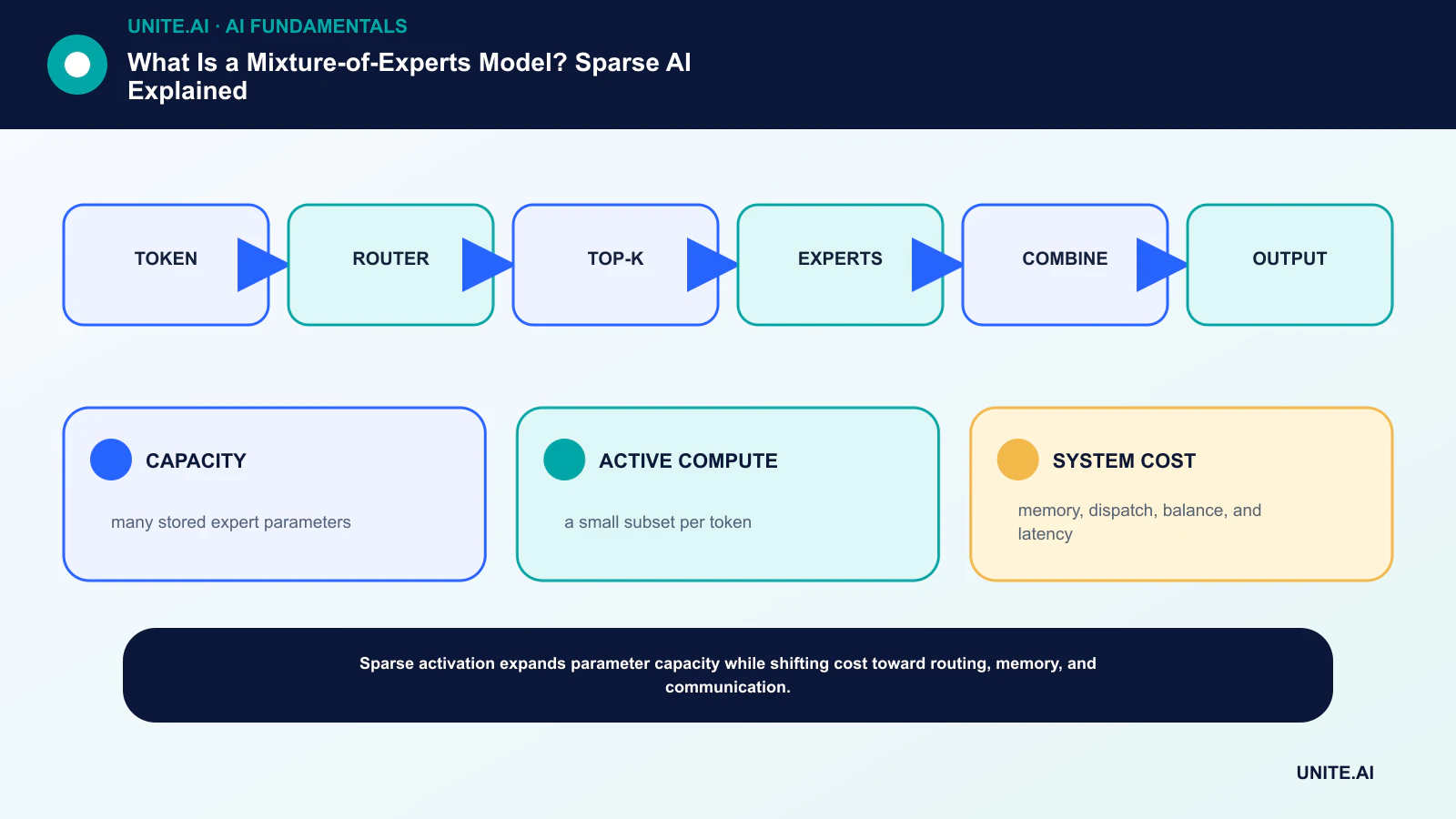
Router and expert layers
In transformer MoE models, selected feed-forward layers are often replaced by expert feed-forward networks. A router scores each token and sends it to one or more experts; their outputs are weighted and returned to the main residual stream.
Attention may remain dense. The surrounding transformer therefore uses a mix of shared computation and conditional expert computation.
Capacity and load balancing
Each expert can process a limited number of tokens in a batch. If too many tokens choose the same expert, some implementations drop or reroute overflow. Auxiliary losses encourage balanced use, while routing noise can improve exploration during training.
Equal traffic is not the same as meaningful specialization. Inspect expert usage by domain, position, and task, but avoid assigning human-readable roles without causal evidence.
Why serving is difficult
Although only a subset is active, all expert weights may need to reside across accelerator memory. Expert parallelism sends tokens between devices, making network bandwidth and all-to-all communication critical. Small batches can underutilize experts.
Quantization, caching, batching, and topology-aware routing can help. Compare MoE and dense alternatives at the same output quality, context, hardware, and service-level objective—not only active FLOPs.
What MoE does and does not imply
MoE provides conditional computation and capacity. It does not guarantee factuality, modular reasoning, interpretability, or a panel of independent agents. Expert networks are learned jointly and may share diffuse features.
MoE complements generative-AI post-training and compression. Monitor routing drift, tail latency, expert failures, memory, and domain quality after deployment.
Routing, expert capacity, and sparse computation
A mixture-of-experts layer contains multiple expert networks and a router that assigns each token to a small subset, often the top one or two experts. The model can hold many parameters while activating only a fraction per token. Sparse activation reduces compute relative to a dense model of similar total parameter count, not to every smaller model.
The router produces expert scores, applies a selection rule, and dispatches token representations. Each expert has finite capacity. If too many tokens choose one expert, the system must drop, reroute, or pad tokens. Capacity factor, auxiliary balancing losses, router noise, and expert parallelism trade quality against utilization and communication.
Experts are not guaranteed to map cleanly to human concepts or domains. Specialization emerges from optimization and may be distributed, unstable, or token-dependent. Interpretability claims should examine routing across layers and contexts and use interventions, not just labels inferred from a handful of high-scoring tokens.
Training and serving distributed MoE models
Training combines data, tensor, pipeline, and expert parallelism. Tokens must often travel between accelerators to reach selected experts, so all-to-all communication can erase arithmetic savings. Placement, batch composition, network bandwidth, token packing, and overlapping communication with computation are central system-design choices.
Load imbalance creates idle experts and overloaded devices. Auxiliary objectives encourage balanced routing but can interfere with the main learning objective; newer methods may adjust bias or routing dynamics. Monitor per-expert token counts, dropped tokens, entropy, gradients, and device time rather than relying on aggregate loss alone.
Serving is difficult because all expert weights may need to remain available even though each token uses only a few. Memory capacity, interconnect, batching, cache behavior, and routing variability affect latency. Quantization and expert offloading help in some settings but can add transfers. Benchmark the exact model and hardware topology.
Quality, evaluation, and deployment tradeoffs
Evaluate MoE models against dense baselines at matched quality, training compute, inference compute, memory, latency, and cost. A parameter-count comparison alone is misleading. Test long contexts, languages, domains, rare tokens, and adversarial prompts because router behavior may shift with distribution and create uneven capabilities.
Routing introduces additional failure modes: expert collapse, unstable specialization, token dropping, correlated outages, and sensitivity to batch composition. Deterministic evaluation should control runtime and routing settings. Operational monitoring should include expert utilization and communication health so a system problem is not mistaken for ordinary model variance.
MoE is attractive when scaling total capacity matters and infrastructure can support sparse distributed execution. Dense models may remain simpler and faster for small batches, edge devices, or constrained interconnects. The architecture is a systems tradeoff, not a universal replacement for dense transformers.
Worked example: evaluating an MoE language model
A research team compares an MoE transformer with dense baselines using matched training tokens and several resource views: active parameters per token, total parameters, accelerator memory, network traffic, training time, inference throughput, and latency. It logs router probabilities, tokens per expert, overflow, dropped tokens, and auxiliary loss by layer, language, and domain. A lower arithmetic count is not accepted as efficiency if communication or underutilization raises total cost.
Quality evaluation covers knowledge, reasoning, long context, rare domains, multilingual tasks, safety, and calibration. The team perturbs batch composition and prompt distribution to see whether routing and output change unexpectedly. Causal expert ablations test specialization claims, while expert failures and network degradation reveal resilience. Results are compared at the same service-level target because a model that only performs well in large batches may not fit interactive use.
For deployment, experts are placed to minimize all-to-all traffic, weights are quantized only after per-expert sensitivity checks, and runtime monitoring detects imbalance or unavailable devices. Capacity and routing settings are versioned with the model. The team chooses MoE only if added parameter capacity improves required tasks enough to justify memory and distributed-systems complexity; otherwise a dense model may be cheaper, easier to operate, and more predictable.
Practical implementation checklist
Turn the concept into a bounded, testable workflow: token → router → top-k → experts → combine → output. Name an accountable owner, document the data and dependencies, establish a simple baseline, set acceptance and stop criteria, test representative failures, and define monitoring, rollback, and review before expanding scope. Record versions and assumptions so another team can reproduce the result and understand what changed.
Before launch, run a documented readiness review with the people who build, operate, secure, and are affected by the system. Test normal cases, boundary conditions, dependency failures, and misuse; preserve the evidence and unresolved risks. Define who can approve release, change a threshold, override an output, or stop operation. Revisit the decision after real-world data arrives, because a technically successful pilot does not guarantee reliable performance at broader scale.
- CAPACITY: many stored expert parameters.
- ACTIVE COMPUTE: a small subset per token.
- SYSTEM COST: memory, dispatch, balance, and latency.
Frequently asked questions
Are MoE experts separate models?
Usually no. They are subnetworks inside one trained model, connected by a router and shared layers. Their learned specialization may not align with intuitive domains.
Why can an MoE have many parameters but moderate compute?
Only a small top-k set of experts activates for each token. The inactive expert parameters still consume storage and memory and may create communication cost.
Primary references