
Reports
2026 State of Manufacturing & Supply Chain: AI, Resilience, and the Path Forward

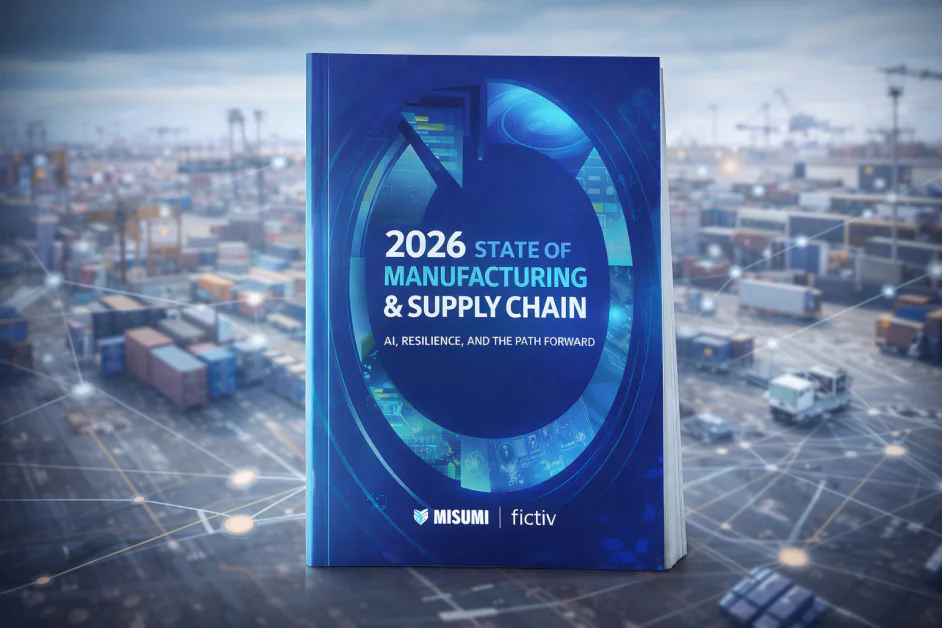
The newly released 11th Annual State of Manufacturing & Supply Chain Report, published by Fictiv, a global supply chain and manufacturing company, in partnership with MISUMI Global, a leading worldwide supplier of mechanical components and manufacturing services, presents a portrait of an industry that is no longer simply responding to disruption, but actively redesigning itself around it. Based on a survey of more than 300 senior supply chain and manufacturing leaders, including 321 director-level and above executives across MedTech, EV, Robotics, and Climate Tech, the findings reveal that volatility has become structural, AI is now viewed as essential infrastructure, and resilience is being built directly into operating models.
This is not incremental optimization. It is a reset of how manufacturing competes.
AI Has Crossed the Line From Advantage to Requirement
In previous years, AI was framed as transformational. In 2026, it is foundational.
The report finds that 97% of leaders say AI is already embedded in core workflows, and 95% say implementing AI is vital to their company’s future success. AI maturity has jumped from 87% to 93% year-over-year, reinforcing that adoption is accelerating, not plateauing.
The center of gravity has shifted. AI is no longer confined to experimentation or pilot projects. It is deeply integrated into supply chain management, inventory management, quality control and inspection, and product design.
Year-over-year, AI deployment in supply chain management rose by 18 percentage points, the single largest increase in functional adoption.
What makes this moment different is not just usage—it’s expectation. A striking 98% of leaders believe AI will drive meaningful productivity gains, with many anticipating 50–100% improvements, and a significant cohort expecting 2–5x gains. A smaller but notable group even forecasts productivity increases beyond 5x.
AI’s biggest early impact in product development is occurring where pain has historically been greatest: quality control and design-for-manufacturability (DFM). Leaders increasingly expect AI to reduce rework loops, detect defects earlier, and surface manufacturability risks before they cascade into cost overruns.
The competitive question is no longer whether AI is used. It is how quickly and systematically it is deployed across workflows.
Digital Manufacturing Platforms Are Becoming Non-Negotiable
If AI is the intelligence layer, digital manufacturing platforms are the operating system.
Belief that digital platforms are essential for production has climbed from 86% in 2024 to 97% in 2026—a dramatic standardization in just two years. What was once viewed as helpful infrastructure is now considered critical to competitiveness.
Nearly 98% of leaders identify significant opportunities to improve supply chains, particularly through quality management, supply chain design support, and DFM, costing, and engineering services.
Manufacturers are increasingly moving away from fragmented, inbox-driven supplier coordination toward centralized, traceable, platform-led execution. Repeatable DFM processes, measurable quality workflows, and predictable lead times are becoming baseline expectations rather than premium differentiators.
Digital is no longer an IT initiative. It is risk mitigation, speed optimization, and margin protection rolled into one.
Sourcing Complexity Is Intensifying
Even as digital adoption rises, friction in the system is increasing.
In 2026, 81% of leaders say supplier sourcing and management is too time-consuming and costly, up from 73% the year before. Complexity is expanding across custom and standard mechanical components, and the coordination burden is rising.
The most pressing lifecycle challenge? Manufacturing planning.
62% of respondents identify manufacturing planning as the greatest supply chain challenge, ahead of sourcing, prototyping, and general demand forecasting. Planning failures are systemic, cascading across design, sourcing, and production.
Engineering bandwidth has become another critical bottleneck. A remarkable 83% of engineers spend four or more hours per week on procurement-related tasks—time diverted from design, testing, and innovation. When asked how productivity would change if those administrative tasks were offloaded, 93% said it would improve moderately or significantly, with 62% predicting significant improvement.
The implication is profound: operational redesign—not just automation—will determine who brings products to market faster.
Volatility Is Now Structural
The report confirms what most executives already feel: global instability is no longer episodic.
Geopolitical tensions are now a significant factor in long-term strategy for 71% of respondents, up from 51% in 2025. Trade compliance and tariff expertise have become core requirements rather than edge capabilities. In fact, 99% say working with suppliers who understand tariffs and compliance is important, and 98% are actively taking steps to mitigate tariff impacts.
Raw material volatility is equally pervasive. 98% report material cost pressures affecting sourcing strategies, forcing moderate to major adjustments across industries including MedTech (90%), Climate Tech (88%), EV (86%), and Robotics (85%).
In response, organizations are adding sourcing partners, redesigning parts, increasing automation, and prioritizing regional diversification. Resilience is no longer about redundancy—it is about optionality built into design and supplier networks.
Regional Resilience Is Reshaping Manufacturing Geography
Perhaps the clearest structural shift in the report is the move toward on-shoring and near-shoring.
In 2026, 81% want to increase U.S. manufacturing, 59% want to increase North American production, and 49% still plan to diversify global manufacturing operations.
Industry intensity is even stronger in key verticals. EV companies lead at 90% seeking expanded U.S. manufacturing, followed by Climate Tech at 87%, MedTech at 82%, and Robotics at 69%.
The United States now ranks highest as a preferred sourcing region at 89%, followed by Canada (47%), Mexico (39%), and the European Union (36%).
But the shift is nuanced. Leaders emphasize that regionalization must remain globally connected. Multi-region sourcing is not merely about cost arbitrage—it is about understanding local execution, regulatory environments, and cultural differences to reduce risk rather than amplify it.
Supplier Quality Is Measured in Data, Not Trust
If volatility is increasing, tolerance for supplier underperformance is shrinking.
Supplier quality certifications and services are important to 98% of respondents, with strong emphasis on traceability, inspection reports, ISO certifications, and APQP frameworks.
When selecting partners, 99% say quality is measured in execution, not assertions. The most critical metrics include sourcing and capacity, on-time delivery, corrective action turnaround, and captured and escaping defect rates.
Across EV and Climate Tech in particular, APQP importance is exceptionally high at 71% and 75%, respectively.
Supplier selection is shifting decisively toward documented systems and measurable performance.
Sustainability Has Become Operational, Not Aspirational
One of the most significant year-over-year shifts appears in sustainability.
In 2025, 60% said implementing sustainable practices was “very important.” In 2026, that figure jumped to 73%.
Across industries, 96% say sustainability is part of sourcing decisions. Climate Tech (83%) and EV (81%) lead intensity, but even Robotics (67%) and MedTech (61%) show strong integration.
Sustainability is no longer confined to ESG reporting. It is influencing supplier selection, materials decisions, network design, and governance documentation.
Larger enterprises are further ahead in formal sustainability governance, meaning mid-market suppliers will increasingly face cascading requirements from major OEM customers.
The Strategic Inflection Point
The conclusion of the report poses a blunt question: when will supply chain be treated as strategic?
The data suggests that 2026 may be the turning point. AI is embedded. Digital platforms are standardized. Planning discipline is tightening. Regional resilience is expanding. Quality and compliance expectations are measurable. Sustainability is operationalized.
Manufacturers are no longer optimizing isolated functions—they are building cohesive operating systems.
In a world where volatility is constant and speed is currency, the leaders of 2026 are not simply adapting. They are engineering resilience directly into how decisions are made, how products are designed, and how supply chains execute.
The competitive baseline has shifted. The only remaining question is who moves fastest.



