AI Fundamentals
Influence Engineering: Personalization, Persuasion, and AI Ethics

 Add Unite.AI to your preferred sources on Google

Influence engineering is a useful umbrella term for designing digital systems that intentionally shape attention, choices, or behavior. Recommendation, personalization, experimentation, persuasive interface design, and emotion-related signals can all be components, but the term is not a settled technical discipline with one standard definition.
The central question is whether a system supports a person’s own goals or steers them through hidden, deceptive, or exploitative mechanisms. More predictive power increases the need for consent, transparency, limits on sensitive inference, independent review, and measurable user welfare.
Key takeaways
- Separate beneficial guidance from manipulation by examining intent, method, disclosure, and user control.
- An inferred emotion is a probabilistic model output, not direct access to a person’s internal state.
- Optimize for user outcomes and long-term welfare, not engagement alone.
- Provide meaningful choice, data minimization, contestability, and monitoring for disparate impact.
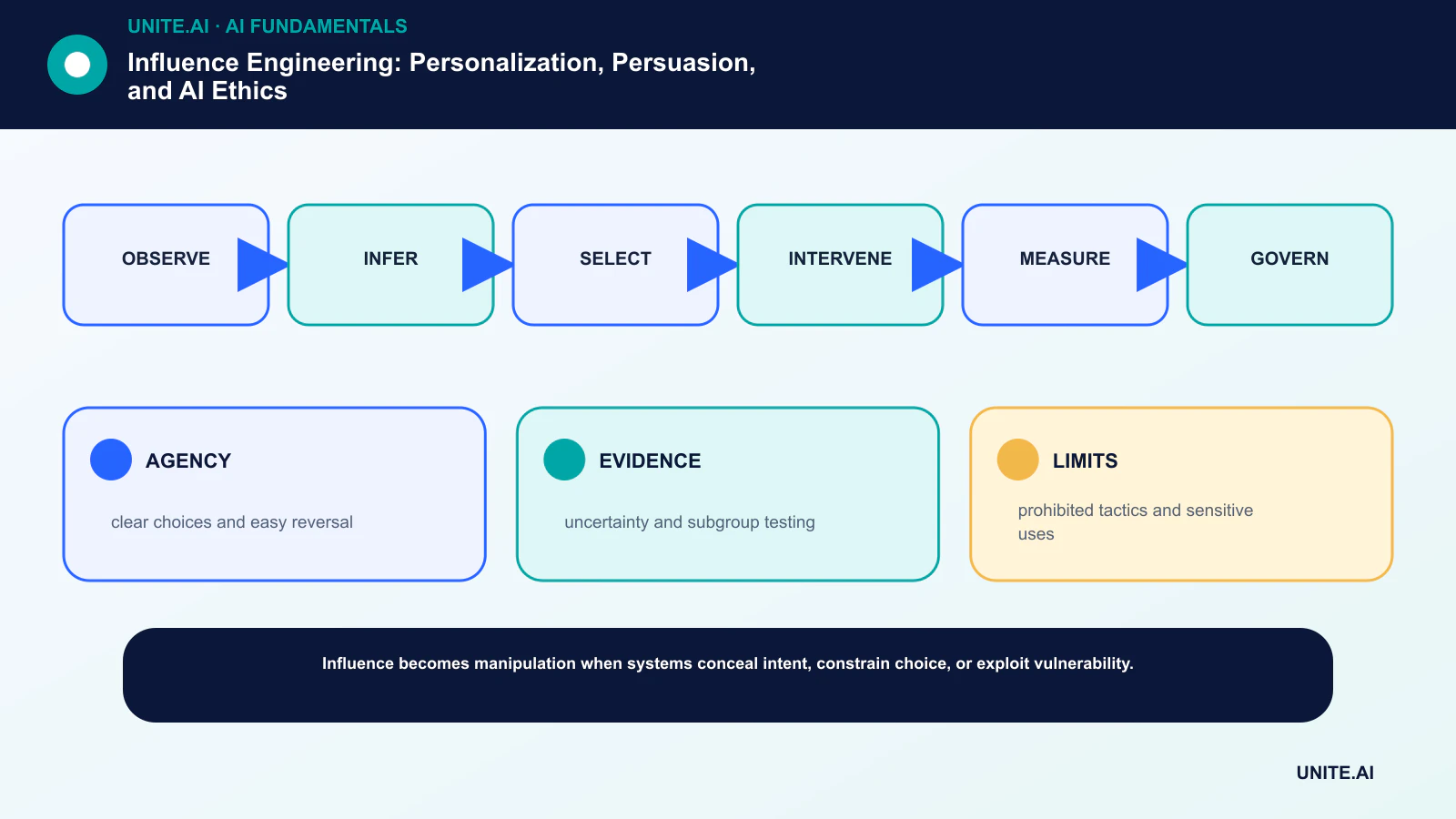
How digital influence works
A system observes behavior, builds a user or context model, selects an intervention, measures a response, and updates the policy. Interventions can include ranking, timing, defaults, social cues, wording, notifications, prices, or conversational responses.
This feedback loop resembles reinforcement learning, but the reward encodes a value judgment. Clicks and session length are easy to measure; informed choice, trust, and long-term benefit are harder but often more important.
Where emotion AI enters
Emotion AI can estimate patterns from facial movement, voice, language, physiology, or interaction. These signals are context-dependent and culturally variable. A model may predict a labeled category without establishing what someone truly feels.
Using such predictions to change a message, price, or opportunity can create a sensitive feedback loop. Performance should be evaluated by subgroup and context, and the system should not infer more than the service genuinely needs.
Persuasion, assistance, and manipulation
A navigation prompt that helps a user follow a chosen plan differs from a disguised advertisement or an obstruction that makes cancellation difficult. Evaluate whether the purpose is disclosed, alternatives remain available, and a reasonable person can understand and reverse the choice.
Dark patterns exploit asymmetry in information or effort. Generative interfaces can scale those tactics by tailoring language continuously, so safeguards must cover the objective and experimentation system—not only the visible screen.
Governance and evaluation
Document the intended benefit, affected groups, prohibited tactics, data sources, retention, optimization objective, and review owner. Predeployment tests should include vulnerable users, adversarial scenarios, and outcomes beyond immediate conversion.
Monitor complaints, reversals, regret, exposure frequency, subgroup outcomes, and unexpected behavior. Apply responsible AI controls and legal review where biometric, consumer-protection, employment, education, or health rules may apply.
The optimization system behind influence
Influence systems are often pipelines rather than one model. A candidate generator selects possible messages or items, a ranking model scores them, an experiment framework assigns treatments, and a feedback service records behavior. Identity resolution and user profiles connect observations across sessions, which makes privacy and purpose limitation central architectural choices.
The optimization target can be immediate, such as a click, or delayed, such as a completed course or sustained health behavior. Proxy metrics invite gaming: a notification policy can increase opens by creating anxiety, and a recommender can increase watch time while reducing satisfaction. Teams should define guardrail metrics and long-term outcomes before optimizing.
Bandit and reinforcement-learning methods add exploration, but exploration exposes real people to uncertain interventions. Bound the action set, exclude sensitive contexts, cap frequency, and use conservative policies. Offline simulation cannot fully predict social response, so staged experiments and stop criteria remain necessary.
Measurement, causality, and vulnerable users
A/B tests estimate an average causal effect under their assignment and measurement assumptions. They can miss harms concentrated in small groups, interactions between concurrent experiments, delayed effects, and people who leave the product. Report distributional outcomes, not only the headline conversion lift.
Personalization complicates explanation because different users see different interventions. Preserve the policy version, eligibility, context, and reason for selection. Audit whether protected or sensitive characteristics are used directly, inferred indirectly, or correlated with features such as location, device, language, or browsing pattern.
Children, people in distress, financially constrained users, and those facing health or employment decisions may be especially vulnerable to tailored pressure. Avoid urgency, social proof, variable rewards, or emotional targeting that exploits those conditions. Independent review should have authority to prohibit an optimization even when it improves revenue.
Design requirements for legitimate influence
A legitimate system states its purpose, makes sponsorship visible, separates recommendation from fact, and lets a person change or disable personalization. Defaults should reflect reasonable expectations. Consent must be specific enough to describe the data and influence mechanism rather than hiding them inside broad terms.
Provide exposure controls, quiet periods, reset, profile inspection, and an explanation of the main factors behind a recommendation. Do not use friction asymmetrically—one click to subscribe but several confusing screens to leave. A user should be able to reverse a decision without punishment unrelated to the service.
Governance should review objectives, feature sources, experiment designs, complaint themes, and downstream outcomes. Maintain a registry of influence systems and high-risk experiments. When a harmful pattern appears, disable the policy, preserve evidence, notify affected users where appropriate, and change the incentive that produced it.
A practical influence-risk assessment
Evaluate an influence system by mapping the actor, objective, audience, data, model, message, channel, feedback loop, and consequence. Distinguish assistance from persuasion and persuasion from manipulation. A reminder chosen by the user differs from covert optimization for compulsive engagement. Risk rises when the system targets vulnerabilities, hides sponsorship, exploits emotional state, creates false urgency, or makes access to essential services contingent on a behavioral response.
Before deployment, test whether personalization changes understanding, autonomy, and outcomes across groups. Use controlled experiments with informed review, but do not optimize only clicks or conversion. Measure regret, complaints, opt-outs, downstream harm, and whether users can identify why they received a message. Prohibit sensitive inferences that are not necessary, constrain allowed objectives, and separate eligibility or pricing decisions from emotional-response optimization.
Interfaces should label synthetic agents and sponsored communication, explain material personalization, and offer meaningful controls. Keep an auditable record of campaigns, target rules, model versions, creative variants, and approvals without retaining unnecessary emotional data. Independent review is appropriate for political, financial, health, employment, education, and child-directed uses. The central question is not whether influence occurs, but whether its purpose, evidence, methods, and power relationship respect informed human agency.
Practical implementation checklist
Turn the concept into a bounded, testable workflow: observe → infer → select → intervene → measure → govern. Name an accountable owner, document the data and dependencies, establish a simple baseline, set acceptance and stop criteria, test representative failures, and define monitoring, rollback, and review before expanding scope. Record versions and assumptions so another team can reproduce the result and understand what changed.
Before launch, run a documented readiness review with the people who build, operate, secure, and are affected by the system. Test normal cases, boundary conditions, dependency failures, and misuse; preserve the evidence and unresolved risks. Define who can approve release, change a threshold, override an output, or stop operation. Revisit the decision after real-world data arrives, because a technically successful pilot does not guarantee reliable performance at broader scale.
- AGENCY: clear choices and easy reversal.
- EVIDENCE: uncertainty and subgroup testing.
- LIMITS: prohibited tactics and sensitive uses.
Frequently asked questions
Is all personalization manipulation?
No. Personalization can reduce effort and improve relevance. Risk rises when objectives are hidden, choices are constrained, sensitive traits are inferred, or the system exploits vulnerability.
Can an AI system know how a person feels?
It can estimate labels from observable signals under a model and dataset. That estimate is uncertain, context-dependent, and should not be presented as direct knowledge of an internal state.
Primary references