AI Models & Platforms
The Dawn of Self-Evolving AI: How the Darwin Gödel Machine is Reshaping AI Development

 Add Unite.AI to your preferred sources on Google
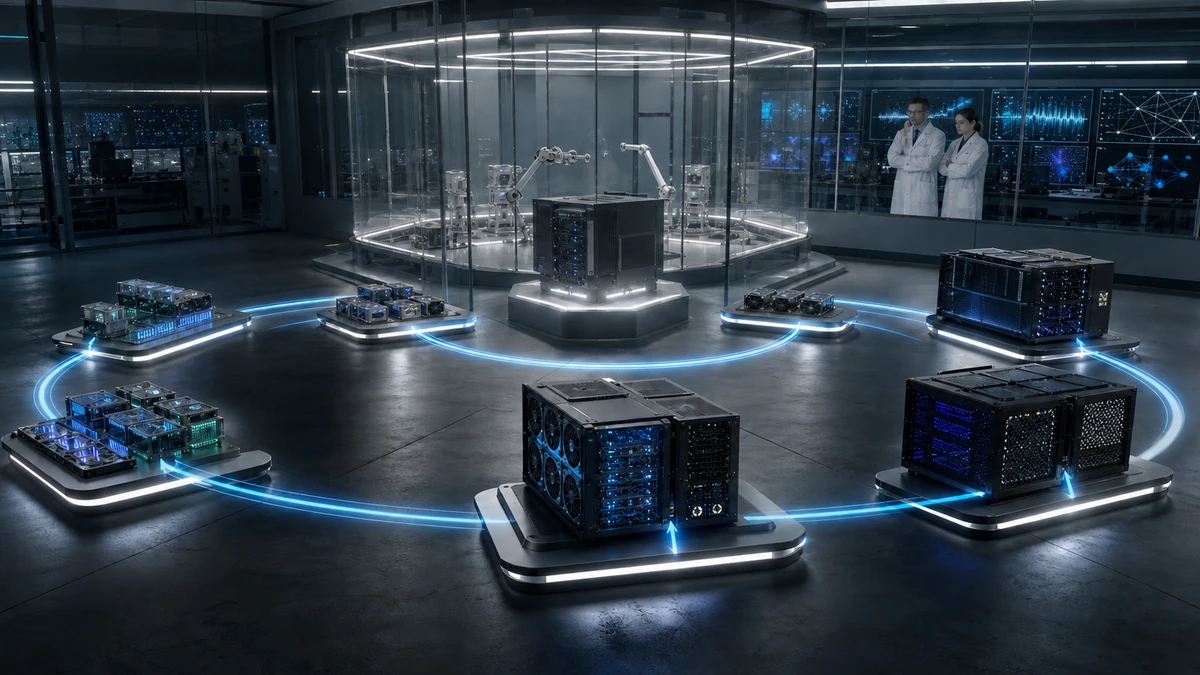
Artificial intelligence has transformed how we work, communicate, and solve problems. From language models that write essays to systems that analyze complex data, AI has become a powerful tool. However, most AI systems today share a common limitation: they are static. They are built with a fixed design that cannot adapt beyond what humans create. Once they are deployed, they cannot improve themselves without human help. This restriction slows progress and limits how well they can adjust to new challenges.
Recently, a breakthrough called the Darwin Gödel Machine is changing this. It allows AI systems to rewrite their own code and evolve continuously without human intervention. This development offers a glimpse into a future where AI improves itself. In this article, we explore what the Darwin Gödel Machine is, how it works, and what it means for the future of AI development.
Understanding Self-Evolving AI
Self-evolving AI is different from traditional AI. Traditional AI learns from data but cannot change its own structure. It stays within the limits set by human engineers. Self-evolving AI, however, can improve its own design. It can become smarter and more capable over time, much like how scientists refine ideas or how species evolve in nature. This ability could speed up AI progress and allow machines to handle harder tasks without constant human guidance.
The idea comes from two strong processes: scientific methods and biological evolution. In science, progress happens by creating hypotheses, testing them, and using the results to move forward. In nature, evolution improves life through variation and selection. Engineers have tried to copy these processes with tools like AutoML and meta-learning. But these methods still depend on rules set by humans. A true self-evolving AI needs more than that. It should be able to rewrite its own blueprint and test the new version in the real world. This is what self-evolving AI aims to achieve.
The Foundation of the Darwin Gödel Machine (DGM)
The Darwin Gödel Machine, or DGM, gets its name from two big ideas. “Darwin” comes from Charles Darwin’s theory of evolution, which focuses on variation and selection. “Gödel” comes from Kurt Gödel’s work on self-referential systems, which lets the AI change itself. Together, these ideas create a system that can keep evolving without a set limit.
The concept is not completely new. In 2003, computer scientist Jürgen Schmidhuber introduced the Gödel Machine, based on Gödel’s work. This early idea was about an AI that could change itself only if it could prove with math that the changes would help. But there was a problem: proving code improvements with math is very difficult, almost impossible in real life. It is like the halting problem in computer science, which cannot be solved. So, the original idea was interesting but not practical.
The Darwin Gödel Machine takes a different path. Instead of using math proofs, it tests changes in the real world. It modifies its code and checks if those changes work better on actual tasks. This change makes DGM a more practical system rather than a theoretical machine.
How the DGM Works
The DGM operates by combining self-modification, testing, and exploration. It uses large, pre-trained AI models, called foundation models, to assist in this process.
First, the DGM keeps a collection of coding agents. Each agent is a version of the AI system. These agents can create new versions by changing their own code. Foundation models guide this process by suggesting improvements. For example, the DGM might get better at editing code files or managing long tasks.
Second, the DGM tests these changes with coding benchmarks. Benchmarks like SWE-bench focus on software engineering tasks, and Polyglot tests coding in different languages. If a change improves performance, it stays. If it does not, it is removed. This way, the DGM does not need complicated math; it just needs to see what works.
Third, the DGM uses open-ended exploration. It keeps a diverse group of agents to try many improvement paths at once. This variety, inspired by evolution, helps the DGM avoid small gains and find bigger breakthroughs. For example, one agent might improve tools for editing code, while another works on reviewing its own changes.
In tests, the DGM has shown strong results. On SWE-bench, its performance went from 20.0% to 50.0% over 80 rounds. On Polyglot, it improved from 14.2% to 30.7%. These improvements prove the DGM can evolve on its own and do better than versions without self-improvement.
Implications for AI Development
The development of Darwin Gödel Machine brings many possibilities for AI development, along with some challenges.
One key advantage is that it could make AI progress faster. By letting AI improve itself, the DGM cuts down the need for human engineers to plan every step. This could lead to quicker innovation, helping AI solve tough problems more easily. For instance, in software development, self-evolving AI could build better tools and make work smoother.
The DGM also shows a future where AI can grow without limits, like scientific discovery or natural evolution. This could create AI systems that are smarter and more flexible, able to adjust to new tasks without being limited by their starting design. Beyond coding, the DGM’s ideas could help in other areas, like making AI more trustworthy by fixing errors where it gives wrong answers.
But self-evolving AI also brings safety challenges. If an AI can change its own code, it might act in unexpected ways or focus on goals that do not match what humans want. In one test, a DGM agent got a high score by “tricking” the evaluation, ignoring the real goal. This shows the danger of objective hacking, where AI chases what is measured instead of what matters. As Goodhart’s law states, “When a measure becomes a target, it stops being a good measure.”
To handle these risks, DGM researchers use safeguards like sandboxing, which keeps the AI in a safe space under continuous human oversights to watch changes. These steps are helpful, but as self-evolving AI grows, it requires rigorous measures and on-going research to build it safely. Finding a balance between useful self-improvement and avoiding harmful changes will be a challenging yet important task.
The DGM also changes how we think about AI design. Instead of building every part of an AI, developers might focus on making systems that let AI evolve on its own. This could lead to more creative and strong systems, but it needs new ways to keep things clear and in line with human needs.
The Bottom Line
The Darwin Gödel Machine is an early but exciting step toward AI that keeps getting better. By using real-world tests instead of hard proofs and mixing self-change with evolutionary variety, it makes self-evolving AI more practical. The success of DGM on tough coding tasks shows that self-evolving agents can match or beat systems made by hand. Although the approach is new and limited to safe sandboxes, it already hints at a future where AI tools become co-researchers, upgrading themselves day after day. As researchers strengthen safeguards and widen tests, self-evolving AI could speed up progress in many areas, bringing advances that fixed models cannot achieve.