Robotics & Physical AI
Robot.com Enters the Humanoid Robotics Race With the Launch of R-noid

 Add Unite.AI to your preferred sources on Google

The humanoid robotics market has quickly become one of the most closely watched sectors in technology, with companies racing to develop machines capable of performing real-world work rather than simply demonstrating laboratory capabilities. Into this increasingly competitive landscape steps Robot.com, a company best known for its autonomous delivery robots, which has now unveiled R-noid, a humanoid platform designed specifically for repetitive, labor-intensive jobs across logistics, hospitality, healthcare, food service, and manufacturing. The launch represents a major expansion of the company’s ambitions and signals its belief that humanoid robots are ready to move beyond experimentation and into everyday operations.
Building on Nearly a Decade of Robotics Experience
Unlike many newer humanoid robotics startups, Robot.com is not beginning from scratch. Founded in 2017 as Kiwibot before rebranding to Robot.com, the company has spent years deploying autonomous robots in commercial environments. According to the company, its fleet now exceeds 500 robots operating across the United States, Canada, Dubai, and the broader Middle East and North Africa region, collectively completing more than 2.5 million real-world tasks. Those deployments have provided valuable experience in maintenance, remote operations, fleet management, and customer support—areas that often prove just as important as the robots themselves.
The company’s existing portfolio already includes several specialized robotic platforms. R-kiwi serves as its autonomous delivery robot, transporting food, packages, and other goods across campuses and commercial properties. R-cargo focuses on material transport and logistics applications, helping move goods within operational facilities. R-kiwi+ extends the concept further by combining autonomous navigation with digital advertising displays, effectively turning robots into mobile out-of-home advertising platforms. The introduction of R-noid adds a humanoid worker to this broader ecosystem, allowing Robot.com to address tasks that require human-like reach and manipulation.
A Practical Approach to Humanoid Design
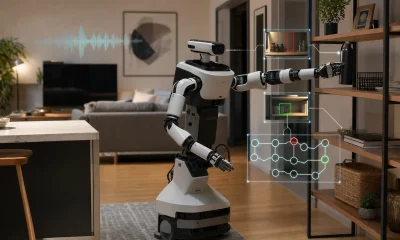
While many companies developing humanoids focus on fully bipedal robots that walk like humans, Robot.com has chosen a different path. R-noid combines a humanoid upper body with a wheeled mobile base, a design that prioritizes stability, reliability, and deployment speed over human-like locomotion. The robot features dual seven-degree-of-freedom arms and an articulated torso capable of reaching nearly two meters vertically, enabling it to interact with shelves, workstations, and equipment designed for human workers.
This design philosophy reflects a broader trend emerging across commercial robotics. Rather than pursuing humanoids capable of doing everything, many companies are increasingly focused on machines that can perform a narrower set of tasks exceptionally well. For Robot.com, the goal is not to build a household assistant but a dependable worker capable of handling repetitive operational duties shift after shift.
The AI Partnerships Powering R-noid
Much of the technology behind R-noid comes through partnerships with some of the most prominent names in robotics AI. Robot.com is working with FieldAI to integrate its Field Foundation Models, which function as a generalized autonomy layer capable of helping robots operate safely in unfamiliar environments while coordinating multiple robots simultaneously. The company says these models are designed to be grounded in physical reality, helping reduce the risk of the hallucination-like failures that can occur when AI systems misinterpret their surroundings.
The robot’s manipulation capabilities are powered by Physical Intelligence’s π0.7 model, a vision-language-action system that combines visual perception, language understanding, and robotic control. Instead of requiring engineers to create separate software systems for each task, the model can interpret natural-language instructions and translate them into physical actions. In practical terms, that means the same robot can perform packing, picking, and folding tasks without requiring an entirely new software architecture for each workflow.
Robot.com has also built its robotics stack around NVIDIA technology. NVIDIA Jetson modules provide onboard computing for perception and decision-making, while NVIDIA (NVDA ) Isaac Sim allows the company to simulate, test, and validate robot behaviors before deployment. This simulation-first approach has become increasingly common among robotics companies seeking to reduce deployment risk and accelerate training.
Designed for Real Work, Not Demonstrations
At launch, R-noid is being deployed across five primary categories: restaurant assistant, picker, packer, folder, and host. These jobs were selected because they are often repetitive, physically demanding, and difficult to staff consistently. Early deployments include a golf course operation where the robot assists with order preparation and logistics tasks, while additional pilots are underway in manufacturing and warehouse environments. The company says the number of tasks R-noid can perform will continue expanding as new data is collected and models improve.
Perhaps the most ambitious claim surrounding the platform is deployment speed. Robot.com says it can move from an initial facility visit to autonomous operation in as little as eight to twelve weeks. The process involves identifying suitable tasks, collecting operational data, training models, and gradually increasing autonomy levels through teleoperation and remote support. Initial deployments typically operate at around 70% autonomy before becoming increasingly self-sufficient.
More Than One Robot
While R-noid is receiving the spotlight, it is only one part of a broader robotics strategy. Robot.com’s existing R-kiwi delivery robots are already familiar sights on university campuses and commercial properties, autonomously transporting food and packages. R-cargo is designed for internal logistics and material movement, helping organizations automate repetitive transportation tasks within facilities. R-kiwi+ combines robotics with digital advertising, transforming autonomous robots into moving media platforms that can interact with consumers in public spaces.
Taken together, these platforms reveal a company that is not betting on a single robotic form factor. Instead, Robot.com is building a portfolio of specialized robots that share a common software foundation while addressing different operational challenges.
Competing in a Crowded Humanoid Market
Robot.com’s expansion comes at a time when competition in humanoid robotics is intensifying. Companies such as Figure AI, Agility Robotics, Apptronik, 1X Technologies, Sanctuary AI, Unitree Robotics, and Tesla (TSLA ) are all pursuing variations of the same vision: robots capable of performing meaningful work in environments originally built for people.
What distinguishes Robot.com is its focus on deployment rather than spectacle. The company is betting that customers care less about whether a robot can walk upstairs and more about whether it can reliably perform useful work today. By leveraging years of operational experience gained through its delivery and logistics robots, Robot.com hopes to accelerate adoption of humanoid systems in industries facing persistent labor shortages.
A Test of the Humanoid Business Model
The launch of R-noid is about more than a new robot. It is also a test of whether humanoid robotics can become a sustainable commercial business rather than a collection of impressive demonstrations. Robot.com is offering the platform through a Robot-as-a-Service model, allowing customers to subscribe to robotic labor instead of purchasing expensive hardware outright. That approach lowers barriers to adoption while giving the company recurring revenue and ongoing access to operational data.
As the humanoid robotics sector moves from prototypes to production deployments, success will increasingly be measured by uptime, reliability, and economic value rather than viral videos. Robot.com believes its experience operating hundreds of robots in real environments gives it an advantage in that transition. Whether R-noid becomes a major player in the emerging robotic workforce remains to be seen, but its launch underscores a growing reality: humanoid robots are no longer being built solely for the future. They are beginning to enter workplaces today, performing tasks that businesses have struggled to fill for years.