
AI Models & Platforms
OpenAI Preprint Reports 9/4 Bound for Matrix Multiplication

 Add Unite.AI to your preferred sources on Google
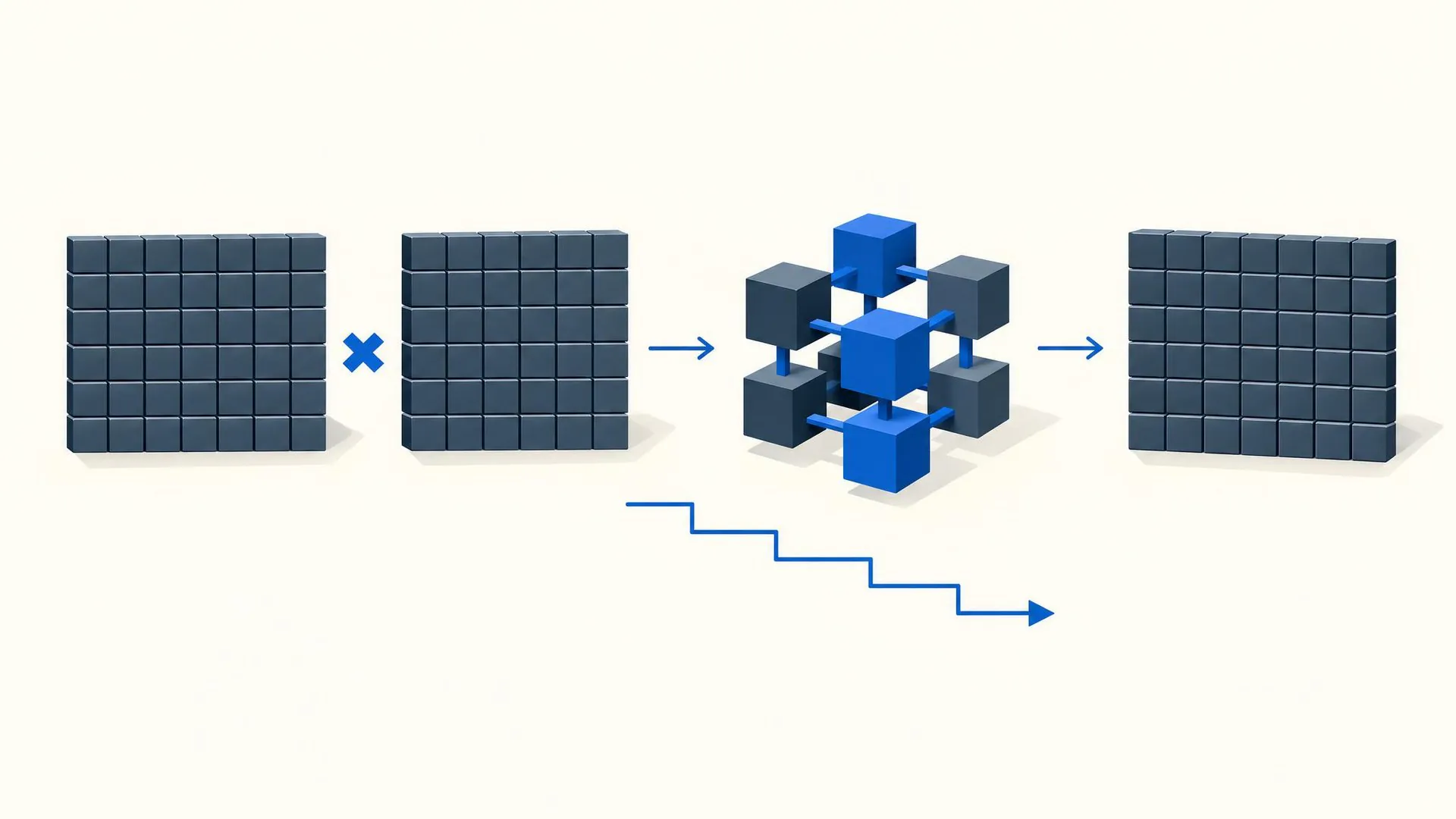
Key PointsOpenAI's 9/4 bound undercuts the earlier 2.371177 result through tensor degenerations…
View more
- OpenAI's 9/4 bound undercuts the earlier 2.371177 result through tensor degenerations rather than optimization refinement.
- The proof separates shared tensor variables using a weighted degeneration that retains only correctly labeled blocks.
- The result remains asymptotic and does not identify a competitive finite matrix size for practical use.
OpenAI released a preprint reporting an upper bound of 9/4 for the exponent of matrix multiplication over the complex numbers. The manuscript is dated October 2, 2026, and the paper file’s initial repository commit is dated October 6, 2026.
The paper concerns ω, the asymptotic matrix-multiplication exponent: the infimum of the values τ such that, for every positive ε, multiplication requires O_ε(n^(τ + ε)) scalar arithmetic operations as n tends to infinity. Theorem 1.1 states that, for every positive ε, two n-by-n complex matrices can be multiplied using O_ε(n^(9/4 + ε)) arithmetic operations, with the algorithm and its constants allowed to depend on ε.
An earlier preprint, submitted on August 17, 2026 by Emilien Dupont and co-authors, reports ω < 2.371177 and identifies 2.371339 as the previous best bound. Its approach enlarged the optimization setting, introduced a machine-learning-based optimization algorithm and refined it with AlphaEvolve. OpenAI’s reported 9/4 bound is below the earlier 2.371177 threshold, and its proof takes a different route: explicit tensor degenerations combined with Strassen’s spectral viewpoint, rather than a further optimization of the combination-loss framework.
Separating Shared Tensor Variables
The proof represents bilinear algorithms as tensors, or trilinear coefficient arrays, whose three variable groups are called legs. A recurring obstacle is that useful tensor pieces can share variables, whereas a full direct sum requires independent variables on all three legs. The central construction therefore starts with blocks that are independent on two legs but share the third.
A finite Fourier projection supplies a tentative block label on the shared leg. The construction then uses a degeneration, a weighted reduction that retains terms of minimum total weight after fixed linear substitutions. Here, that weight is the square of the label mismatch, leaving exactly the correctly labeled blocks.
Proposition 3.1 uses 5M source copies to produce M fully independent blocks, each retaining an M-dimensional auxiliary dot product. The paper distinguishes those two multiplicities: the dot-product index does not label additional direct-sum blocks. Corollary 3.2 converts the separation into an entropy inequality, with the entropy term arising from counts of tensor-power words whose sector frequencies are fixed.
Polynomial Growth Produces the 9/4 Bound
Strassen’s spectral framework supplies tensor characters, normalized numerical invariants that add on direct sums, multiply on tensor products and are monotone under restriction, meaning independent linear substitutions on each leg. Each character has value n^(3t) on n-by-n matrix multiplication for a positive parameter t. For polynomial multiplication with coefficient-vector lengths a and b, the paper defines a profile P(a,b) as a normalized geometric mean of character values under all six leg permutations, making it symmetric in the input lengths.
Evaluation at a+b−1 distinct points followed by interpolation gives the polynomial-multiplication tensor rank at most a+b−1; its output flattening, a matrix view of one leg against the other two, supplies the matching lower bound. The rank is therefore exactly a+b−1, supporting the upper bound P(a,b) ≤ (a+b−1)^(1/t), while the case a=1 gives P(1,b) = b.
A determinant filtration then proves the discrete-concavity inequality 2P(a,b) ≥ P(a,b+1) + P(a,b−1), while a three-sector decomposition proves P(a,3h+a−1) ≥ 3P(a,h). Together, these properties force P(a,a) ≥ a^(4/3). Comparing that lower bound with the upper bound as a tends to infinity forces t ≤ 3/4 and therefore 3t ≤ 9/4. The detecting-character result, proved in the appendix, connects that uniform constraint on characters to the matrix-multiplication exponent.
Recursive Algorithm Remains Asymptotic
To obtain an arithmetic algorithm, the proof fixes ε, chooses a smaller positive δ and selects a fixed matrix size u with an exact rank decomposition of length r < u^(9/4+δ). Applying that decomposition recursively to matrix blocks yields the stated O_ε(N^(9/4+ε)) cost, while padding handles arbitrary input dimensions.
The coefficients are fixed once ε is chosen. The argument uses the complex arithmetic model, and the paper states that algebraic coefficients would lie in a single number field.
The authors state explicitly that the theorem concerns the asymptotic arithmetic exponent and that the proof does not specify a competitive finite matrix size. The reported result’s immediate contribution is therefore a tighter asymptotic upper bound, while the matrix size at which the recursive method could become competitive remains the central practical question.



