
AI Models & Platforms
Perplexity Guide Details Permission and Citation Tests for AI Search

 Add Unite.AI to your preferred sources on Google
Key PointsGenerated answers can expose restricted documents that never appear as listed search…
View more
- Generated answers can expose restricted documents that never appear as listed search results.
- Teams should retest a baseline set of 20 genuine employee questions after monthly reviews.
- Maeil Business Newspaper reported 44.3% more searches after adding AI answers.
Perplexity published an internal-search guide on November 24, 2026, urging separate permission and citation tests for AI-generated answers and citing Maeil Business Newspaper’s reported gains of 44.3% more searches and 22.6% more people using search after the publisher added AI answers.
The guide addresses two environments: visitors searching a company’s website and employees looking through workplace material such as policies, contracts and meeting notes. In both, an internal search engine indexes selected content, matches queries against that material and ranks the results, while the organization controls what is included and how matches are ordered.
Its five-part framework covers index scope, query interpretation, access rights, result ranking and correction of failed searches. The recommended sequence begins with the search already built into ecommerce, content-management and workplace systems. A purchase is framed around a specific missing capability, while custom development is reserved for requirements no available tool can satisfy and only when a team can maintain the system.
AI Answers Require Separate Tests
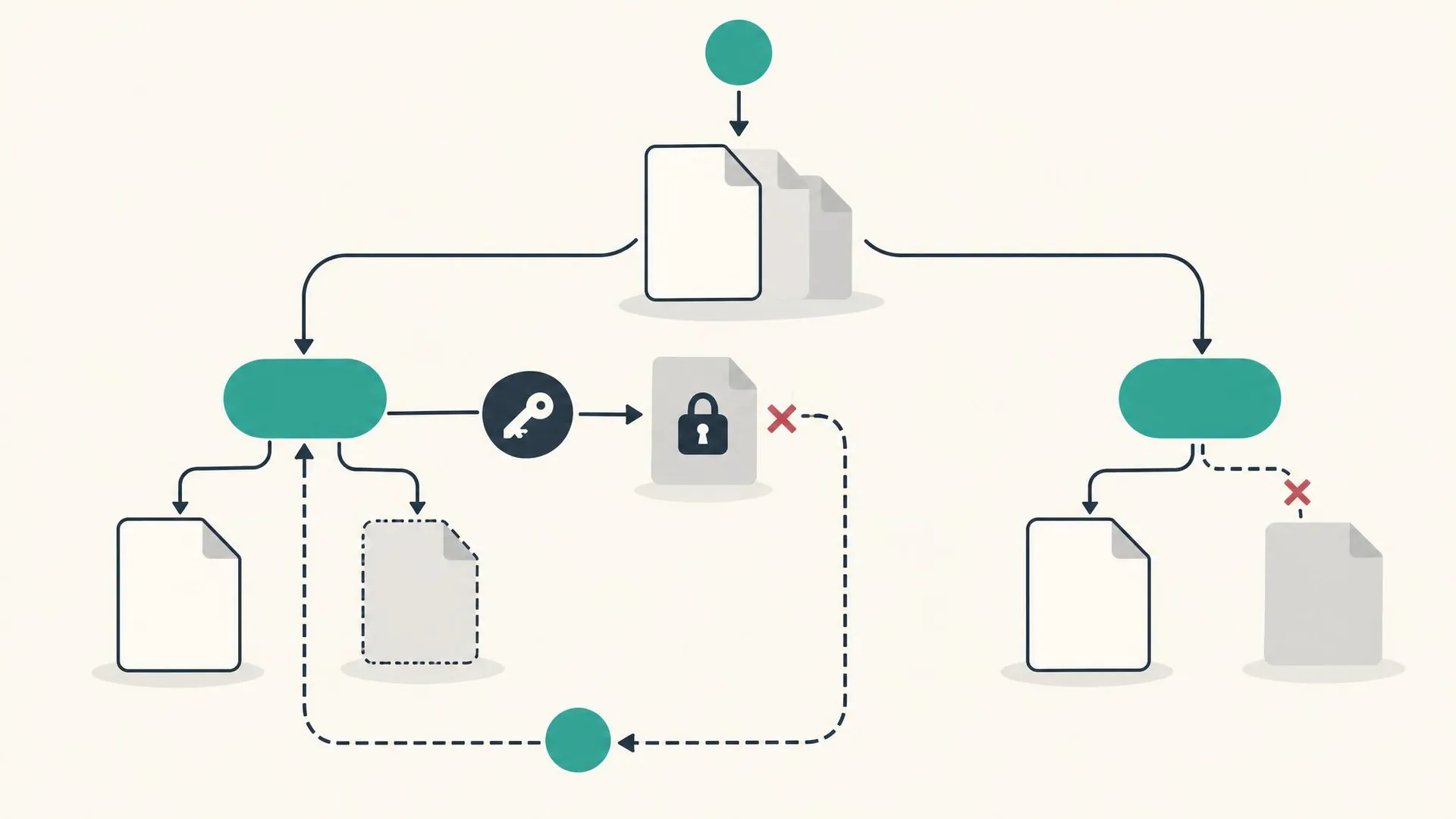
Generated answers create a distinct access-control problem. A response can use information from a document even when that document never appears as a listed result, so checking only visible links can miss content the searcher is not permitted to open. Perplexity’s suggested test uses an account with a new hire’s permissions to search for both accessible and restricted material, including previews and generated responses. Access to a test document is then withdrawn and the exercise repeated.
Ranking needs the same scrutiny inside the answer. A results page can surface the current, approved policy while the generated response relies on an older copy. A separate exercise uses ten employee questions whose answers are already known. The responsible team identifies the approved document for each one, and the reviewer checks where it appears, whether the AI answer cites it and whether the summary retains the policy’s conditions and exceptions.
For ongoing evaluation, the guide calls for a baseline set of 20 genuine employee questions, each run in its original wording. Teams are told to distinguish failures caused by missing content, disconnected sources, permissions, query wording and ranking. Monthly reviews of no-result searches and flagged answers should lead to another run of that test set, because a log showing that an answer was delivered does not show whether it was correct.
Internal Knowledge Search Mechanics and Limits
Internal Knowledge Search provides Perplexity’s own Enterprise example. Administrators can place up to 500 files in a shared organization repository, and users can select Web, Org Files or Web + Org Files, or choose None for a response without external sources. Answers based on organization files include inline citations that let users open or download the underlying documents, according to Perplexity’s product documentation.
The repository supports XLSX, PPTX, DOCX, PDF and CSV files up to 50 MB each. PNG and JPEG images are not supported for Internal Knowledge Search but can be attached directly to a query, while video files are indexed through audio transcription. Perplexity also warns that language-model-generated titles and summaries may contain inaccuracies and points users to the original file content when errors appear.
Project uploads remain outside the organization-wide repository. Only users in the same organization can be invited to a Project, and its files are limited to the creator and invited collaborators. A separate direct-attachment route allows up to ten files per session and deletes them after seven days; organization files remain until an administrator removes or updates them.
Maeil’s AI Search Deployment
The customer example is Maeil Business Newspaper, which publishes more than 600 articles daily across 14 categories. Its earlier on-site search directed readers to relevant stories but still required them to open several articles to assemble an answer. Maeil implemented Perplexity’s Sonar API to synthesize information across articles and cite the original stories, according to a Perplexity customer case study. Sonar API is now part of Agent API.
Maeil’s AI Task Force at Maekyung Media Group led onboarding and jointly developed deployment strategies with Perplexity. The case study also says Maeil planned to recommend follow-up questions based specifically on its existing content.
Maeil’s reported adoption gives the guide a concrete customer example, while its checklists show the operating work behind one. For enterprise teams, AI answers add continuing responsibilities for source ownership, access control and correctness checks after deployment.



