Thought Leaders
As AI’s Power Hunger Becomes a Crisis, NTT Research Bets on Light

 Add Unite.AI to your preferred sources on Google

A leadership transition at NTT Research’s Physics & Informatics Lab announced today, April 15, 2026, arrives at a pivotal moment – when the case for photonic computing has never been more urgent.
NTT Research – the Silicon Valley-based research division of Japanese telecom giant NTT – announced that Dr. Tetsuomi Sogawa will become the new director of its Physics & Informatics (PHI) Lab effective May 1, succeeding founding director Dr. Yoshihisa Yamamoto, who is retiring after building the Sunnyvale, California-based lab into one of the world’s most credentialed photonic computing research centers.
The announcement was made at Upgrade 2026, NTT’s annual research and innovation summit being held April 15 to 16 in Silicon Valley.
“The PHI Lab’s research, which has built good momentum over the last seven years, is basically going to continue in the same direction from a macro perspective. With Dr. Sogawa’s very strong research management background, I’m definitely hoping that the PHI Lab’s research will be accelerated under the new leadership,” said NTT Research president and CEO Kazu Gomi at the Upgrade 2026 inaugural press conference.
The appointment comes as the AI industry faces a deepening energy reckoning. The International Energy Agency now projects that global data center electricity consumption will exceed 1,000 TWh by the end of 2026 – an amount equivalent to Japan’s entire annual electricity usage.
“The PHI Lab’s focus is to use physics to – in layman’s terms – replace the digital computation platform that everybody is aware of with new kinds of physics-based computation platforms. One of the easiest things you can imagine is optical-physics-based quantum computers,” Gomi added.
U.S. data centers alone consumed 183 terawatt-hours of electricity in 2024, accounting for more than 4% of the country’s total electricity consumption – roughly equivalent to the annual electricity demand of the entire nation of Pakistan – and that figure is predicted to grow by 133% by 2030.
Into that crisis steps Sogawa, a scientist who spent more than three decades at NTT’s core research division helping develop the very optical technologies that NTT believes can serve as a structural alternative to power-hungry silicon computing.
His mandate, in the words of Gomi, is to bring “optical quantum innovations from the lab to reality.”
A founding era ends
Yamamoto is no ordinary outgoing director; he pioneered the research of coherent optical communications and optical amplifier repeater in the late 1970s and early 1980s, and later went on to pioneer the Coherent Ising Machine (CIM) – a special-purpose optical computer designed to solve notoriously complex combinatorial optimization problems. His career effectively tracks the history of modern photonics itself, and the lab he built reflects that depth.
Beyond this, the outgoing director’s honors include the Charles Hard Townes Medal, the IEEE PS Quantum Electronics Award, the Okawa Prize, and the Medal of Honor with Purple Ribbon from the Government of Japan.
Since 2019, the PHI Lab has delivered over 150 papers, five appearing in Nature, one in Science, and twenty in Nature sister journals – a remarkable publication record for any research institution, let alone a corporate one.
Heading over to Sogawa isn’t just a staffing move – it’s a generational relay race, with the baton being a vision of computing powered by light rather than electrons.
The energy wall
To understand who this appointment matters beyond the research community, it helps to look at what silicon-based AI infrastructure has done to global power grids in just a few years.
By late 2025, AI data centers were using about 29.6 gigawatts of power globally – equivalent to the peak electricity demand of New York State. Meanwhile, the Stanford University AI Index 2026 reports that global AI computing capacity has surged approximately 3.3x per year, a pace pushing governments and tech companies to scramble for new energy sources.
As per Tech Insider, Microsoft (MSFT ) has signed a 2 GW nuclear commitment; Amazon (AMZN ) has secured large-scale solar in Texas; and yet, Virginia grid operators – home to the world’s largest data center market – have issued formal capacity warnings through 2028, and Northern Virginia has effectively halted new data center permits.
The underlying hardware is the core problem: between 2021 and 2024, average data center rack power densities more than doubled. And, from 2025, the commercial deployment of AI accelerators such as NVIDIA GB200 Superchip has driven rack densities beyond 50 kW and in some cases over 100 kW – rendering traditional air-cooling obsolete and mandating a shift to power-intensive liquid cooling systems.
All in all, traditional CMOS-based computing is reaching its scaling limits and struggling to meet these immense demands in a carbon-sustainable manner, underscoring the need for alternative hardware. Photonic computing, however, has emerged as a promising alternative through its energy-efficient computing capabilities in the optical domain, according to Nature researchers.
The question is whether photonics can move from promising alternatives to deployed infrastructure fast enough to matter.
What the PHI Lab actually does
The PHI Lab’s work sits at the intersection of quantum information science, neuroscience, and photonics – an unusual combination that reflects a conviction that the next computing paradigm won’t look like any current one.
Two threads of research are particularly central to the lab’s identity and commercial relevance: the CIM, and the thin-film lithium niobate (TFLN).
Rather than solving problems one at a time like current computers, the CIM uses a network of optical parametric oscillators to solve everything at once, making it well-suited to computations with large numbers of variables – the kind that underpin drug discovery, logistics optimization, and financial modeling.
Research has shown that an experimental CIM reached a benchmark target of complex optimization problems in just 70 microseconds, while a state-of-the-art CPU required 2.1 milliseconds to reach the same target – roughly a 30x speed advantage, without a fraction of the power draw.
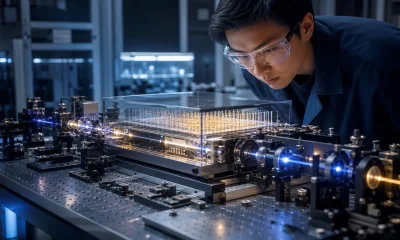
On the other hand, the nonlinear characteristics of TFLN opens new possibilities, as the limitations of silicon chips become more manifest: where previously the CIM physically occupied laboratory tables, TFLN chips allow the optical structures of the entire machine to reside on a single photonics processor.
In December 2025, the PHI Lab published results demonstrating a photonic processor built around a lithium niobate slab waveguide provided about 10,000 programmable spatial degrees of freedom and can perform all-optical neutral-network inference in a single pass.
“The device is a first of its kind, allowing us to essentially paint any optical circuitry we want and then draw it in the blink of a second,” noted Martin Stein, postdoctoral fellow at NTT Research.
Separately, MIT and PHI Lab researchers published work on Netcast and optically driven deep neural network architecture, where overall client-side energy consumption could plummet three orders of magnitude below what is possible in existing digital semiconductors.
The torch-carrier
Sogawa joined NTT Basic Research Laboratories in 1991, working on semiconductor quantum nanostructures, and rose steadily through the organization – appointed Director of NTT-BRL in 2013, then Director of the NTT Science and Core Technology Laboratory Group in 2018, the very division where many of IOWN’s foundational technologies were first developed.
IOWN – NTT’s Innovative Optical and Wireless Network initiative – is the company’s long-range bet that future communications infrastructure will be optical, not electronic. NTT says, in fact, its IOWN photonics platform can reduce the power consumption of telecom networks to one-hundredth of current levels while increasing data capacity and cutting latency.
Now, NTT is partnering with chipmaker Broadcom (AVGO ) and others to commercialize second-generation photonic-electronic convergence switches in 2026, with a roadmap extending to optical internship links from 2028 and intrachip connections from 2032.
Sogawa was central to making that roadmap technically credible, particularly through work on ultra-low-power optical transistors using photonic crystals. He also serves as program director of Japan’s third Cross-ministerial Strategic Innovation Promotion Program (SIP3), where his mandate is explicitly to translate academic research into deployed innovation – precisely the gap the PHI Lab is now under pressure to close.
“My career has been built on the core belief that truly impactful technical innovation begins with an idea – a theory that can be fundamentally tested, improved and re-tested over time,” Sogawa said in the announcement. He called PHI Lab “a manifestation of that belief” and credited Yamamoto for thoughtfully assembling and fostering its team.
Japan’s bigger play
Sogawa’s appointment also slots into a wider geopolitical picture. Japan is advancing a room-temperature quantum computing strategy built on light rather than electricity – framing it as a simpler, more energy-efficient route while the U.S. and China build increasingly complex hardware dependent on deep-cryogenic refrigeration and exotic materials.
NTT, working with quantum developer OptQC, is positioning photonic quantum technologies as a pathway toward commercially viable quantum platforms that can scale without the heavy infrastructure of current systems.
The alignment between Sogawa’s appointment, IOWN’s commercialization timeline, and Japan’s national innovation agenda is not coincidence; NTT is positioning itself as the global standard-bearer for a computing transition it believes is inevitable – and the PHI Lab is its most visible research front in that effort.
What’s next?
Sogawa’s immediate task is to deepen the lab’s study of linear and nonlinear photonic devices while increasing collaboration across NTT’s global R&D network to push fundamental research toward real-world deployment.
In an era when AI companies are signing nuclear power deals just to keep their data centers running, the pitch from optical computing – faster, cooler, radically more energy-efficient – has moved from academic curiosity to genuine industrial urgency.
The PHI Lab under Yamamoto built the scientific credibility. Under Sogawa, the pressure is on to convert it into something the world can actually plug in.