AI Models & Platforms
OpenAI Begins Limited Customer Trials of Alpha Private Inference

 Add Unite.AI to your preferred sources on Google
Key PointsPrivate Inference protects prompts and responses during model processing while Zero…
View more
- Private Inference protects prompts and responses during model processing while Zero Data Retention governs what is stored afterward.
- Safety review runs offline in a hardware-attested runtime that limits plaintext output to predefined safety signals and approved metadata.
- Expanding processing-time privacy beyond the initial customer group depends on confidential-compute capacity OpenAI is still securing.
OpenAI CEO Sam Altman announced on X on November 25, 2026, that the company is testing Private Inference with a small group of customers as part of OpenAI Private Intelligence, the company’s privacy framework for business use of frontier AI.
Altman said stronger privacy protections would make frontier AI useful for more work and described business privacy as important to a healthy ecosystem. The emphasis puts processing-time confidentiality alongside retention, access and residency controls in OpenAI’s enterprise offering, presenting privacy as part of the product’s usefulness for sensitive work.
OpenAI’s Private Intelligence product page lists Private Inference as Alpha and shows an API Preview in its workflow. Organizations can register interest in Private Inference, Zero Data Retention with Private Safety Processing, or both, and are asked to describe their privacy needs and AI use cases.
The DevDay 2026 recap had introduced Private Intelligence and described Private Inference as a preview coming in fall 2026, so Altman’s post supplies a customer-testing update to that earlier preview.
Privacy During Model Processing
Private Inference addresses a different exposure from Zero Data Retention. OpenAI says the feature uses confidential computing and strict controls designed to protect prompts and responses while a model is processing them. Zero Data Retention applies after that step: for eligible API workflows, OpenAI does not keep the prompt or model response. The two features therefore separate confidentiality during computation from the question of what is stored afterward.
Before agents act, customer-facing controls cover the data and tools available to them, their permitted actions and the points requiring approval. In the API workflow, a prompt is encrypted in transit and passes through real-time safeguards before Private Inference handles model processing and the application receives its response. OpenAI says the wider framework also assigns ownership of business inputs and outputs to the customer and includes access restrictions, encryption and ongoing threat detection.
Safety Review Uses Customer-Controlled Storage
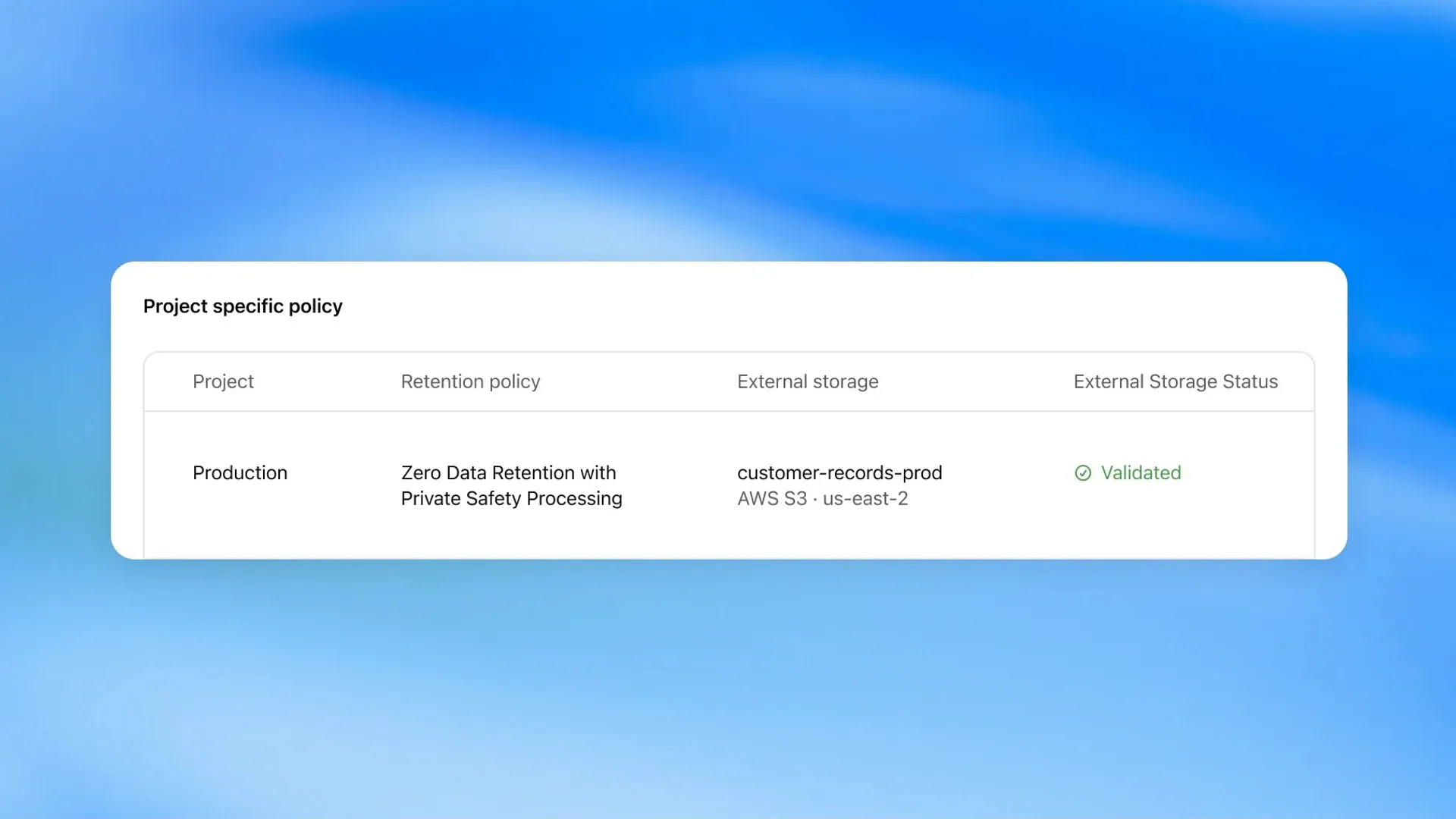
Zero Data Retention with Private Safety Processing moves safety review offline while keeping customer prompts and responses out of OpenAI’s retained records. Interactions enter that process through either a safety-classifier referral or an approved sampling policy. A classifier referral alone does not establish a policy violation, and the review process is designed to keep the underlying content inaccessible to OpenAI personnel.
Encryption and storage happen in the background, so the safety process does not hold up the model’s response. A selected interaction is saved as an encrypted record in regional cloud storage controlled by the customer. OpenAI’s own index contains operational details and a pointer to that record; the prompt and response themselves are not copied into the index.
The automated review runs inside the hardware-attested Safety Review Runtime, a protected computing environment with human access disabled. Its plaintext output is limited to predefined safety signals and approved operational metadata. Detailed findings are encrypted before leaving the runtime and stored in the customer’s cloud account under the original record’s expiration.
Customers must keep those encrypted records for at least 30 days, the time-to-live applied when they are written, and can connect storage on AWS, Azure, Google Cloud or Oracle Cloud Infrastructure. Enterprise Key Management adds a customer-controlled outer encryption layer around OpenAI’s inner encryption. Revoking authorization for the customer’s key prevents decryption of retained records, but it neither erases them nor reverses processing that has already occurred.
Existing Controls Cover Training and Location
Private Inference adds to OpenAI’s existing business-data commitments. The business-data policy says inputs and outputs from its business products and API platform are excluded from model training and improvement by default, unless a customer explicitly opts in to share data. The established baseline also includes AES-256 encryption at rest, TLS 1.2 or higher in transit, customer-managed keys and configurable retention for qualifying organizations.
Location controls form another layer. Eligible customers can store content in specified regions and opt into in-region GPU inference in the United States or Europe. Those settings address where data resides or runs, while Private Inference is intended to safeguard content during computation.
Shekar, the OpenAI contact Altman directed interested organizations to, described the test as a first step toward private intelligence for everyone and said OpenAI was obtaining confidential-compute capacity for a much larger rollout. That makes the trial a test of deployment as well as architecture: expanding processing-time privacy beyond the initial group depends on specialized capacity that is still being secured.