
Healthcare
NVIDIA’s Surgical World Model Now Runs Live on One GPU

 Add Unite.AI to your preferred sources on Google
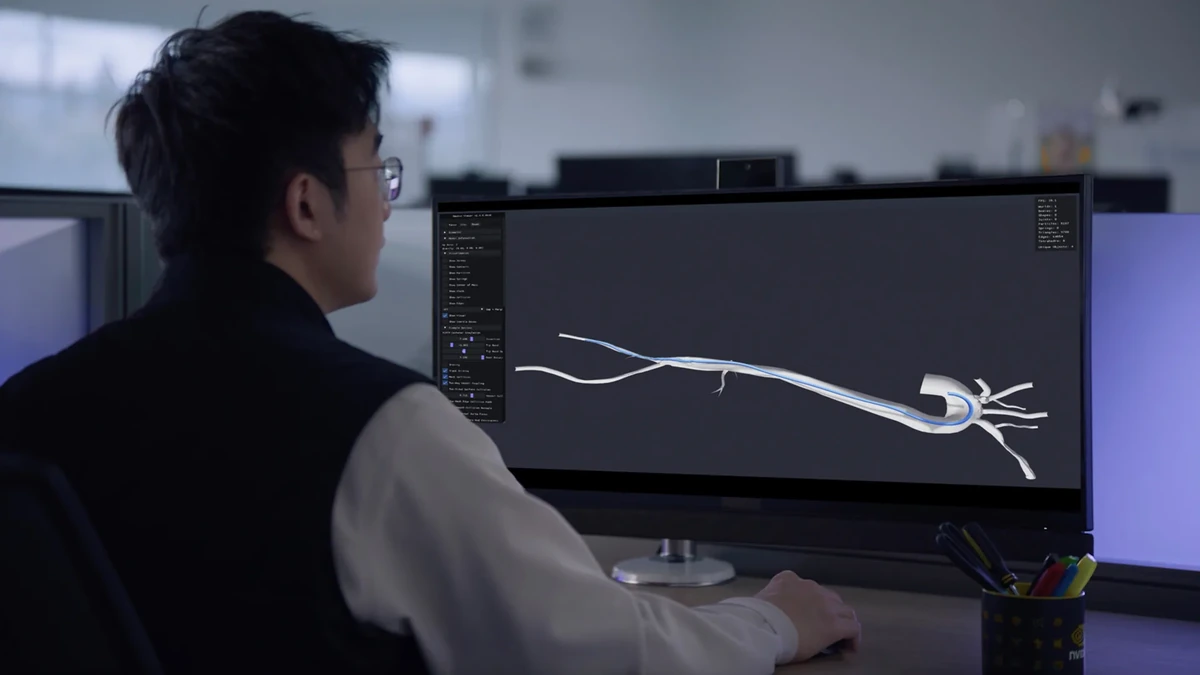
NVIDIA (NVDA ) has released a surgical simulator that generates the operating field in real time, fast enough for a surgeon or a trained robot policy to steer the scene while it is being produced. The model, Cosmos-H-Dreams, runs at about 160 frames per second on a single RTX PRO 6000 GPU, up from roughly 10 frames per second for the offline model it was distilled from, according to NVIDIA’s own figures. Weights and serving code went up on July 23, 2026, and the company published the technical breakdown four days later.
There is no physics engine underneath. Instead of authoring tissue, sutures and instrument contact by hand, the model learns visual dynamics from paired surgical video and robot kinematics, then predicts what the camera would see next. It takes one initial frame plus a live stream of arm commands and generates the following block of 12 frames before consuming the next batch of actions. A browser client can drive it from a keyboard, a Meta Quest headset can map tracked controller motion into robot actions, and a learned surgical policy can be dropped into the same loop in place of the human. The same class of model has pulled in serious money elsewhere in the industry, including Odyssey’s $310 million Series B for world models.
How the frame rate was bought
Cosmos-H-Dreams is a distilled student of a slower model. The teacher, Cosmos-H-Surgical-Simulator, is built on NVIDIA’s 2-billion-parameter Cosmos-Predict2.5 video model and produces surgical rollouts in one pass after the fact, which suits scoring a recorded trajectory but not driving one. The student was trained to keep going from its own generated history rather than from clean ground truth, a procedure the model card calls self-forcing distillation, and it produces each latent frame in two to four denoising steps instead of the teacher’s many. FlashDreams, NVIDIA’s streaming inference library, covers the rest by holding a rolling cache of past frames and pre-capturing the repeated GPU work so the hardware is not re-planning it on every step.
The released checkpoint does one job: tabletop suturing on the da Vinci Research Kit, a physical platform academic labs use to develop and test surgical policies. It runs at 288 by 512 pixels and accepts commands at an effective 10 Hz. This is a bench task, not a body.
The training mixture is arguably more interesting than the frame rate. Alongside successful suturing and knot-tying demonstrations from Johns Hopkins, NVIDIA deliberately kept failure and out-of-distribution episodes: needle drops, missed throws, knots that did not hold. Its stated reason is that a simulator meant to score policies has to reproduce the consequences of poor actions, not only ideal demonstrations.
Versius gets wired in
NVIDIA says it worked with CMR Surgical and Cambridge Consultants, the Capgemini-owned engineering firm, to connect the model to the surgeon controller for CMR’s Versius platform and run it live. CMR demonstrated the setup to a surgical audience at a robotic surgery conference in Florida in late July 2026. The company has reason to be in this loop early: NVIDIA credits it with contributing nearly 500 hours of anonymized Versius procedure data to the Open-H Embodiment dataset the model family was pretrained on, and CMR describes itself as the largest contributor to that dataset.
CMR is also direct about what the demonstration is not. A footnote on its release states that the simulation is “for research and demonstration purposes only,” is not part of the cleared Versius Plus system, and is not meant for clinical decision-making or patient care. Versius Plus itself is cleared in the US only for gallbladder removal in adults, with a gynecology application pending. Regulatory clearance for surgical hardware still moves procedure by procedure, as Momentis’s Anovo robot showed when it won US clearance for multiport surgery. NVIDIA draws the same line in its own post: this is a research and development platform, not a diagnostic system and not a controller for a physical surgical robot.
The validation agenda
The model is the generative half of the Medical Physics Simulation framework NVIDIA open-sourced on July 22, 2026 within its Isaac for Healthcare stack, where conventional solvers handle contact and friction and the learned model handles visual scene dynamics. It is the same position NVIDIA has taken on the factory floor, supplying the simulation layer other vendors build products on.
NVIDIA’s post says the immediate next step is to evaluate more than visual quality, and it proposes a family of closed-loop tests as the measure of whether the fast version is accurate enough to trust:
- tool-tip reach and pose accuracy
- gripper-cycle fidelity and stability when the instruments are idle
- drift over long rollouts
- agreement between simulated and real policy outcomes
The closest transfer evidence so far comes from the earlier lineage: a 2025 paper by NVIDIA and Johns Hopkins researchers reported strong correlation between rollouts in the offline surgical model and policy outcomes on a physical da Vinci research system for suture-pad tasks, plus preliminary alignment on ex-vivo porcine gallbladder work. That was the slow bidirectional model rather than the two-step student, and the repository itself notes the faster schedule costs some fidelity.
Getting hands on it is cheap by frontier-model standards. The weights carry NVIDIA’s open model license and the serving code is Apache 2.0, with the repository asking for a GPU with 12 GB of memory, a current driver and Linux. There is no technical report yet; the repository’s link to one points at a placeholder file. Video-conditioned robot policies are already moving onto production lines, as with mimic robotics’ FLUX-mimic at an Audi plant, but surgery has a harder acceptance test. For the labs training surgical policies, the question that matters is whether a score earned inside this simulator predicts what the arm does on a real suture pad. NVIDIA has named that benchmark, and its results are what the next round of evidence will turn on.



