AI Fundamentals
What is Computational Thinking?

 Add Unite.AI to your preferred sources on Google
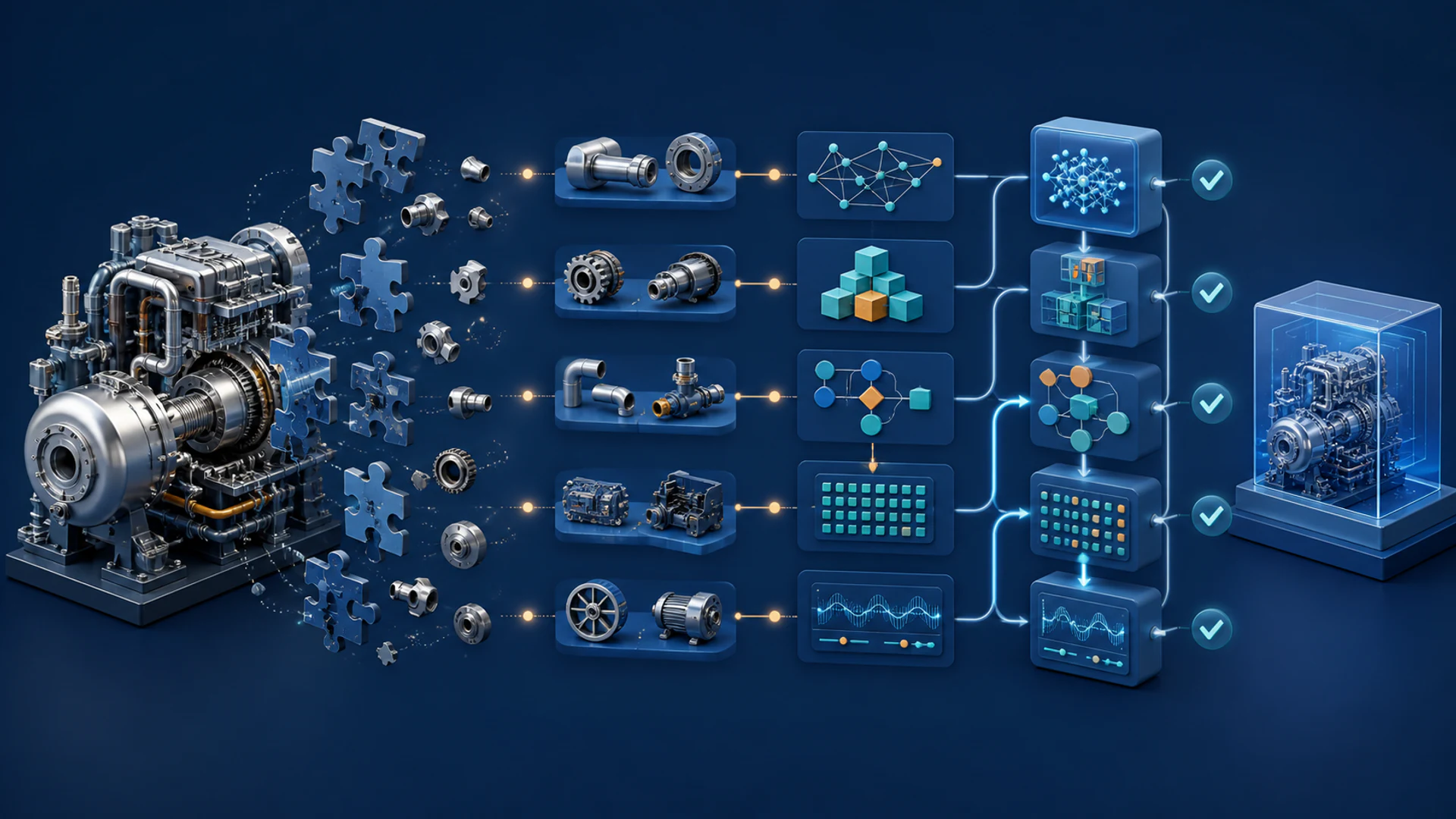
Computational thinking is a way of formulating problems and solutions so that information-processing steps can be carried out systematically by a person, computer or network of systems. It includes abstraction and algorithm design, but it also includes deciding what should be represented and how a proposed solution will be tested.
Computational thinking is broader than programming. Code may implement a solution, yet the difficult work often comes earlier: defining the objective, decomposing the problem, selecting relevant detail and recognizing where automation is inappropriate.
Key takeaways
- Formulate the problem before optimizing a procedure.
- Decomposition separates a complex system into interacting parts; abstraction hides detail that is irrelevant at a chosen level.
- Algorithms need inputs, outputs, assumptions, stopping conditions and tests.
- Computational thinking does not remove social judgment, ambiguous values or accountability.
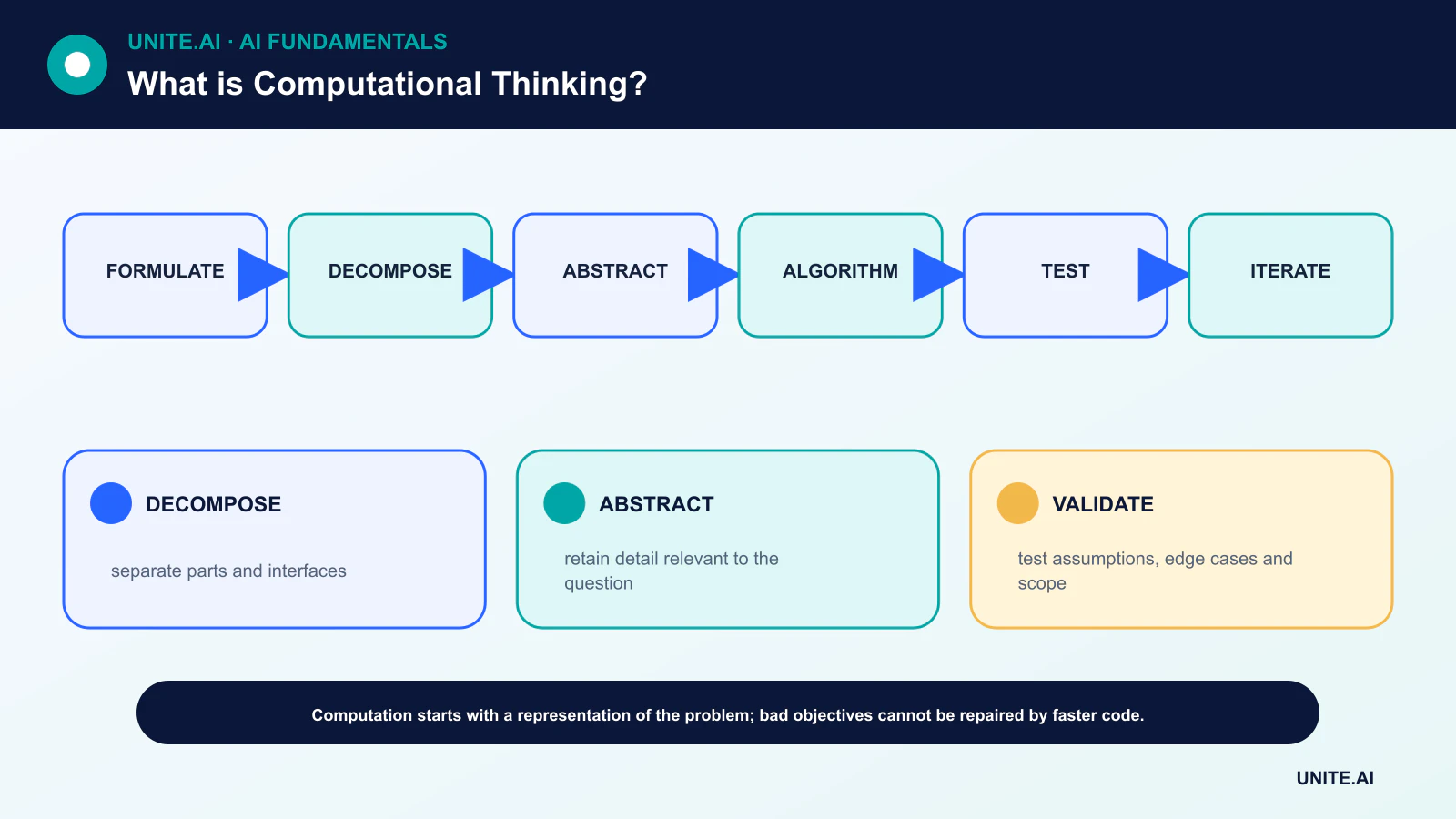
Formulate the problem and objective
Identify the people affected, the decision to support, the available information and the consequences of error. Translate a vague request into an observable outcome without confusing an easy-to-measure proxy with the real goal.
In machine learning, predicting clicks may be technically convenient but may not represent satisfaction. Computational thinking begins by testing that formulation rather than immediately selecting an algorithm.
Decompose systems and dependencies
Break the problem into components that can be reasoned about separately: data collection, validation, transformation, decision logic, user interaction and monitoring. Record interfaces and feedback between them so local improvements do not damage the wider system.
Decomposition is not fragmentation. A team must recombine the parts and test end-to-end behavior, including timing, missing inputs and failures in upstream or downstream services.
Abstract and represent
An abstraction retains details relevant to a question and suppresses others. A graph can represent connections, a table can represent records, and a probability distribution can represent uncertainty. The same real-world situation can require different representations for different decisions.
All representations omit something. Document units, categories, time windows and missingness. The distinction between structured and unstructured data affects what can be expressed and which transformations may lose context.
Design an algorithm and automate carefully
An algorithm is a defined procedure with inputs, steps and outputs. Consider correctness, termination, complexity, memory, failure behavior and whether results are deterministic or probabilistic. Use examples and edge cases before generalizing.
Automation should include validation and a safe response to unsupported inputs. A process that runs quickly but encodes the wrong objective is not an improvement. Human review can be part of the algorithmic system rather than evidence that it failed.
Test, iterate and generalize
Unit tests check components; integration tests check interfaces; scenario tests exercise end-to-end behavior. Compare expected and observed results, trace errors to assumptions, and revise the formulation when the evidence contradicts it.
Generalization asks whether the approach transfers beyond the examples used to design it. State the valid scope. Problems involving rights, values or contested goals require participatory judgment and governance in addition to computation.
The core practices of computational thinking
Computational thinking frames a problem so a person or machine can execute a solution. Decomposition breaks a complex goal into manageable parts; pattern recognition identifies repeated structure; abstraction retains information relevant to the task; algorithm design specifies steps and conditions. Representation is equally important: tables, graphs, states, coordinates, and data types make some operations easy and others difficult. The purpose is disciplined problem solving, not merely learning to write code.
A good decomposition defines interfaces and ownership between parts. Abstraction should hide incidental detail without hiding constraints needed for correctness. Algorithms need inputs, outputs, preconditions, invariants, termination, and error behavior. Pseudocode, flowcharts, decision tables, and examples help before implementation. Efficiency considers time, memory, communication, energy, and human effort, but optimization should follow a correct baseline. Some problems are undecidable or computationally intractable at scale, making approximation and tradeoffs essential.
Testing, debugging, and data reasoning
Testing derives cases from requirements: normal, boundary, empty, malformed, repeated, extreme, and adversarial. Debugging forms hypotheses, observes state, isolates causes, and verifies a fix without adding regressions. Reproducibility records inputs, versions, and environment. For data problems, ask how observations were sampled, measured, labeled, missing, and transformed. An algorithm can execute perfectly and still produce a wrong conclusion because the representation or data-generating assumption was invalid.
Automation changes a process and its incentives. Identify who provides input, who is affected by output, what exceptions exist, and how appeal or correction works. Privacy, accessibility, security, and fairness belong in problem definition, not an afterthought. A deterministic specification is preferable for exact rules; machine learning is appropriate when patterns must be estimated from data and errors can be evaluated. Choosing not to automate can be the correct computational decision.
Teaching and applying the skill
Learners should solve the same problem with physical steps, pseudocode, a spreadsheet, and code to see how representations change reasoning. Projects should require explanation and tests, not only a working output. In organizations, computational thinking improves requirement writing, workflow design, data analysis, and collaboration with engineers. Its durable value is the ability to make assumptions explicit, construct a reproducible process, and recognize where uncertainty or human judgment prevents a problem from being reduced to a simple algorithm.
Worked example: designing a school bus routing algorithm
Students decompose the task into stops, riders, capacity, time windows, travel times, accessibility, and safety constraints. They represent the road network as a graph, create a simple greedy route, and test it against small cases with known solutions. Boundary tests include no riders, an unreachable stop, vehicle failure, and a rider requiring an accessible bus. Efficiency is compared only after correctness and constraints are visible.
The class then studies tradeoffs: shortest distance may create long individual rides or unequal service. They add fairness and resilience metrics, document assumptions, and allow planners to override with a reason. Personal addresses are protected and sample data is synthetic. The exercise demonstrates that abstraction enables computation but also decides which human needs appear in the model. Computational thinking includes recognizing when a clean optimization objective omits an important value or exception.
Implementation evidence and operational readiness
A production decision needs more than a successful demonstration. Define the intended users, operating environment, inputs, outputs, dependencies, owner, and the consequence of each important failure. Establish a reproducible baseline and a versioned evaluation set before tuning. Test ordinary cases, boundary conditions, malformed or missing input, distribution shift, dependency outage, misuse, and the groups or environments most likely to be underserved. Measure task quality together with calibration or uncertainty, latency, throughput, resource cost, accessibility, privacy, and security. Record every transformation and threshold so an independent reviewer can reproduce the result and distinguish evidence from an attractive prototype.
Before launch, assign authority for release, exceptions, changes, rollback, and retirement. Use a staged rollout, preserve a safe fallback, and verify monitoring with deliberately injected failures. Operational telemetry should reveal input quality, output behavior, model or rule version, dependency health, human overrides, and confirmed outcomes without collecting unnecessary sensitive data. Define alert thresholds and a response owner, then review real-world evidence after deployment rather than assuming offline performance will persist. Reevaluate whenever data sources, users, models, vendors, policies, hardware, or objectives change. A maintained system also needs documented recovery, incident learning, deletion and retention procedures, and a clear point at which it should be disabled or replaced.
Frequently asked questions
Is computational thinking the same as coding?
No. Coding expresses instructions in a programming language; computational thinking includes problem formulation, representation, algorithm design, testing and evaluation.
Can every problem be solved computationally?
No. Some problems are undecidable or infeasible, and many human problems have ambiguous objectives or value conflicts that computation cannot resolve on its own.
Primary references