AI Fundamentals
What is Meta-Learning?

 Add Unite.AI to your preferred sources on Google

Meta-learning trains a system across a distribution of tasks so it can adapt to a new, related task using limited data or computation. It is often summarized as “learning to learn,” but the technical objective is more precise: optimize the learner so experience across earlier tasks improves adaptation to a later one.
Meta-learning overlaps with few-shot learning and transfer learning, but the terms are not interchangeable. Few-shot describes the amount of target data; transfer describes reuse; meta-learning explicitly makes adaptation across tasks part of training.
Key takeaways
- Meta-training uses many tasks, not just many independent examples.
- An N-way K-shot episode contains N classes and K labeled support examples per class.
- Gradient-based, metric-based, memory-based, and learned-optimizer methods adapt in different ways.
- Performance depends strongly on whether meta-training tasks resemble the target task.
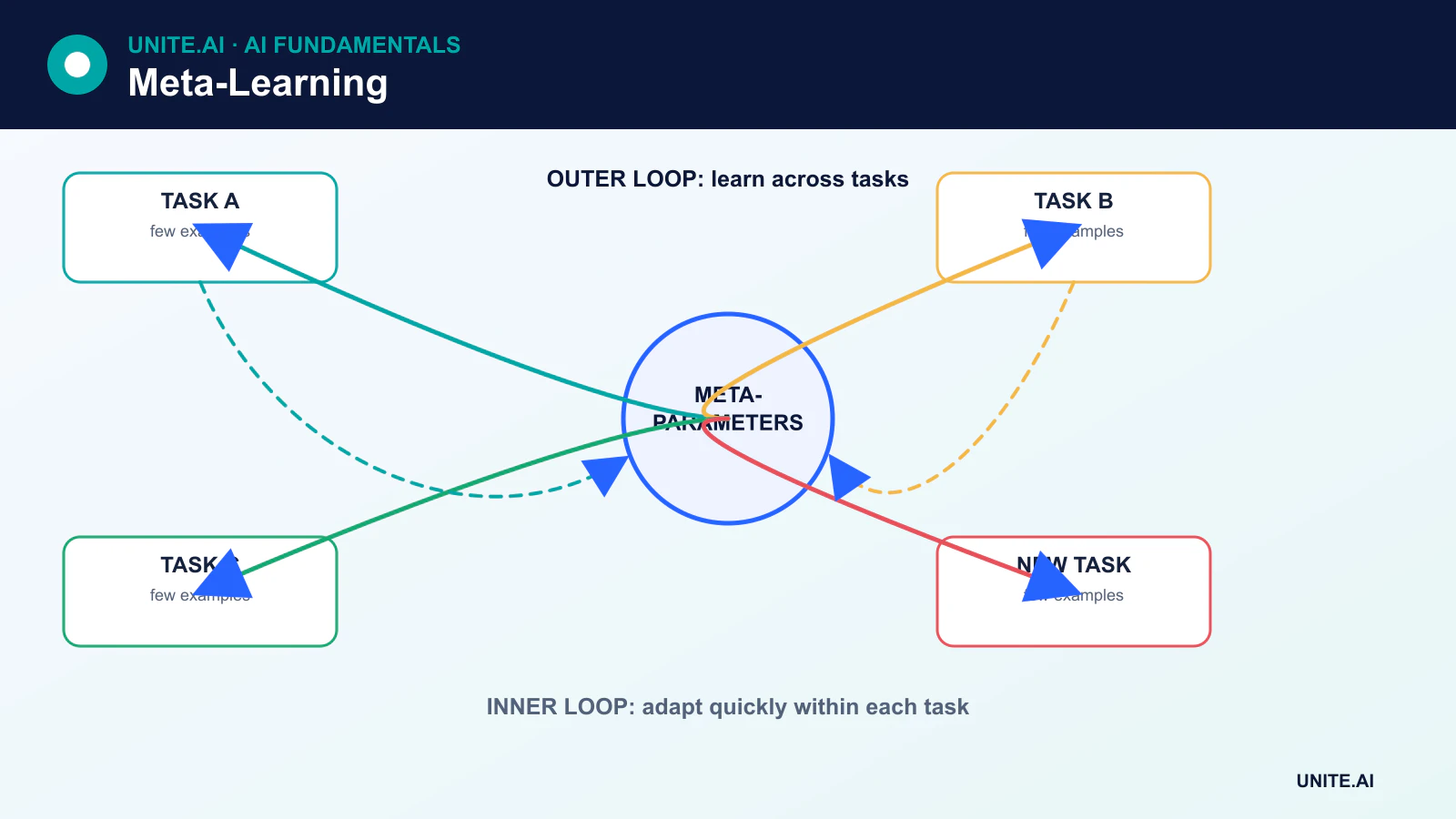
Tasks, support sets, and query sets
A meta-learning dataset is organized as tasks. In few-shot classification, an episode may be 5-way 1-shot: five classes, one labeled support example per class, and additional query examples used to evaluate adaptation. A 5-way 5-shot task has five support examples for each of five classes—not five examples total.
During meta-training, the learner repeatedly adapts on a support set and is evaluated on a query set. The outer objective improves future query performance across tasks. Meta-validation tunes choices on separate tasks, and meta-testing evaluates genuinely unseen tasks or classes.
Gradient-based meta-learning
Model-Agnostic Meta-Learning (MAML) learns an initialization from which a small number of gradient steps produce good performance on a new task. The inner loop adapts model parameters using support data. The outer loop updates the shared initialization using query loss across sampled tasks.
MAML is not limited to classification; it can be applied to regression and reinforcement learning when the model and task are differentiable. Reptile offers a simpler first-order approach that moves parameters toward task-adapted solutions without calculating the full MAML meta-gradient.
Metric-based meta-learning
Metric-based methods learn an embedding in which examples from the same class are close and different classes are separated. A prototypical network averages support embeddings to form one prototype per class, then classifies queries by distance to those prototypes.
Matching and Siamese-style networks use related similarity mechanisms. These methods do not merely check whether a model “hits a target metric”; the learned distance or representation is itself part of the prediction procedure.
Memory-based methods and learned optimizers
Memory-based systems use recurrent or attention-based state to store information about the current task. Learned optimizers take gradients or training signals as inputs and learn how to update another model. These methods can discover adaptation rules, but they add parameters, compute, and another level of potential overfitting.
Meta-learning and in-context learning
Large transformers can adapt their output from examples supplied in a prompt without updating weights. This is called in-context learning. It resembles meta-learning behavior, and training data may encourage task inference, but an in-context learner is not automatically trained with a classical episodic meta-learning objective.
Where meta-learning is useful
Potential applications include personalization, robotics, low-resource recognition, scientific tasks with few measurements, and rapid adaptation to new environments. Meta-learning is most attractive when many related source tasks are available but target-task data is scarce.
Limitations
Meta-learning can be computationally expensive because training nests adaptation inside optimization. Results are sensitive to task construction, support/query leakage, architecture, and domain shift. A model trained on narrow, homogeneous tasks may adapt poorly outside that distribution.
Comparisons should include ordinary transfer-learning and multitask baselines. A strong pretrained representation followed by standard fine-tuning can be simpler and more effective than a dedicated meta-learning algorithm.
Tasks, adaptation, and the inner–outer optimization structure
Meta-learning trains over a distribution of tasks so a learner can adapt to a new task with limited data or updates. Each episode samples a task, divides examples into a support set used for adaptation and a query set used for evaluation, and updates shared knowledge across episodes. Metric-based methods learn an embedding and comparison rule; optimization-based methods learn initialization or update behavior; memory- and model-based methods condition on task examples. The task distribution is the real training data and must resemble future adaptation problems.
In model-agnostic meta-learning, an inner loop adapts parameters on support examples and an outer loop optimizes performance on query examples after adaptation. Higher-order gradients can be expensive; first-order approximations trade fidelity for cost. Prototypical networks represent each class by a support-set centroid and classify by distance. These methods assume that class geometry, adaptation steps, and episode construction reflect deployment. A method can appear to learn quickly while exploiting fixed labels, acquisition artifacts, or overlap among source datasets.
Evaluation, baselines, and real-world limitations
Separate training, validation, and test tasks—not merely examples—to measure adaptation to genuinely unseen tasks. Report accuracy or loss as a function of shots and adaptation steps, confidence intervals across tasks, compute, memory, and sensitivity to support-set composition. Compare with transfer learning, fine-tuning a pretrained model, nearest neighbors, and a model trained jointly on all source data. Many apparent meta-learning gains shrink when baselines receive equivalent backbones, augmentation, and tuning.
Real deployments need a way to recognize when a new task lies outside the meta-training distribution. Poor or mislabeled support examples can cause rapid confident failure. Limit update magnitude, validate adapted models, preserve a fallback, and protect adaptation data from poisoning. Track base model, task sampler, episode seeds, and adaptation code. Meta-learning is useful for repeated families of small-data problems, but it does not create general learning ability from arbitrary examples and does not remove the need for domain-specific evaluation.
Worked example: few-shot adaptation across machines
A manufacturer treats each machine type as a task and meta-trains an anomaly representation across many machines with verified maintenance outcomes. Test machines are entirely excluded from task training. For a new machine, a small support set covers normal operating modes rather than arbitrary minutes of data. Meta-learning is compared with a pretrained frozen encoder, nearest neighbors, and ordinary fine-tuning using the same support examples and compute.
Evaluation repeats many support selections and reports event recall, false alarms, adaptation time, and variance. The system abstains when the new machine’s sensor set or dynamics fall outside the task distribution. Adaptation updates are bounded and reviewed before they influence maintenance. Support labels and machine identity are protected from poisoning, and every adapted model retains its base version and examples. Rapid adaptation is accepted only if it consistently beats simpler transfer under realistic task shift.
Implementation evidence and operational readiness
A production decision needs more than a successful demonstration. Define the intended users, operating environment, inputs, outputs, dependencies, owner, and the consequence of each important failure. Establish a reproducible baseline and a versioned evaluation set before tuning. Test ordinary cases, boundary conditions, malformed or missing input, distribution shift, dependency outage, misuse, and the groups or environments most likely to be underserved. Measure task quality together with calibration or uncertainty, latency, throughput, resource cost, accessibility, privacy, and security. Record every transformation and threshold so an independent reviewer can reproduce the result and distinguish evidence from an attractive prototype.
Before launch, assign authority for release, exceptions, changes, rollback, and retirement. Use a staged rollout, preserve a safe fallback, and verify monitoring with deliberately injected failures. Operational telemetry should reveal input quality, output behavior, model or rule version, dependency health, human overrides, and confirmed outcomes without collecting unnecessary sensitive data. Define alert thresholds and a response owner, then review real-world evidence after deployment rather than assuming offline performance will persist. Reevaluate whenever data sources, users, models, vendors, policies, hardware, or objectives change. A maintained system also needs documented recovery, incident learning, deletion and retention procedures, and a clear point at which it should be disabled or replaced.
Frequently asked questions
Is few-shot prompting meta-learning?
Few-shot prompting is an in-context adaptation technique. It may display behavior associated with learning across tasks, but it is not automatically trained with support/query episodes or an explicit meta-optimization loop.
What is the biggest meta-learning risk?
A mismatch between meta-training tasks and the target task can make rapid adaptation look strong in a benchmark but fail in deployment. Task splits and source provenance must be audited as carefully as ordinary train/test splits.
Primary references