AI Fundamentals
What is Ethical Hacking and How Does It Work?

 Add Unite.AI to your preferred sources on Google

Ethical hacking is authorized security testing performed within an agreed scope to identify and validate weaknesses before malicious actors exploit them. The word ethical does not come from technical skill alone; it comes from permission, proportional methods, careful data handling and responsible reporting.
Testing without explicit authorization can be illegal and harmful even when the tester intends to help. A professional engagement defines targets, excluded systems, allowed techniques, time windows, contacts, stop conditions and how evidence will be protected.
Key takeaways
- Written authorization and rules of engagement come before reconnaissance or scanning.
- Testing should prove risk with the least harmful method that supplies adequate evidence.
- A finding becomes useful through severity analysis, remediation guidance and retesting.
- Ethical hacking complements—not replaces—secure design, patching, monitoring and incident response.
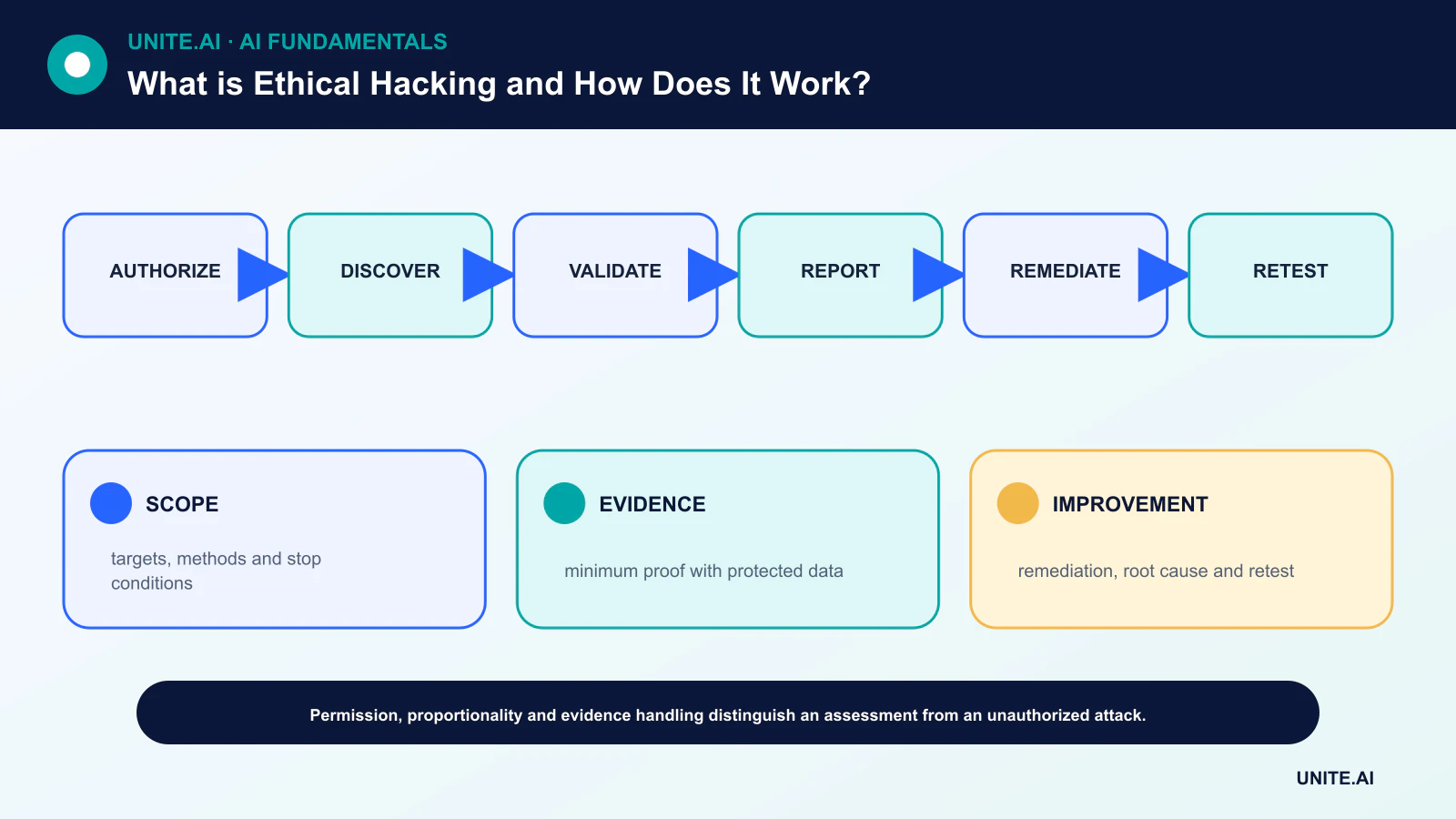
Authorization, scope and safety
The owner and tester agree which hosts, applications, identities, facilities and third parties are in scope. The rules specify whether social engineering, denial-of-service, credential attacks, persistence or data access are prohibited or constrained.
Emergency contacts and stop conditions matter because testing can disrupt production. The plan should define evidence retention, encryption, deletion, legal review and procedures for encountering personal or unrelated data.
Discovery and threat-informed planning
Passive reconnaissance reviews authorized public information; active discovery maps reachable services and configurations. Threat modeling identifies valuable assets, trust boundaries and plausible attacker goals so effort is directed by risk rather than a generic checklist.
Automated scanners can find known patterns but produce false positives and miss business-logic flaws. Human analysis combines configuration, application behavior, identity paths and the organization’s cybersecurity controls.
Validation and controlled exploitation
The tester confirms whether a suspected weakness is reachable and what impact it permits. Proof should stop once sufficient evidence exists. Copying an entire database or establishing unnecessary persistence is rarely justified when a harmless sample demonstrates the issue.
Privilege escalation and lateral movement require explicit scope. Segmentation, monitoring and response are part of the assessment: a test can reveal whether defenders detect and contain the activity, not only whether an entry point exists.
Reporting, remediation and retesting
A useful report describes the affected asset, prerequisites, evidence, potential impact, severity rationale and concrete remediation. It separates confirmed exploitation from theoretical risk and protects exploit details according to the engagement rules.
Owners prioritize fixes based on exposure and business impact, then retest. Root-cause analysis may identify reusable improvements in secure development, identity, configuration or DevOps pipelines.
Pen tests, red teams and disclosure
A penetration test usually assesses defined systems over a limited period. A red team tests detection and response against an objective; blue teams defend; purple teaming turns adversarial findings into collaborative improvement. A vulnerability assessment is broader scanning and analysis, not always exploitation.
Independent researchers should follow the organization’s vulnerability disclosure policy or an applicable safe-harbor program. If no policy exists, use established coordination channels and legal guidance—do not assume public exposure authorizes testing.
Authorization, scope, and testing methodology
Ethical hacking is authorized security testing intended to identify and help remediate weaknesses. Written rules of engagement define systems, identities, dates, techniques, data handling, communication, stop conditions, and prohibited impacts. Permission from the actual system owner is essential; a public IP or bug is not authorization. Testers should minimize disruption, protect evidence, coordinate on critical findings, and have an emergency contact. Legal and contractual requirements vary by jurisdiction and service provider.
A professional engagement begins with asset and threat context, then reconnaissance within scope, attack-surface mapping, vulnerability identification, validation, and controlled exploitation only as needed to prove impact. Testing spans applications, APIs, cloud configuration, identity, networks, wireless, mobile, hardware, and human processes. Automated scanners find known patterns but produce false positives and miss chained logic flaws. Manual reasoning examines authorization, business logic, trust boundaries, and paths from an initial weakness to valuable assets.
Evidence, remediation, and safe reporting
A finding should include affected asset, preconditions, reproducible steps, observed evidence, impact, likelihood, severity rationale, and remediation. Do not collect more sensitive data than necessary; redact secrets and personal information. Preserve timestamps and tool versions. Severity should reflect real environment and controls rather than a generic score alone. Immediate notification is appropriate when testing exposes active compromise, destructive risk, or a path that others can exploit.
Remediation validation confirms the root cause is removed without introducing regressions. Fix classes of weakness—authorization design, secret management, input handling, segmentation—not only one URL. Track time to remediate, recurrence, asset coverage, and control improvement. A long report with many low-value scanner findings can obscure the few attack paths that matter. Lessons should feed secure design, code review, monitoring, and incident response.
Programs, disclosure, and ethics
Penetration tests are point-in-time samples; continuous vulnerability management, threat modeling, red teaming, and bug bounty programs serve different purposes. Coordinated disclosure gives maintainers a safe channel and reasonable remediation time while protecting users. Testers must avoid extortion, unnecessary access, and public release that creates disproportionate harm. Ethical hacking earns its name through authorization, proportionality, competence, evidence, and responsible handling—not simply because the tester believes the target should be more secure.
Worked example: testing an API authorization boundary
A company authorizes testers to assess a staging API and specified production accounts during a fixed window. Rules prohibit denial-of-service and access to real customer content beyond minimal proof. Testers map roles, object identifiers, and endpoints and discover that a low-privilege user can request another tenant’s invoice. They capture a redacted response, stop further access, and notify the designated contact immediately.
The report identifies broken object-level authorization, affected routes, impact, reproduction, and a centralized permission check. Developers fix the shared authorization layer and add negative tests across every object type. Retesting uses synthetic tenants and confirms logs detect attempts. The organization hunts historical access, evaluates notification duties, and updates threat models. The tester does not publish exploit details until coordinated remediation protects users. Authorization and evidence—not the novelty of the exploit—make the work ethical.
Implementation evidence and operational readiness
A production decision needs more than a successful demonstration. Define the intended users, operating environment, inputs, outputs, dependencies, owner, and the consequence of each important failure. Establish a reproducible baseline and a versioned evaluation set before tuning. Test ordinary cases, boundary conditions, malformed or missing input, distribution shift, dependency outage, misuse, and the groups or environments most likely to be underserved. Measure task quality together with calibration or uncertainty, latency, throughput, resource cost, accessibility, privacy, and security. Record every transformation and threshold so an independent reviewer can reproduce the result and distinguish evidence from an attractive prototype.
Before launch, assign authority for release, exceptions, changes, rollback, and retirement. Use a staged rollout, preserve a safe fallback, and verify monitoring with deliberately injected failures. Operational telemetry should reveal input quality, output behavior, model or rule version, dependency health, human overrides, and confirmed outcomes without collecting unnecessary sensitive data. Define alert thresholds and a response owner, then review real-world evidence after deployment rather than assuming offline performance will persist. Reevaluate whenever data sources, users, models, vendors, policies, hardware, or objectives change. A maintained system also needs documented recovery, incident learning, deletion and retention procedures, and a clear point at which it should be disabled or replaced.
Frequently asked questions
Can I ethically scan any public website?
No. Public reachability is not authorization. Test only systems covered by written permission or a clearly applicable vulnerability-disclosure policy.
Does a clean penetration test prove a system is secure?
No. It means the assessment did not confirm additional findings within its scope, time, methods and knowledge. Security requires continuous controls and monitoring.
Primary references