AI Fundamentals
Coding and AI: A Beginner’s Path into Artificial Intelligence

 Add Unite.AI to your preferred sources on Google

You can begin learning AI without prior professional programming experience, but building reliable systems eventually requires enough coding, data, and evaluation skill to inspect what the tools are doing. The fastest path is a small sequence of projects tied to fundamentals rather than a long tour of disconnected tutorials.
AI-assisted coding can explain syntax, generate examples, and help debug. Treat its output as a draft: run it, test it, read the documentation, and understand the data and permissions before trusting it.
Key takeaways
- Learn basic Python, notebooks, Git, the command line, and how to read errors.
- Build one small supervised-learning project before jumping to agents or large models.
- Use train, validation, and test data correctly; compare with a simple baseline.
- Let AI assist the feedback loop, but verify code, sources, licenses, security, and results yourself.
Stage 1: programming foundations
Learn variables, collections, conditions, loops, functions, modules, files, environments, and exceptions. Practice reading a CSV, transforming records, calling a documented API, writing a test, and using Git to track changes.
You do not need advanced mathematics before writing code, but you should learn basic probability, vectors, averages, distributions, and graphs as they become relevant. Computational thinking helps turn a vague goal into testable steps.
Stage 2: a complete ML project
Choose a small public dataset and a clear prediction question. Explore the data, create an independent split, build a baseline, train a simple model, inspect errors, and write down limitations. Use scikit-learn before a custom neural network when it fits.
This project makes machine-learning concepts concrete: features, labels, leakage, overfitting, metrics, reproducibility, and the difference between a model score and a useful decision.
Stage 3: deep learning and language models
Learn tensors, batches, loss, gradient descent, and backpropagation through a small image or text model. Then use a pretrained model through an API or open library, record prompts and versions, and compare it with a simpler method.
Explore generative AI through a bounded application with retrieval or tool use. Add validation, citations, permissions, and fallback so the project teaches systems engineering as well as prompting.
Use AI coding assistants deliberately
Ask for small functions, tests, explanations, edge cases, and documentation references. Run static checks and tests, review dependency changes, and never paste secrets or private data without authorization. If you cannot explain a critical line, slow down.
A useful portfolio shows the question, data rights, baseline, method, evaluation, errors, and what you would improve. Finished, documented small projects demonstrate more judgment than copied code from a large demo.
A practical learning path from problem to prototype
Begin with a specific task and a small set of representative examples rather than a broad ambition to ‘learn AI.’ Classifying support messages, extracting invoice fields, or answering questions from approved documents provides observable inputs and outputs. Write what a good result looks like before choosing a model or tool.
No-code interfaces can teach prompting, data preparation, evaluation, and workflow design, but they do not remove the need for technical judgment. Learn tables, files, APIs, authentication, variables, conditions, and basic statistics. These concepts explain how data moves, why integrations fail, and what a model result does—and does not—mean.
Build a baseline with a simple rule, search method, spreadsheet, or small model. Then compare an AI approach on the same test cases. A baseline reveals whether complexity adds value and gives beginners a concrete debugging target. Keep test data separate from examples used to configure or prompt the system.
Prompting, APIs, and the transition to code
A useful prompt states the task, relevant context, constraints, output schema, and examples when necessary. Prompt changes are software changes: version them, test them against a fixed evaluation set, and inspect failures. Do not treat fluent explanations from the model as proof that the answer or cited evidence is correct.
Workflow builders connect model calls to forms, databases, files, and business applications. Understand what data each step sends to third parties, how credentials are stored, and what happens on timeout or retry. Add input validation, structured outputs, rate limits, human approval, and logs before using a prototype with real users.
Code becomes valuable when the workflow needs custom logic, repeatable tests, scale, performance, portability, or detailed security controls. Python and JavaScript are common entry points, but the language matters less than fundamentals: functions, data structures, packages, errors, version control, and tests. Use generated code only after reading and running it safely.
Portfolio projects, evaluation, and career development
A strong beginner project documents the problem, users, data permissions, baseline, architecture, evaluation set, metrics, failures, risks, and next steps. A polished interface without evaluation demonstrates less than a small, reproducible experiment. Remove private data and secrets before publishing code, screenshots, prompts, or logs.
Evaluate task success rather than model impressiveness. Classification needs class-specific precision and recall; extraction needs field accuracy; retrieval needs evidence coverage; generation needs factuality, usefulness, safety, latency, and cost. Review performance across languages, edge cases, and affected groups, and define when a human must decide.
AI work includes product management, domain expertise, data operations, evaluation, design, security, policy, and change management as well as model development. Build depth in one domain and enough technical literacy to collaborate across roles. Credible portfolios explain tradeoffs and limitations instead of presenting every prototype as production-ready automation.
Worked example: a beginner builds a document triage assistant
A learner collects a small set of public or permitted documents and defines three categories plus an ‘uncertain’ outcome. They label examples using a written rule, reserve a test set, and implement a keyword baseline in a spreadsheet. A no-code model or API then returns a structured category and confidence, which is compared with the same cases. Incorrect and ambiguous examples become the learning material, not something hidden in a demo.
The workflow accepts a file, extracts text, removes unsupported formats, calls the model with a fixed schema, validates the response, and sends uncertain cases to review. It stores only necessary fields and never includes credentials in prompts or shared screenshots. The learner records model name, prompt version, latency, cost, and output so changes can be tested rather than judged from memory.
A portfolio write-up reports per-class precision and recall, privacy assumptions, failure examples, and the boundary between prototype and production. The next coding step may replace a fragile manual integration with a small tested function or API. This progression teaches transferable skills: problem definition, data quality, evaluation, interfaces, error handling, security, and communication. Those fundamentals matter more than claiming to have built a sophisticated agent after one successful example.
Practical implementation checklist
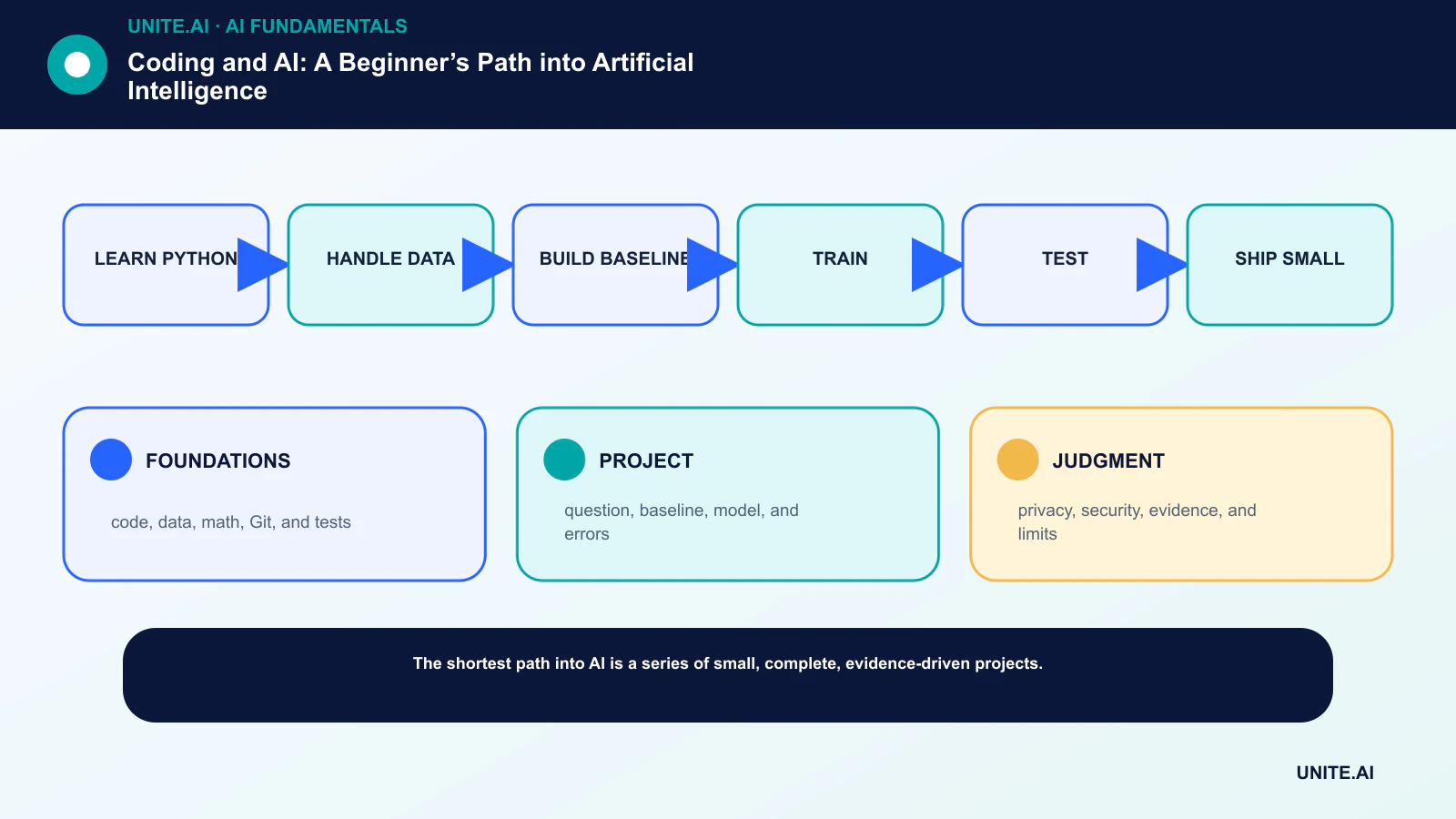
Turn the concept into a bounded, testable workflow: learn python → handle data → build baseline → train → test → ship small. Name an accountable owner, document the data and dependencies, establish a simple baseline, set acceptance and stop criteria, test representative failures, and define monitoring, rollback, and review before expanding scope. Record versions and assumptions so another team can reproduce the result and understand what changed.
Before launch, run a documented readiness review with the people who build, operate, secure, and are affected by the system. Test normal cases, boundary conditions, dependency failures, and misuse; preserve the evidence and unresolved risks. Define who can approve release, change a threshold, override an output, or stop operation. Revisit the decision after real-world data arrives, because a technically successful pilot does not guarantee reliable performance at broader scale.
- FOUNDATIONS: code, data, math, Git, and tests.
- PROJECT: question, baseline, model, and errors.
- JUDGMENT: privacy, security, evidence, and limits.
Frequently asked questions
Do I need a computer science degree to work in AI?
No. Roles include engineering, research, product, design, operations, data, evaluation, policy, and domain expertise. Each has a different depth of coding requirement.
Which programming language should a beginner learn?
Python is a practical first choice because its syntax is approachable and its data and ML ecosystem is broad. The underlying problem-solving skills transfer to other languages.
Primary references