
Head-to-Head
Slack vs. ClickUp: Which Is Better for Teamwork and Project Delivery?

 Add Unite.AI to your preferred sources on Google
Unite.AI may receive compensation when you use links to products we review. This does not influence our editorial evaluations. Read our affiliate disclosure.

Key PointsClickUp suits project-heavy teams needing tasks dependencies and reporting in one…
View more
- ClickUp suits project-heavy teams needing tasks dependencies and reporting in one accountable home.
- Slack remains valuable as a communication layer when work already spans departments and connected tools.
- Connecting ClickUp to an established Slack organization often beats migrating every conversation.
A busy channel is good at surfacing a request and much less reliable as a delivery plan. Slack and ClickUp overlap more than a simple chat-versus-tasks comparison suggests: Slack has Lists and workflows, while ClickUp includes Chat and collaborative Docs. The decision is which environment should organize the team’s daily work.
Quick Verdict
Choose Slack when your biggest need is communication across departments and the tools you already use. Choose ClickUp when tasks, dependencies, time, and reporting need one accountable home. We prefer ClickUp as the delivery system for a project-heavy team, with Slack retained when its wider communication network already has value.
Both products appear in our best AI collaboration tools guide. This comparison evaluates where each belongs in a real team workflow, including where using them together is more useful than replacing one with the other.
Slack vs. ClickUp at a Glance
| Decision | Slack | ClickUp |
|---|---|---|
| Best fit | Communication across people and tools | Projects from task intake to reporting |
| Task follow-through | Lists with item threads | Tasks, subtasks, dependencies and views |
| Conversation | Channels, DMs and huddles | Chat alongside project records |
| AI example | Brief a teammate from the discussion | Draft action items from project content |
| Using both | Escalate and discuss the work | Keep ownership and progress authoritative |
The Same Team Problem, Two Different Approaches
Consider a product team preparing a website launch. Design must finish before development, copy needs approval, and analytics must be ready before release. A marketing lead needs a quick answer about launch risk, while individual contributors need to know what to do next.
Coordinate the work in Slack
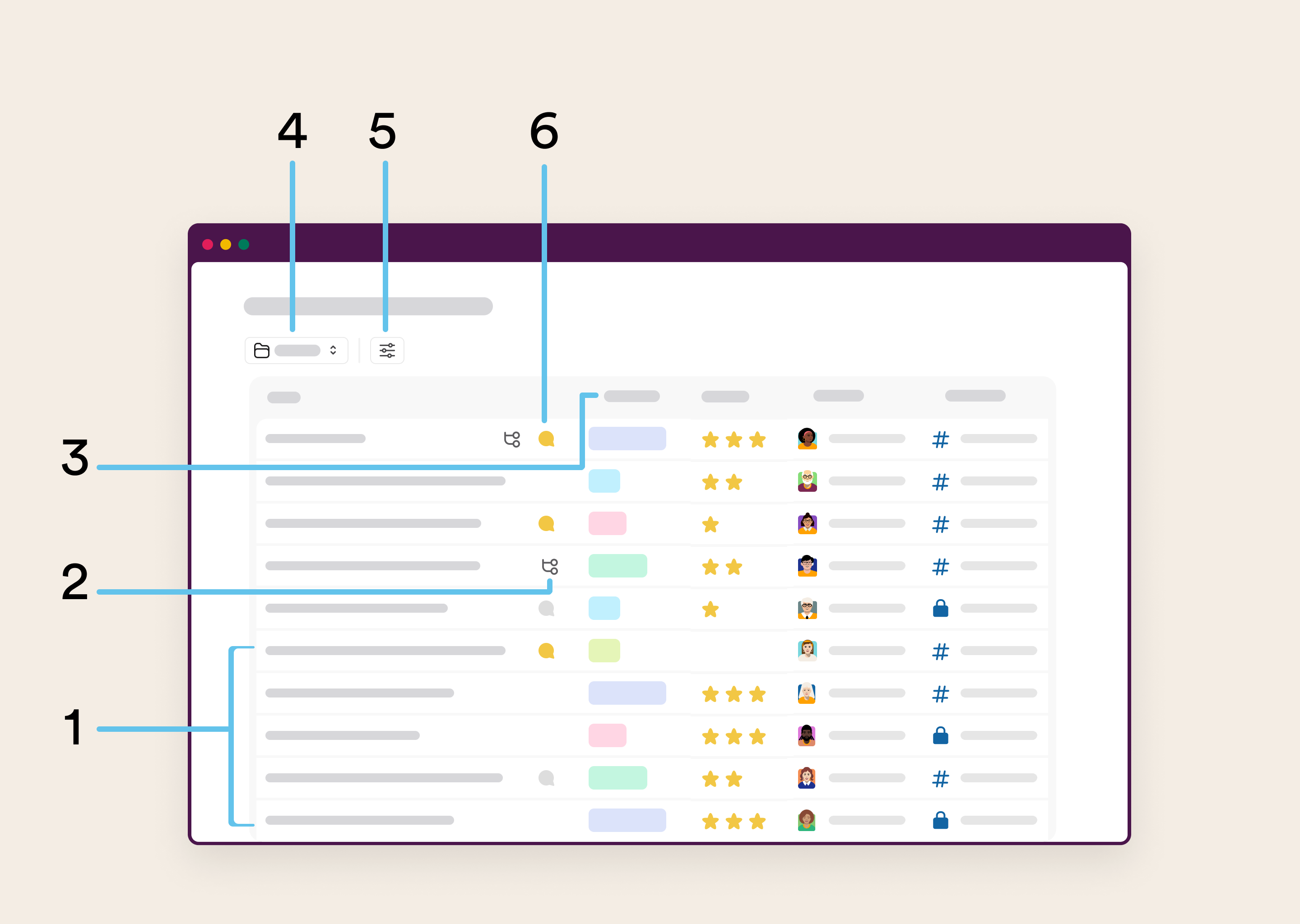
Slack is a natural place to create the launch channel, bring design and engineering into the same thread, and capture the decision behind a change. A Slack list can assign small follow-ups with dates and status. A canvas can keep the brief and key links visible, reducing the time new participants spend asking for context.
Organize the work in ClickUp
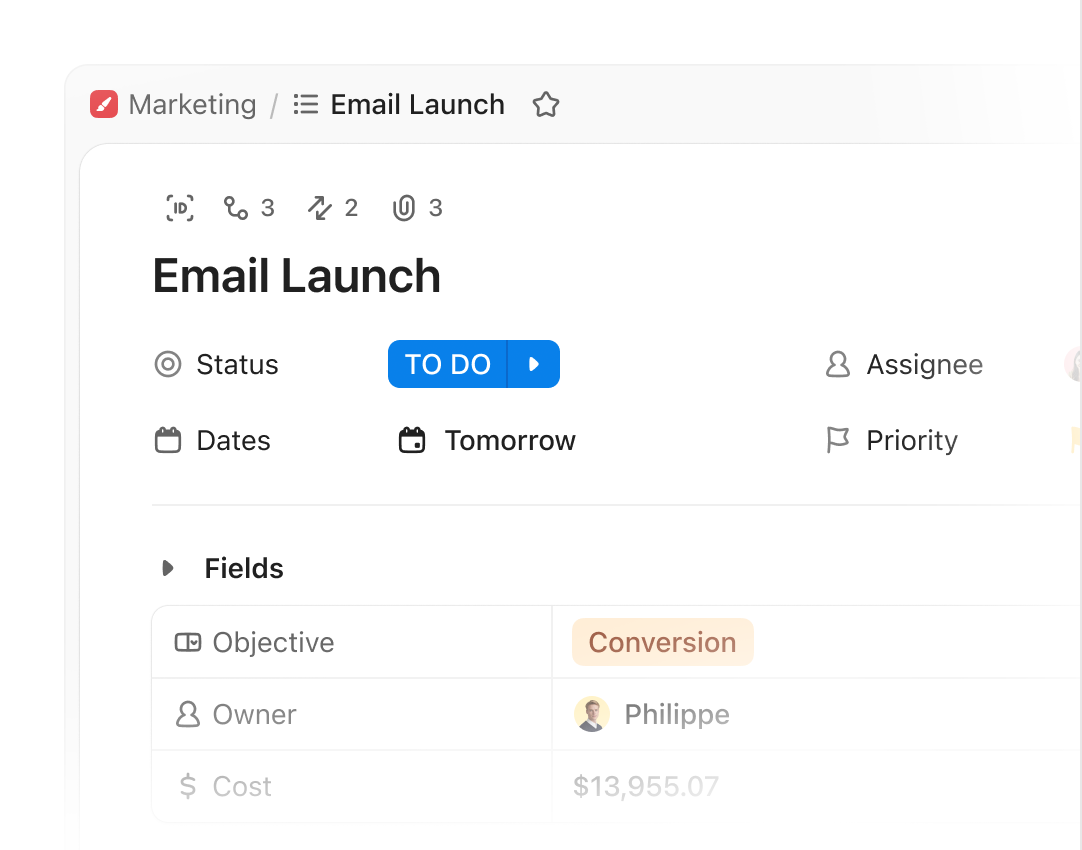
ClickUp gives the launch a more explicit delivery structure. Tasks can carry an assignee, due date, status, and custom fields; subtasks separate work that belongs under a larger deliverable. Dependencies make the relationship between design, development, and approval more visible. A manager can move between a task list and a schedule view without reconstructing the plan from messages.
For a small, straightforward launch, Slack Lists may be enough. Our recommendation moves toward ClickUp when there are repeated handoffs, several launches, or a need to track effort and report progress consistently. ClickUp’s flexibility brings setup work of its own: too many statuses and custom fields make a simple project harder to use.
Where the AI Helps in Practice
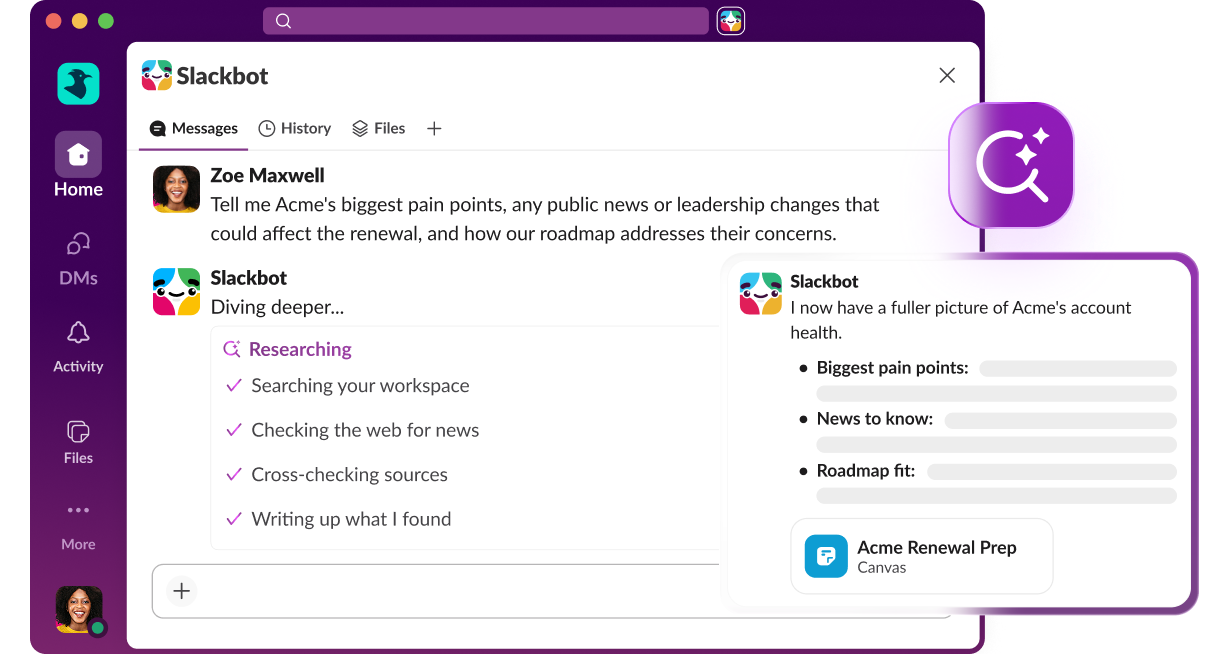
In Slack, a useful AI request starts with work the team has already discussed: summarize the open questions, explain a decision, or prepare a brief for someone joining the project. Slackbot’s value comes from the relevant context it can access, not from replacing an accountable owner. The official example below shows research being organized into a canvas; it is a vendor product example, not a result from our own test.
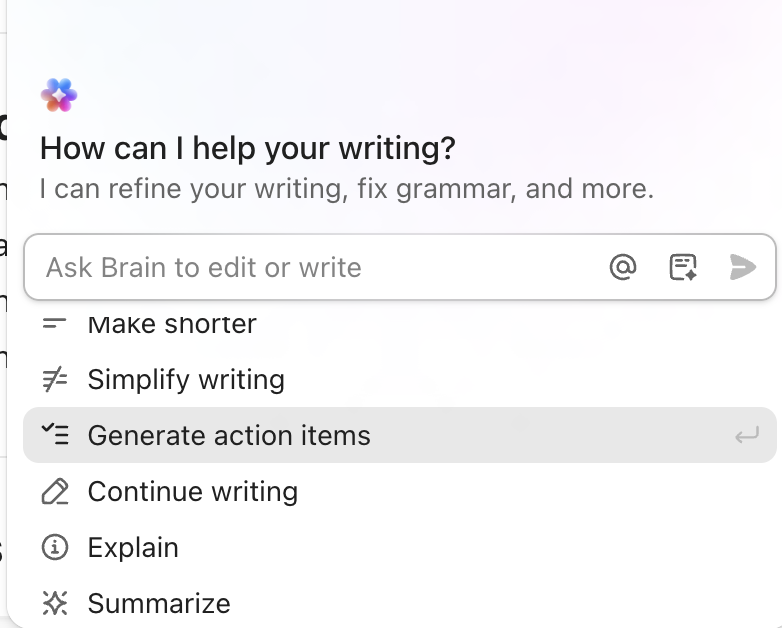
ClickUp Brain can work with project context, and the action-item menu shown below illustrates the connection between writing and follow-up work. The useful result is a proposed set of actions that a team can assign and refine. For the launch example, we would keep those actions in the project so that a summary and the delivery record do not drift apart.
Slack is the stronger choice when the question is who said what, why a decision changed, or which colleague needs to join the discussion. ClickUp is the stronger starting point when the output needs to become managed project work. Neither AI output settles a dependency or commits a deadline on its own; a project owner still needs to approve the change.
Plan choice matters for this workflow. Slack Free and Pro provide a limited Slackbot preview; Business+ includes 15 messages per member each week, with additional usage available through the applicable credit arrangement. Permission and connected-app scope determine what the assistant can use. A paid communication plan and unrestricted AI usage are different purchases.
See the Products in Action
Slack’s official overview below shows how AI fits into the communication workspace. Use it to understand the product’s approach alongside the concrete work examples above.
Slack AI | AI that works where you do. Video: Slack.
The ClickUp overview provides a second view of the decision: how AI can support project follow-through rather than just summarize discussion.
How to Streamline Project Management With ClickUp Brain. Video: ClickUp.
Using Slack and ClickUp Together
ClickUp’s Slack integration can create tasks from messages, show rich previews, and post activity updates to chosen channels. That supports a practical handoff: a customer issue arrives in Slack, someone turns it into a ClickUp task, and the channel receives meaningful progress changes rather than a second manually maintained task list.
Use one authoritative task record. If the same deliverable lives independently in a Slack list and a ClickUp task, somebody will eventually update only one. ClickUp documents the integration as available across plans, but particular automation and connected-search capabilities have their own plan requirements. An integration is also not permission for every user to see every private task.
What a Ten-Person Team Would Pay
The examples below use standard USD annual-billing rates, expressed as a monthly equivalent. They exclude tax, temporary promotions, and additional AI usage. Annual billing means paying the annual commitment, rather than buying a month at the displayed equivalent.
| Decision | Slack | ClickUp |
|---|---|---|
| Practical paid starting point | Pro: $7.25/user/month annually | Core: $9/user/month annually |
| 10-person monthly equivalent | $72.50, or $870 per year | $90, or $1,080 per year |
| Broader AI / reporting option | Business+: $15/user/month annually | Business: $17/user/month annually |
| 10-person higher-tier equivalent | $150/month; $1,800/year | $170/month; $2,040/year |
For ten people, Slack Pro plus ClickUp Core comes to a $162.50 monthly equivalent, or $1,950 billed annually, before tax and optional usage. Slack Pro plus ClickUp Business is $242.50 per month equivalent, or $2,910 per year. The combined stack is easier to justify when Slack already connects departments or external collaborators beyond the project team.
ClickUp’s current Core pricing includes a Brain trial, while Business includes Brain with a pooled credit allowance. Do not treat a trial label as a permanent unlimited AI entitlement. Slack Pro is also different from Business+ for ongoing Slackbot use. For an AI-centered comparison, the higher tiers and actual credit consumption matter more than the cheapest paid seat.
Strengths and Trade-Offs
Slack
- Strong everyday communication across teams and connected apps
- Lists and canvases keep lightweight work close to its discussion
- Message volume needs deliberate channel and notification habits
- Paid history and AI plan limits affect long-term usefulness
ClickUp
- Detailed task ownership and multiple planning views
- Docs, Chat and delivery work can share a workspace
- Dependencies and reporting suit repeated project execution
- A flexible hierarchy requires thoughtful setup
- Advanced reporting and AI usage differ by plan
- Moving a whole organization’s existing conversations can be disruptive
Which Should Your Team Choose?
Choose Slack if colleagues need a better way to coordinate, ask questions, and act on information from several business tools. Its strongest case is a team whose work already spans departments and needs a shared communication layer.
Choose ClickUp if work has dependencies, time tracking, repeated assignments, or reporting needs that outgrow a lightweight list. Its integrated Chat may also reduce the need for a separate messenger within a self-contained project team.
We recommend Slack for teams whose coordination spans many departments and business tools, and ClickUp for teams whose main problem is executing projects reliably. For an established Slack organization, connecting ClickUp is often a better move than migrating every conversation just to improve task management.
Sources
- Slack plans and feature comparison
- How Slack Lists work
- Slackbot capabilities and official product examples
- Slackbot message limits and credit usage
- Workflow Builder and automation
- ClickUp plans and AI allowances
- ClickUp integration with Slack
- ClickUp activity notifications in Slack
- ClickUp Slack automation



